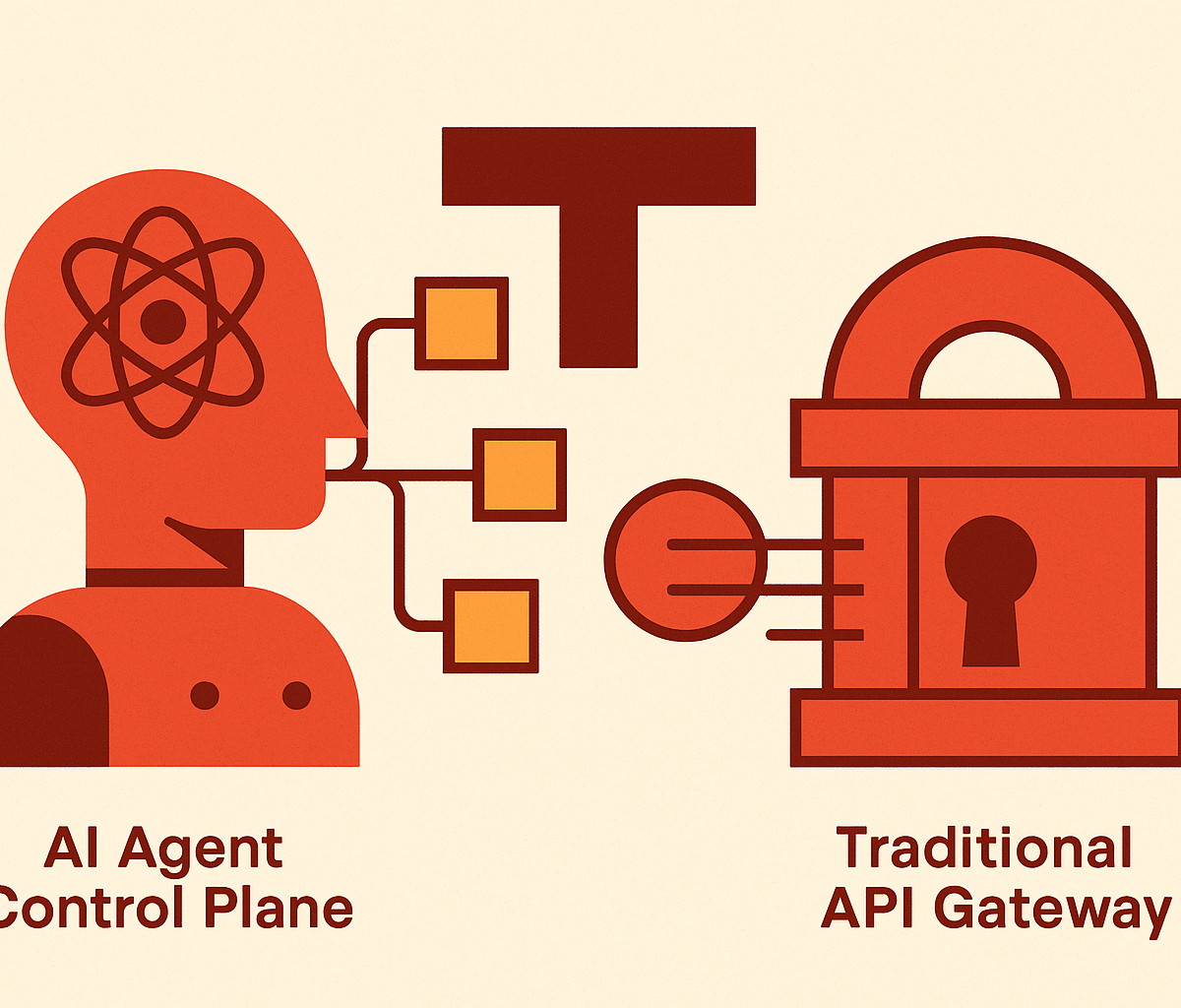
Multi-Agent Control Plane Design Patterns
Enterprises need governance layers to control sprawling agent fleets before projects fail.

Enterprises stopped deploying single-purpose AI assistants a while back. What they run now are fleets: dozens or hundreds of agents from different vendors, crossing different domains, calling internal APIs and external SaaS tools in sequence, often with no single person able to say what any given agent is allowed to do. Orchestration frameworks like LangGraph, AutoGen, and CrewAI handle the runtime mechanics fine, task sequencing, state, tool dispatch. None of them were built to enforce policy, carry identity through a call chain, or produce an audit trail a compliance officer would sign off on. Forrester gave that gap a name in late 2025: the agent control plane, a third layer sitting next to the build plane and the orchestration plane. What follows is a map of the patterns that make that layer work, not the version that looks good on a slide.
How agent sprawl turns an orchestration problem into a governance crisis
Gartner projects agent counts inside a single large enterprise will reach the hundreds of thousands within a few years, up from a handful today. That's the number that turns sprawl from an abstract worry into a Monday-morning problem, the kind where someone finally asks "wait, who owns this thing?" and nobody in the room has an answer.
At low counts, informal governance holds up fine. A small platform team can track which agents exist, what they touch, who owns them, and answer for it in a hallway conversation. Try that at enterprise scale. Ownership records go stale, service accounts pile up permissions nobody remembers granting, and no single team has eyes across every domain anymore. Most enterprises today have no documented governance for machine-to-machine interactions. Fewer still have anything built for agents specifically, rather than retrofitted from the old human-user model, the digital equivalent of stretching a jacket meant for one person over a family of ten. Platforms like SpeakeasyAPI exist precisely to fill that gap, providing a governed layer for deploying and observing AI agents across an organization.
Shadow AI makes this worse in a way that's easy to underestimate. In 2026, shadow AI isn't an employee pasting a paragraph into ChatGPT. It's an agent with persistent memory, tool-calling ability, and access to internal APIs, running with zero audit trail because nobody signed off on it in the first place. Surveys of cybersecurity leaders find most already suspect, or have confirmed, employees using banned AI tools, and a sizable chunk expect a security or compliance incident tied to shadow AI within the year. An agent that governance tooling can't see is an agent it can't govern. That's the whole problem, really, stated as plainly as it gets.
The industry's own overcorrection proves the point. Sprawling, unconstrained agent meshes, the kind where any agent calls any other agent with no checkpoints, are getting ripped out of production right now. What's replacing them: bounded, deterministic workflows with hard circuit breakers and a human required to sign off on anything risky. Industry projections put a large share of agentic AI projects on track to be canceled by 2027, and the postmortems mostly point at orchestration and governance failures, not bad models. The models work fine. The scaffolding around them is where projects go to die, quietly, usually around month nine.
None of this is a maturity problem you fix in year two. The control plane isn't infrastructure you bolt on after a deployment starts working; it's the precondition for a deployment reaching production at all, and staying there.
The three-plane model and where the control plane sits within it
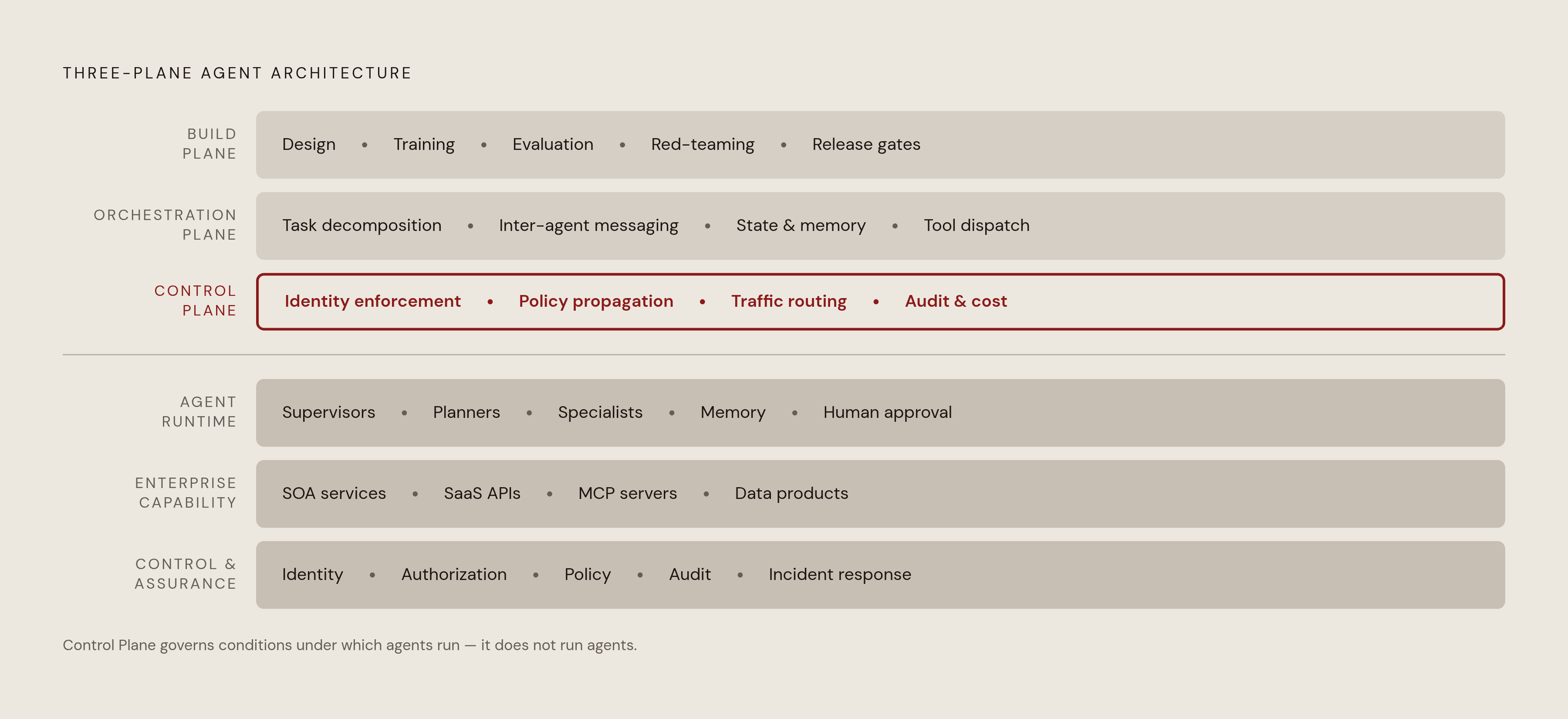
Forrester and Deloitte have each articulated a three-plane picture worth borrowing as shared vocabulary. Worth borrowing as shared vocabulary before wading into specific patterns.
The build plane is where agents get designed, trained, evaluated, and released: model selection, tool definitions, prompt engineering, red-teaming, release gates. The orchestration plane is where agents actually run: task decomposition, inter-agent messaging, state and memory, tool dispatch. The control plane sits across both, and its job is narrow but non-negotiable: enforce identity, spread policy consistently, route traffic, log everything, watch cost and risk as it happens. It doesn't run agents. It governs the conditions under which agents get to run and the actions they get to take. Picture the way a network control plane relates to packets moving through a distributed system, a layer that shapes behavior without sitting inside every single transaction.
The CEAD model, published on arXiv in 2025, breaks this down further inside the runtime itself. An Agent Runtime Plane holds the supervisors, planners, specialist agents, memory and retrieval systems, tool routers, and human-approval workflows, the actual execution environment. An Enterprise Capability Plane covers the SOA services, SaaS APIs, MCP servers, data products, and external agent-to-agent peers that agents consume, always through explicit contracts rather than open access. A Supporting Control and Assurance Plane handles identity, authorization, policy, audit, incident response, and privacy review.
CEAD's architecture rests on one foundational rule worth committing to memory: the runtime must conform to the design plane, not invent its own authority through a clever system prompt. Authority comes from governance, not from whatever an agent claims about itself mid-inference. Every pattern below exists to make that rule real instead of aspirational.
Routing patterns: directing agent traffic through a governed chokepoint
API gateways solved this problem once already, for a different generation of software: one entry point enforces authentication, rate limits, and routing policy before any request reaches a backend. Agent traffic needs the same chokepoint, and the dominant answer in production right now goes by the Supervisor Pattern.
A central supervisor, either an agent itself or a plain deterministic orchestrator, takes in every incoming task and hands it off to specialist agents based on capability, role, and policy. The supervisor isn't just directing traffic, it's the enforcement point, deciding which agent gets to act, under what constraints, and whether a human has to sign off before anything moves forward. Hard circuit breakers at this level, ones that demand explicit human authorization before high-risk actions, are what "human on the loop" looks like when someone actually builds it instead of just promising it in a slide deck.
Phase-gating pairs well with this. Instead of letting agents chain actions freely, a phase-gated architecture forces explicit validation at set checkpoints before the next phase can start. Every phase transition becomes a logged governance event rather than a silent state change buried somewhere inside an orchestrator nobody can inspect later.
MCP routing deserves its own paragraph, since it's where a lot of the current exposure sits. An MCP gateway applies the same chokepoint logic to tool calls: every agent request to an MCP server routes through one central point that checks authentication, authorization, and logging before the call ever reaches its target. Skip the gateway and agents connect straight to MCP servers, each running its own auth setup, no shared visibility, no policy that holds anywhere consistently. Gartner's guidance here is blunt: treat MCP like any other API surface, gateway-first, never point-to-point. Routing is also where cost control lives. A central layer can decide which model an agent gets to call for a given task, so nothing defaults to the priciest option out of laziness or a misconfigured setting somewhere.
Identity enforcement patterns for non-human agents
Traditional identity and access management assumes a human: someone logs in once, holds a role, acts inside a session that eventually ends. AI agents break that model on every axis you can name. They act with no person in the loop, spawn sub-agents on their own initiative, run across several sessions at once, and rack up tool permissions in ways no human employee ever could just by showing up and doing their job.
Most organizations already run AI agents in production. Most of those haven't treated the agents as distinct, identity-bearing entities at all; they run under shared service accounts with no clear owner, the agent equivalent of handing every new hire the same login and hoping nobody notices.
The fix is a non-human identity pattern: each agent instance gets its own scoped credential, issued by an enterprise identity provider, not a shared service account and not a static API key sitting forgotten in a config file for three years. That credential goes through the same lifecycle a human identity goes through: provisioning, rotation, expiration, revocation. Microsoft's Entra Agent ID, generally available in April 2026, handles this through what it calls agent identity blueprints, reusable templates that define an agent type's ownership, access scope, and audit behavior once, then apply that definition to every instance automatically. That kills the ad-hoc service-principal sprawl that defined most 2025 deployments. Okta's equivalent, also GA in April 2026, extends single sign-on and joiner-mover-leaver lifecycle management to AI agents and retires static API keys in favor of short-lived, scoped credentials.
Identity has to travel through the whole call chain, not just sit at the front door. When an agent acts for a human user, that user's permissions need to follow every downstream tool call and sub-agent it triggers. The rule in practice: if the human can't delete a repository, no agent acting on their behalf can either, and that has to be enforced at the protocol layer, not assumed because a system prompt says so. JWT and OIDC-based propagation through MCP gateways is the current production approach: the gateway checks the incoming token and passes a scoped credential downstream, instead of letting agents call MCP servers under their own, often over-privileged, credentials.
Zero Trust extends the same logic. Entra Agent ID applies Conditional Access, Identity Protection, and Privileged Identity Management to non-human identities, the same risk-based controls that already govern human accounts. Without a reliable identity attached to each agent, role-based access control is fiction anyway; there's no principal left to actually bind a role to.
RBAC and least-privilege patterns across agent fleets
Least privilege is harder to enforce for agents than for people, and the reason is structural, not cultural. Agents get assigned a tool set at definition time, but any single task usually needs a fraction of what the agent was handed. That gap is an attack surface, full stop. The OWASP Top 10 for Agentic Applications, published in 2026, addresses the risk surface that over-permissioned agents create. MCP-specific research from April 2025 found tool permission sets that let an attacker chain several legitimate tool calls together into a data exfiltration path, a risk that exists purely because the agent had more access than the task in front of it actually required.
One answer is a least-privilege adapter pattern: agents consume enterprise capabilities (APIs, SaaS systems, data products, MCP servers) through explicit adapter contracts that spell out the minimum permission set each capability needs. Under CEAD's Enterprise Capability Plane, agents don't own capabilities by default. They get granted access through a contract, scoped tightly to the task at hand.
Role hierarchy inside a Supervisor Pattern deployment does similar work. The supervisor holds elevated permissions for orchestration (task assignment, spawning sub-agents, managing state) while specialist agents hold narrow, task-scoped permissions and nothing beyond that. The hierarchy bakes least privilege into the architecture itself, rather than leaning on a policy document nobody rereads once the system goes live.
Dynamic permission scoping pushes this further inside phase-gated workflows: an agent's effective permissions expand and contract as it moves through phases, picking up elevated access only for the phase that needs it, then shedding it again once that phase ends. It's just-in-time access, the same pattern Privileged Identity Management already runs for human privileged accounts, just applied to machines this time.
Binding RBAC to an existing identity provider, Okta or Entra ID, rather than some framework-native role system, has one clean payoff: role changes propagate through the enterprise's existing IAM process automatically. An agent loses access the moment the team that owns it changes scope, and nobody has to remember a separate config buried inside the agent framework somewhere.
Policy propagation patterns: enforcing rules consistently across a distributed fleet
Here's the core problem with a fleet built from five different frameworks: every one of them expresses constraints its own way. LangGraph uses graph-level guards. CrewAI uses task-level rules. A custom-built agent might have no formal constraint mechanism at all. Try to enforce one enterprise policy, say, no agent sends PII to an external API without explicit approval, through each framework's native mechanism, and you end up writing the same logic five separate times, while anything without a native mechanism just skips the policy entirely. Every time.
Policy-as-infrastructure fixes this by pulling policy out of individual agent configs entirely. Write it once, at the control plane, and enforce it at every chokepoint it touches: the gateway, the identity layer, the routing layer. Same logic a firewall rule uses at the network perimeter, the constraint holds regardless of what any individual host's software happens to do.
Timing matters here too, and it's not a small detail. Real-time enforcement and after-the-fact audit are not interchangeable, and treating them as the same thing is a compliance mistake waiting to happen. Blocking a PII-laden response before it leaves the network is categorically different from logging that it left. GDPR Article 32 and HIPAA Section 164.312 both require technical measures that prevent unauthorized disclosure. A log entry after the fact doesn't satisfy a prevention requirement, no matter how detailed the log turns out to be.
Prompt injection makes the sharpest case for why enforcement needs to read the content, not just check the metadata. The EchoLeak vulnerability in Microsoft 365 Copilot, a zero-click prompt injection that quietly pulled data out the back door, and CVE-2025-53773, a hidden prompt injection buried in pull request descriptions that enabled remote code execution through GitHub Copilot, both work the same trick: hide the instructions inside content the agent was already going to read anyway. Checking who sent a request and what permissions they hold catches none of that. Someone, or something, has to actually read what the content says. NIST's AI Risk Management Framework calls for threat modeling that covers adversarial input risks, semantic attacks included, and ISO 42001 requires risk assessments for input manipulation specifically. Both land on the same technical demand: inspection and filtering belong at the control plane, in front of the model, not buried somewhere inside it where nobody can audit the decision afterward.