AI Agent Control Plane vs Traditional API Gateway
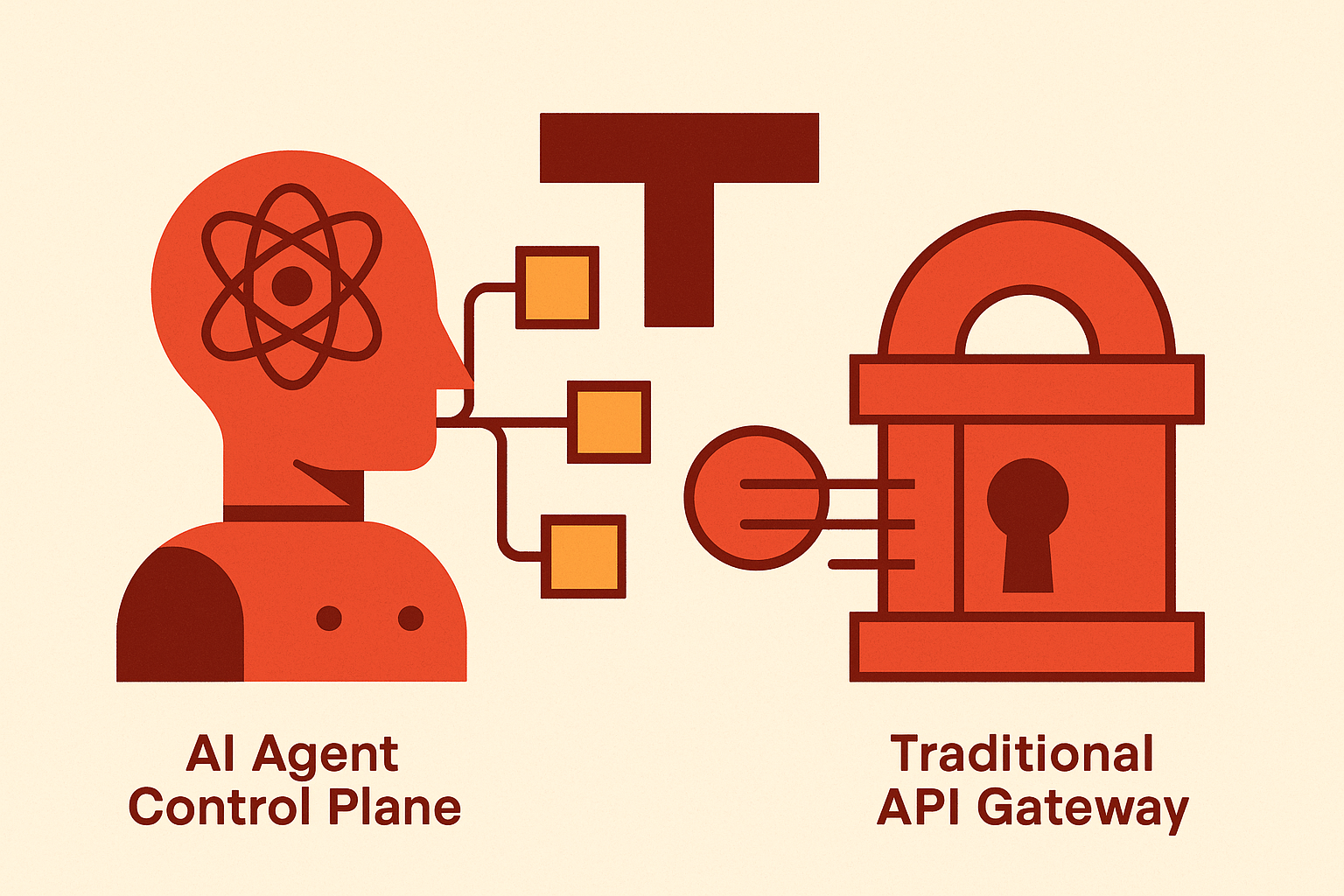
An agent doesn't wait for you to click "confirm." That's the whole shift, and it's a bigger one than most security teams have priced in. Earlier AI tools wrote text and a person decided what to do with it, so a chatbot could hallucinate all afternoon and the worst outcome was an embarrassing paragraph. Production agents execute commands, call APIs, edit files, push deployments, and nobody stands between the decision and the action anymore.
Identity gets messy fast, too. One agent might run under a single service account while acting on behalf of a dozen different employees across a single day, sometimes within the same session. Traditional access control puts a principal on one side of a line and a resource on the other. Agents smear that line across both sides at once, so a token that's technically valid tells you almost nothing about who's actually driving.
The request model breaks the same way. A gateway reasons about one call at a time. An agent's real unit of work is a chain: search a database, read the result, decide what to write, call a second tool, act on whatever that returns. Try to govern step three without knowing what happened in steps one and two, and the policy check either misses the risk or blocks something completely harmless. Intent only becomes legible once you can see the whole chain, and a gateway was never built to hold that much context in its head.
A wrong answer from an old-school assistant was a content problem, while a wrong action from an agent is an operations problem, sometimes a compliance one. Model Context Protocol, or MCP, makes this concrete: when agents talk to tools over MCP, the "request" is a tool call with parameters the model generated on the fly, not a path a developer hardcoded at build time. There's no route to match against, no schema the gateway was ever handed.
I've watched teams try to force MCP traffic through a gateway built for REST and it's a bit like trying to log a phone conversation using a system built to log fax transmissions. The gateway is answering a question nobody's asking anymore.
The specific governance gaps that appear when you route agent traffic through an API gateway
People route agent traffic through the gateway anyway, because that's the infrastructure already sitting there, wired up, paid for. A handful of gaps open up almost immediately once they do, and they don't announce themselves until something's already gone sideways.
A gateway confirms a service token is valid, but it cannot tell you which human's intent that token is currently carrying out, so per-user authorization and any audit trail worth handing to a compliance officer become close to impossible to reconstruct after the fact. You end up with a valid credential and a completely blank picture of whose decision it represented.
Logging looks fine on paper, right up until you actually need it for something. Individual requests get recorded, sure, but nothing threads them together: no record of the reasoning chain, no record of which tool call fed into which, no record of what the agent was even trying to do. The audit log ends up as a pile of disconnected HTTP calls, missing exactly the connective tissue an investigator would ask for first.
Content inspection doesn't happen at all. Gateways look at HTTP structure, headers, paths, methods, but what they miss is what's sitting inside the payload. A prompt injection, a customer's Social Security number heading out to an external model, an API secret buried in a tool call parameter: invisible at this layer, because nothing here was ever built to read semantic content.
Permissions stop at the service level, so "this agent can search records but can't export them" isn't a policy a gateway knows how to express. There's no interrupt button anywhere, either, since gateways are pass-through by design; there's no way to freeze a workflow mid-execution and hold it for a human sign-off before something high-stakes goes through.
And cost tracking is the blind spot nobody notices until the invoice lands. Gateways count requests and measure bytes. They have no concept of token consumption or per-agent model spend, so financial oversight of agentic workloads needs its own telemetry layer, built from scratch. On the protocol side, agents split traffic between STDIO for local tools and Streamable HTTP for remote ones, and a gateway built around REST has no logic to normalize those transports, no way to hold session state for an MCP connection meant to persist across dozens of calls.
Why shadow AI compounds every one of these gaps before governance infrastructure is in place
Shadow AI used to mean an employee had a ChatGPT tab open they weren't supposed to have, a cute problem in retrospect. Now it means locally running MCP servers, AI features flipped on by default inside some SaaS tool nobody reviewed, agents authorized through OAuth without security ever seeing the request come in, developer tools like Cursor or Claude Code operating well outside whatever perimeter the security team thinks it controls.
Most security teams have only inventoried a small slice of the AI tools actually running in their environment. That gap, between what's known and what's active, is where confidence outpaces reality. A large share of executives believe existing policy already covers unauthorized agent behavior, while a similarly large share of organizations report they've already had a confirmed or suspected AI agent security incident. Sit those two numbers next to each other and you're looking at the shape of the problem right now.
Gateway logs won't surface any of it, and this is a structural gap: an agent running on someone's laptop, or connecting straight to an external MCP server, never touches the enterprise gateway at all. There's no partial record sitting somewhere waiting to be found. The activity just never registers, full stop.
Shadow AI incidents also expose customer data and intellectual property more often than incidents that pass through channels someone was actually watching, and they take longer to catch. That delay compounds the exposure rather than just stretching it out. An enterprise governing only the agents it approved, through the gateway it already runs, is governing a fraction of its real AI risk surface. The rest is running quietly, somewhere the gateway can't see, which is a strange thing to be at peace with once you say it out loud.
What an AI agent control plane adds that an API gateway cannot provide
A control plane is a layer that sits between agents and everything they can reach, carrying actual awareness of identity, context, state, and intent across a full workflow instead of one call at a time.
Contextual identity comes first. The control plane resolves which human an agent session is currently acting for, tying that back to the identity provider so role-based access reflects the real person's entitlements instead of whatever the service account happens to be allowed to do. Permissions get defined at the tool level, not the route level: an agent can read a database but not write to it, or query a system but not export from it, enforced the moment the tool actually gets called.
Content gets inspected inline, with prompts and responses checked for PII, embedded secrets, and injection patterns in real time, before anything reaches the model or a tool fires. Every tool call gets logged with its place in the reasoning chain, the human identity behind it, and the outcome, producing an audit trail someone can reconstruct for a SOC 2 or HIPAA or GDPR review instead of reverse-engineering the story from raw request logs.
High-stakes calls can be paused and held for human approval before they run, a hard checkpoint a pass-through gateway simply has no equivalent for. Token consumption, model cost, and spend per agent or per team get tracked as operational metrics rather than backed into after the invoice shows up. The whole thing understands MCP natively, normalizing STDIO and Streamable HTTP, holding session state across a multi-step workflow, applying the same policy no matter which transport the agent happens to be using.
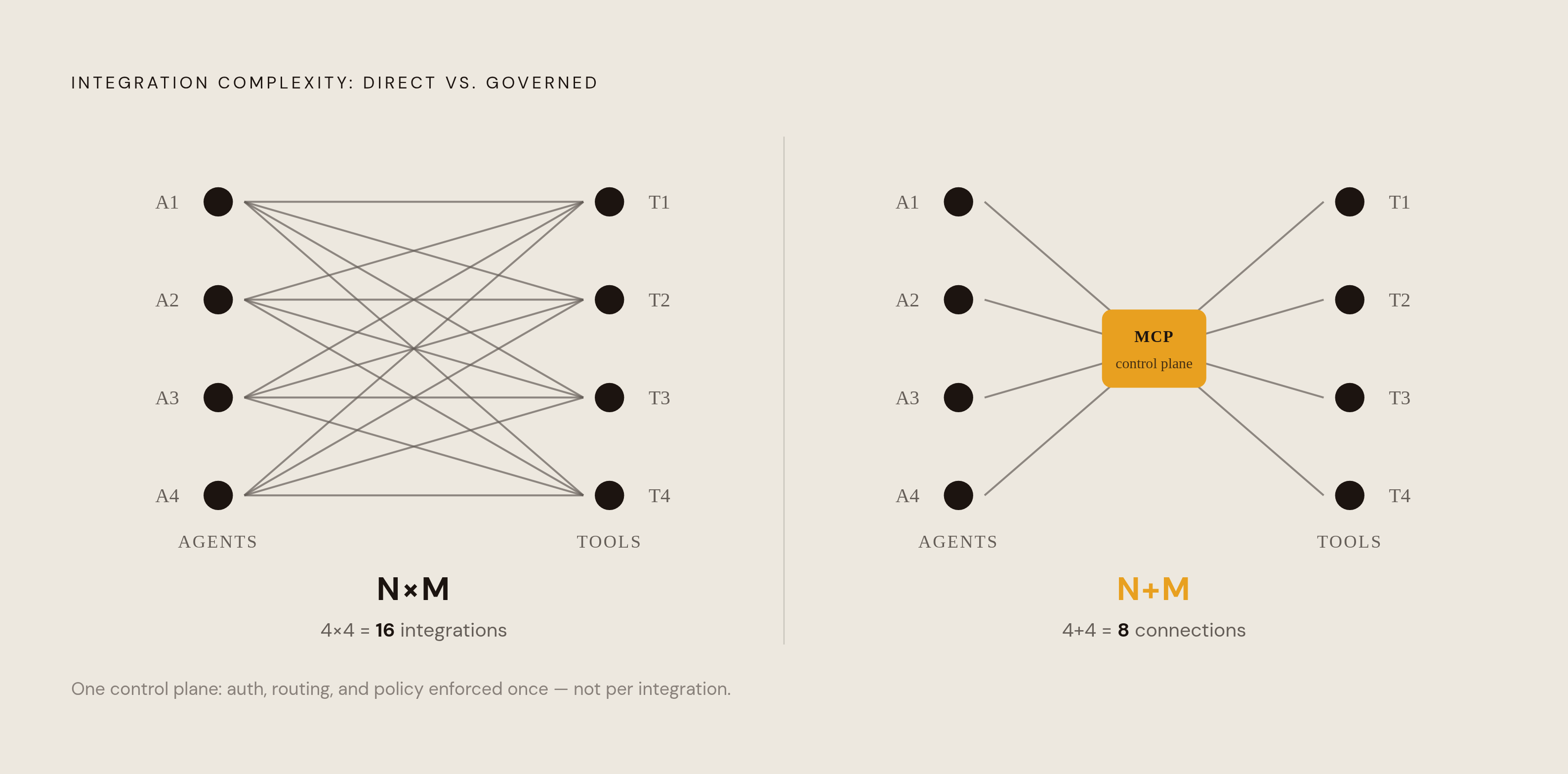
There's a structural payoff underneath all this. Connect N agents directly to M tools and you get N×M custom integrations, each one its own thing to secure and maintain separately. Put a governed MCP layer in between instead, and each agent authenticates once to the control plane, which handles routing, auth, and policy for every tool sitting behind it. That's N+M complexity, where what used to multiply now just adds, and finance departments tend to notice that kind of thing before the security argument even gets made.
How the emerging market is organizing around this infrastructure gap
The AI agent infrastructure market is growing faster than nearly any other corner of enterprise software right now, a fairly blunt signal that the governance gap above isn't theoretical to the people writing the checks.
Forrester has already named the agent control plane its own infrastructure category, separate from development environments and orchestration tools, on the reasoning that governance needs to sit outside both build and orchestration to provide independent visibility at all. Forrester's read on the moment doesn't hedge: architecture is moving faster than the standards meant to support it. Three gaps get called out by name: incomplete instrumentation, no portable agent identity, no shared schema for governance across planes. Gartner's projection on agent proliferation adds urgency from a different angle. Enterprises are expected to go from a handful of agents to fleets of them within a few years, and that's already showing up at the leading edge of the market, not sitting on some five-year roadmap slide.
Consolidation is happening along two paths at once. Security incumbents are buying their way into gateway capability; Palo Alto Networks' acquisition of Portkey folded a standalone AI gateway directly into its platform. Hyperscalers are building native control planes: AWS Bedrock AgentCore, Google's Vertex AI Agent Builder with its Agent Gateway and Agent Registry, and Azure AI Foundry each offer a cloud-native governance layer, with the obvious tradeoff of tighter integration against getting locked to one vendor's stack. Enterprise platform players are coming in from a third direction; Salesforce's MuleSoft Agent Fabric and ServiceNow's AI Control Tower show the control plane idea getting absorbed straight into software stacks companies already run day to day.
Not every vendor in this space covers the whole territory. Some offer a single primitive, an MCP gateway here, an observability dashboard there, and expect enterprises to stitch several of them together into something that resembles a system. A platform built around the primitives that fall out of agentic workloads specifically connects agents and MCP servers to existing identity providers, enforces role-based access at the tool level, catches shadow AI and injection attempts as they happen, and surfaces cost and usage in real time. SpeakeasyAPI, for instance, approaches this as an enterprise AI control plane rather than a gateway extension. Running as a neutral, cloud-agnostic layer matters if you'd rather not bet your governance model on a single hyperscaler's roadmap.
What to look for when evaluating an AI agent control plane
Start with identity. Does the platform plug into Okta, Entra ID, or whatever SAML or OIDC setup you already run, or does it want you to stand up a parallel identity system just for agents? The second option means you now have two access control problems instead of one.
Check whether permissions actually reach the tool level, not just the service or the route, and whether PII blocking, injection detection, and secrets scanning happen inline, before a payload reaches a model, rather than showing up later as a note buried in a log file. Confirm the platform speaks MCP natively: normalized transports, session state held across a multi-step workflow, not bolted on as an afterthought once someone files a support ticket about it.
Audit logs need to hold up in front of an actual auditor, structured around the workflow itself: agent identity, human identity, the sequence of tool calls, the outcome, in a format that satisfies SOC 2, HIPAA, or GDPR requirements rather than making someone reconstruct the story by hand the night before a deadline. Human approval needs to be a real mechanism, configurable by role or tool type or data sensitivity, one that keeps functioning once volume picks up rather than quietly fading into a checkbox nobody watches. Cost and token usage should get tracked per agent and per team, with budget caps that stop an overrun before it happens rather than an alert that arrives politely after the bill does.
Shadow AI detection is the one people skip, and it's the one that matters most. Does the platform find unsanctioned activity happening outside its own governed channel, or does it only see what it already manages? A tool that only watches what it already controls is grading its own homework, and everyone knows how that grade turns out.
Underneath all of this sits one architectural question. Does the platform stand outside both the build environment and the orchestration layer, giving you independent visibility, or is it instrumentation run by the same team that built the thing it's supposed to be checking? That distinction is the whole ballgame, the difference between oversight and a rubber stamp with extra steps.
Enterprises will govern agentic AI eventually, and the only open question is timing, whether the infrastructure gets built before the incident that forces the conversation, or after.