Shadow AI Detection in Enterprise Networks
Organizations must layer network, browser, identity, and behavioral detection to catch shadow AI.

Shadow AI is already inside enterprise networks. The security question is no longer whether it exists, but whether organizations can detect it faster than it proliferates, and whether detection alone is even enough. Based on available evidence, the answer to that second question is an unequivocal no.
Where Shadow AI Hides: The Network, Browser, and Identity Gaps Security Teams Routinely Miss
No single monitoring layer reveals the full picture. Shadow AI exploits the seams between network visibility, endpoint control, and identity governance, and it does so with remarkable efficiency because most of those seams were never designed to be load-bearing from a security standpoint.
The Network Layer: A Good Start, Not a Complete Answer
Network signals are typically the first and most accessible source of evidence. DNS logs, web proxy data, and CASB records all capture outbound traffic destinations, and early behavioral indicators are detectable if you know what to look for: elevated connection frequency to external AI service endpoints, a higher ratio of POST requests relative to ordinary browsing patterns, and outbound payload sizes that exceed what standard SaaS interactions would generate. API traffic to paths like /v1/chat/completions is a reliable fingerprint of AI tool usage, distinct enough at a statistical level to serve as a detection signal in its own right.
The limitation is equally clear. Network inspection tells you a connection was made. It does not tell you what was typed, what was uploaded, or whose account was used to send it.
Browser Extensions: The Least Monitored Entry Point
Verizon's 2026 Data Breach Investigations Report found that more than one in seven enterprise users were running unauthorized AI extensions in their browsers. That figure deserves more attention than it typically receives, because browser extensions operate inside the browser context, which places them entirely beyond the reach of network-layer inspection. A CASB sees traffic leaving the device; it does not see what an extension does before that traffic departs.
Extensions can intercept clipboard content, read page content, and transmit data in ways that appear, from the network's perspective, to be ordinary browser activity. This is not a theoretical attack surface. It is a structural gap in the monitoring architecture that most enterprises have not closed.
The Personal Account Problem
A significant share of enterprise AI usage flows through personal accounts accessed on managed devices. An employee opens ChatGPT or Claude in a browser, signs into their personal account, and submits a document. The device is managed. The account is invisible to the organization's identity infrastructure. CASB tools see the managed device; they do not see which account authenticated to the service. This is a structural limitation, not a configuration problem, and it means that CASB coverage of AI usage is systematically incomplete.
Embedded AI features in sanctioned SaaS applications compound the issue further. When Microsoft Copilot processes a document inside Microsoft 365, or when Salesforce Einstein operates on CRM records, the traffic is indistinguishable from normal SaaS usage at the network layer. The tool is approved. The data processing is invisible.
The Identity Layer: The Most Underused Signal
Service accounts, personal OAuth tokens, and unmanaged credentials created by AI tools are largely invisible to most IAM systems. This is not a minor operational gap. It is the precursor to a credential sprawl problem that becomes structurally critical once organizations move from individual AI tools to agentic deployments, a subject addressed in detail in the MCP section below. The identity layer contains some of the most actionable detection signals available; it is also the layer most organizations have invested the least in instrumenting for AI-specific threats.
How a Layered Detection Approach Closes the Coverage Gaps No Single Tool Can Fill
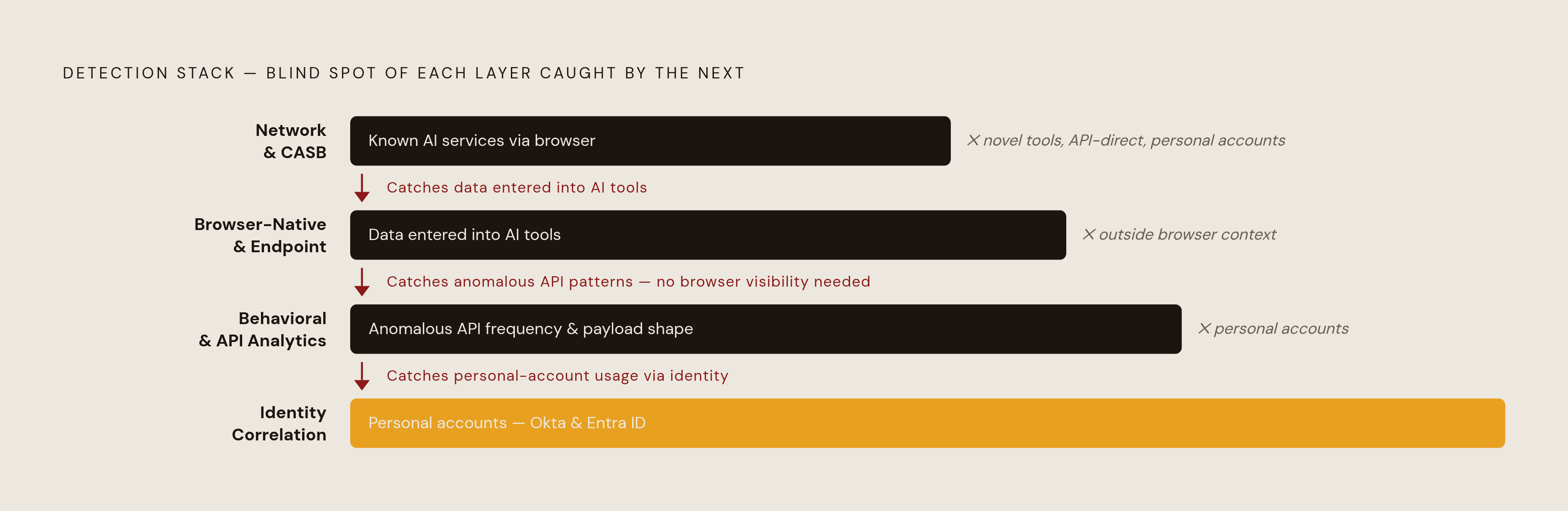
The argument for layered detection is straightforward: each technique catches what the others miss, and running any one of them in isolation produces a false sense of coverage that is more dangerous than having no detection at all.
Network and CASB
CASB platforms from Netskope, Zscaler AI Protect, and Palo Alto Networks Prisma SASE 4.0 offer generative AI application cataloging at meaningful scale. For known, cataloged AI services accessed through standard browser traffic, they provide solid coverage. Their limitations are equally consistent: novel tools, API-direct integrations, and browser-based access through personal accounts fall outside the detection envelope.
Browser-Native and Endpoint Visibility
Browser-native solutions, including Harmonic Security and Cato Networks' Enterprise Browser, provide interaction-level visibility that network inspection cannot reach. They can surface what data is being entered into AI tools, not merely that a connection was established. That capability set has since been integrated into broader endpoint security platforms. The practical value of this layer is substantial: it closes the gap between "a connection was made" and "sensitive data left the organization."
Behavioral and API Analytics
NLP-based detection of AI-generated text patterns in documents, communications, and code repositories adds a signal that operates independently of network or browser visibility. Anomaly detection on API call frequency and payload shape, both of which are statistically distinct from ordinary SaaS activity, can identify usage patterns that evade categorical detection.
Identity Correlation
Correlating AI tool usage against identity signals surfaces the personal-account usage that network tools structurally miss. Integration with existing identity providers, specifically Okta and Entra ID, is the practical mechanism here. Building a separate identity system for AI-specific monitoring is unnecessary and inadvisable; the existing infrastructure is already instrumented, it simply needs to be connected to the AI detection layer.
The Unification Problem
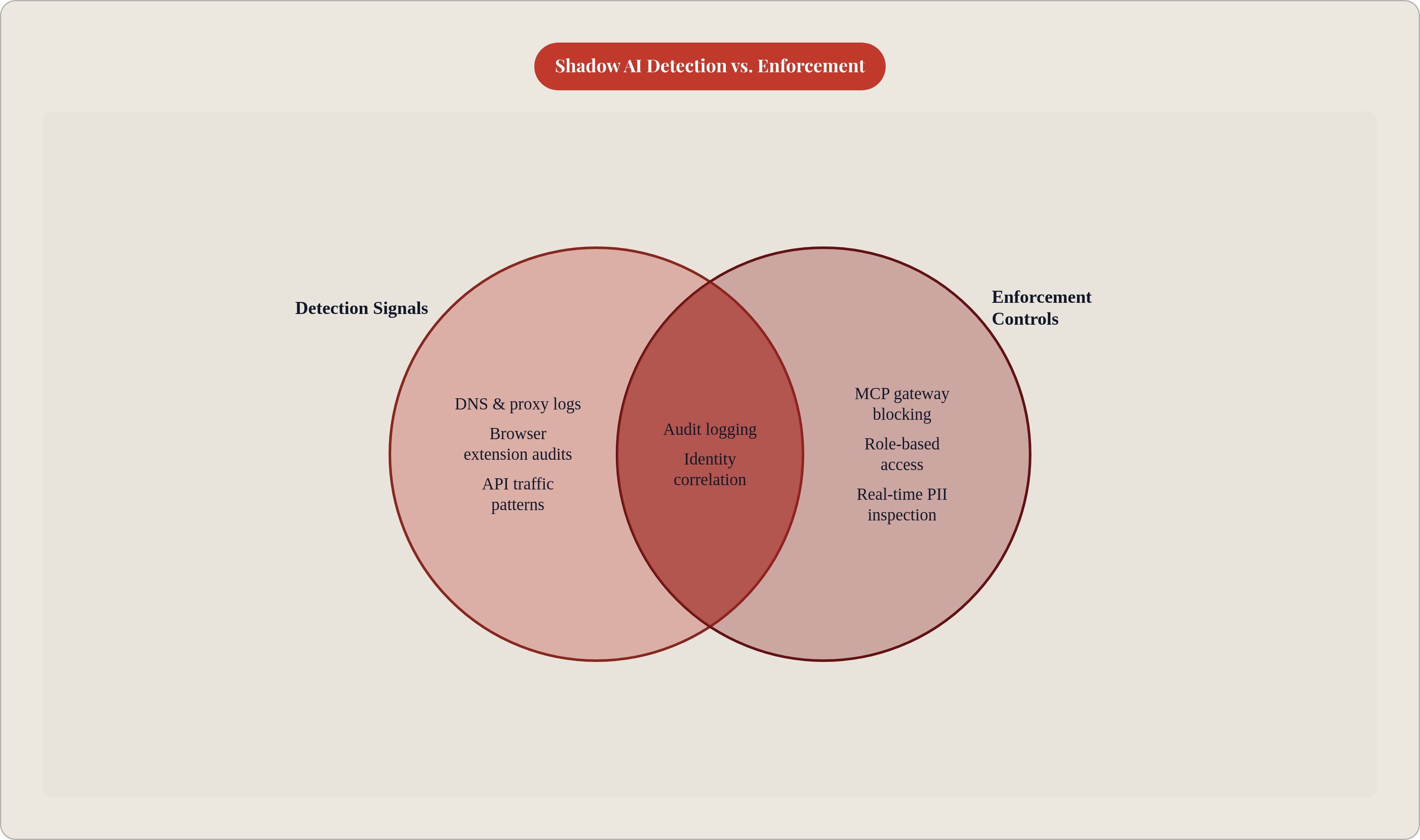
A shadow AI finding sitting in its own dashboard, disconnected from asset criticality and business context, does not tell a security team what to prioritize. Correlating shadow AI signals against a unified vulnerability and exposure model converts a list of incidents into an actionable risk picture. Detection without enforcement is surveillance. Surveillance is not control.
Why AI Agents and MCP Servers Create a Detection Problem That Existing Tools Were Not Designed For
Traditional shadow AI detection operates on a simple assumption: a human is making a discrete, intentional request to an external service. Agentic AI invalidates that assumption entirely.
Agents make many requests autonomously. They chain tool calls across multiple services. They operate on schedules or event triggers that the user never directly observes. The resulting traffic signature looks nothing like human-initiated shadow IT, which means that detection logic calibrated for the previous generation of the problem will systematically fail to catch the current one.
The MCP Inflection Point
Model Context Protocol, released by Anthropic in late 2024 and now governed as a founding project of the Agentic AI Foundation under the Linux Foundation, has become the de facto integration layer for agents calling external tools. It reached a very large monthly SDK download count within roughly eighteen months of release and now has backing from every major AI laboratory. MCP is, in practical terms, the plumbing through which agentic AI operates at enterprise scale. That makes it the relevant surface area for both attack and governance.
Credential Sprawl at Scale
Without a centralized gateway, each agent carries its own API keys, OAuth tokens, and service account credentials for every tool it accesses. Those credentials accumulate across environment variables, configuration files, and secret stores. GitGuardian's research found thousands of unique secrets exposed in MCP configuration files in 2025 alone, with Google API keys and PostgreSQL connection strings among the most commonly leaked types.
The original MCP specification shipped without a comprehensive authentication framework. OAuth 2.1 support was added in June 2025, but implementation quality varies significantly across deployments. Known vulnerabilities published in April 2025 include prompt injection, tool permission combinations that enable data exfiltration, and lookalike tools that silently substitute for trusted ones. CVE-2025-6514, which affected mcp-remote versions 0.0.5 through 0.1.15 and was patched in v0.1.16, illustrates that the MCP ecosystem is still actively maturing its security posture.
The scale problem is what makes detection structurally insufficient on its own: agents proliferate faster than any monitoring team can manually review, and the surface area expands with every new MCP server connection an agent is authorized to reach.
What an MCP Gateway Actually Does and Why It Has Become the Enforcement Point for Agentic Shadow AI
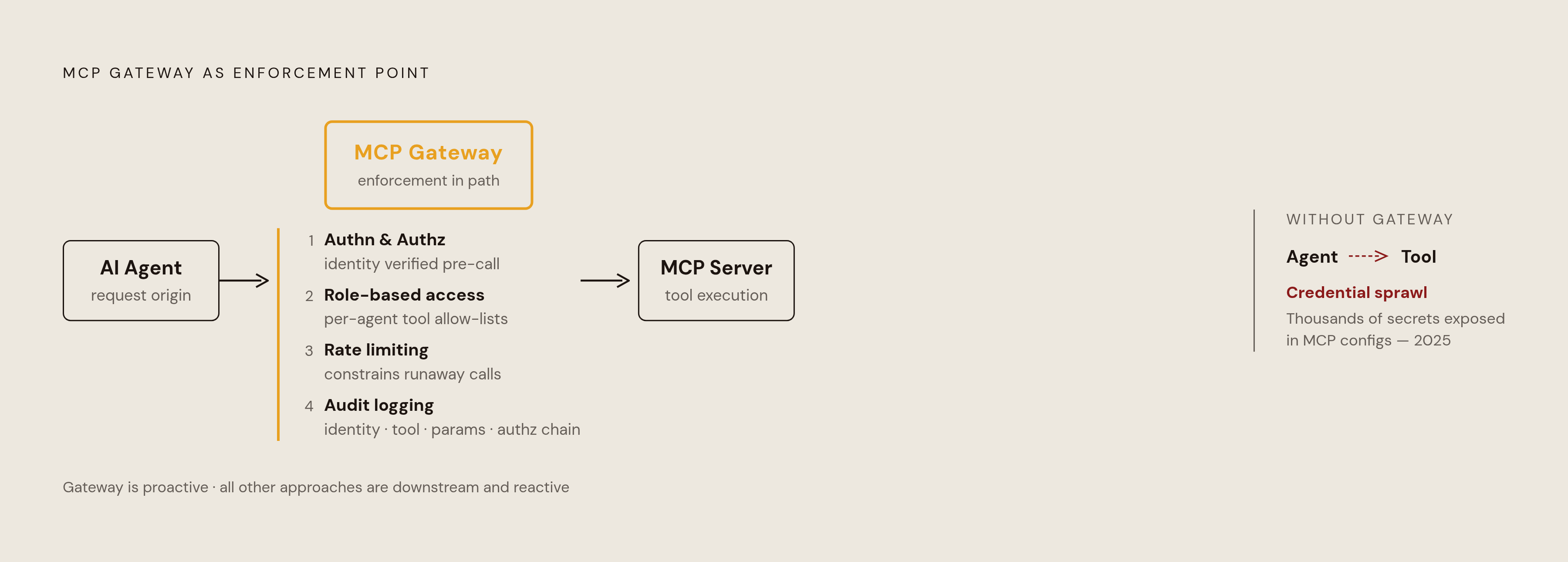
An MCP gateway functions as a reverse proxy between AI agents and MCP servers. Every agent request routes through the gateway before it reaches any tool. This is the architectural property that makes gateways enforcement mechanisms rather than monitoring mechanisms: they sit in the request path, not beside it.
What Gets Enforced at the Point of Request
At the request level, a gateway enforces authentication and authorization, verifying agent identity before any tool call proceeds. Role-based access controls determine which users or agents can access which tools, enforced at the request level rather than at the application level. Rate limiting constrains runaway agent behavior and limits blast radius when something goes wrong. Audit logging captures every tool invocation with contextual metadata: agent identity, tool name, parameters, results, and the human authorization chain that delegated the action.
Compliance frameworks including SOC 2, HIPAA, GDPR, PCI DSS, and the EU AI Act impose audit, accountability, and transparency obligations that require attributable, auditable records of system actions. A gateway that captures the full authorization chain is the practical mechanism for satisfying those requirements.
How a Gateway Converts Shadow AI Into Sanctioned AI
The governance mechanism is straightforward: a catalog of approved MCP servers replaces ad hoc agent-to-server connections, unauthorized server connections are blocked rather than merely detected, and security teams gain visibility into exactly which tools are used, when data is accessed, and at what frequency. This is the observability floor that compliance requires and that no downstream monitoring approach can replicate.
The official MCP roadmap explicitly identifies gateway and proxy patterns, enterprise-managed authentication, and audit trails as core production requirements. This is not a vendor add-on to an otherwise complete specification. It is the intended production architecture.
The Gateway Landscape
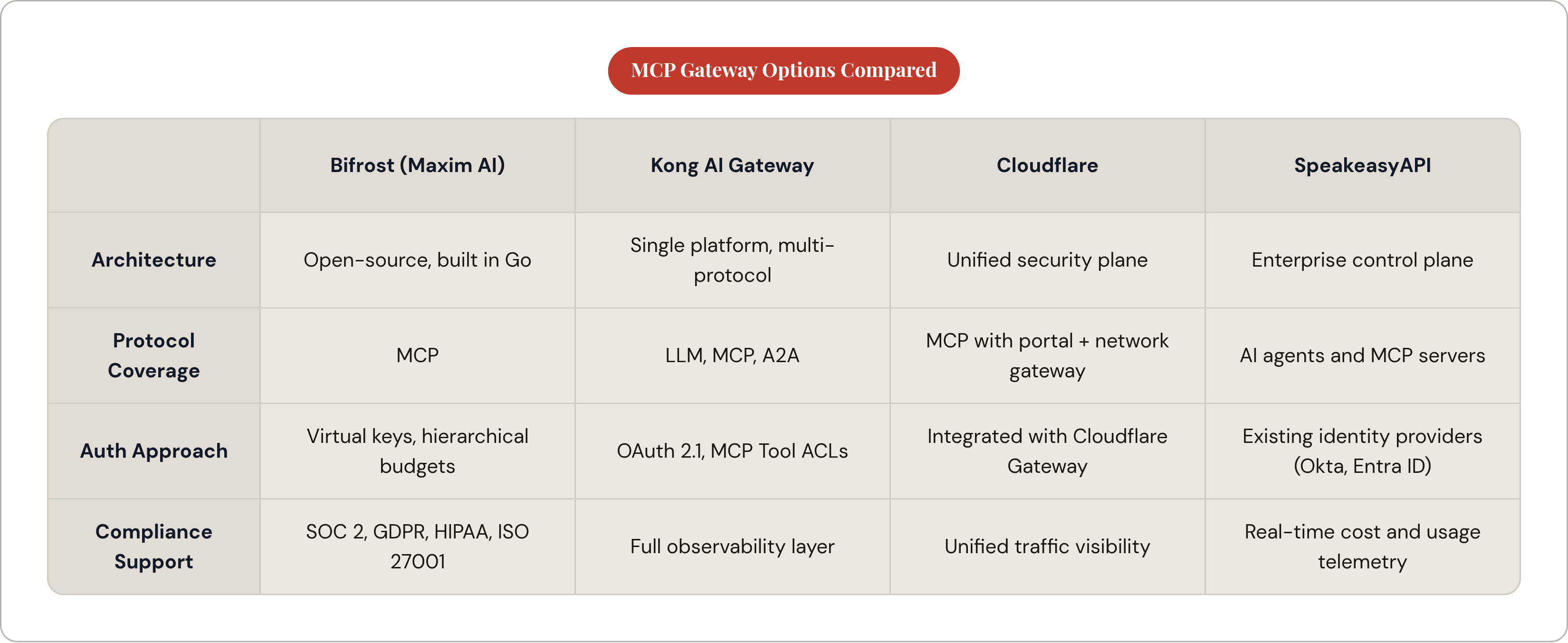
Several options have emerged in this category, each with a distinct architecture. Bifrost from Maxim AI is open-source, built in Go, and uses a governance model based on virtual keys with hierarchical budgets, rate limits, and per-key MCP tool allow-lists, with built-in audit logs designed for SOC 2, GDPR, HIPAA, and ISO 27001. Kong AI Gateway covers LLM, MCP, and A2A protocol types on a single platform with OAuth 2.1, MCP Tool ACLs, and full observability. Cloudflare combines its AI Gateway, MCP Server Portals, and Cloudflare Gateway into a unified security plane for MCP traffic.
The Real-Time Threat Layer: Prompt Injection, PII Exposure, and Secrets Leakage That Governance Must Address
Prompt injection has become the top vulnerability in the OWASP Top 10 for LLM Applications and the fastest-growing category of AI-specific attack, with year-over-year growth documented in OWASP's 2026 LLM Security Report. The reason it is so difficult to prevent is architectural, not incidental.
Why Injection Is Structurally Hard to Prevent
LLMs cannot reliably distinguish between operator instructions and content from external sources. System prompts, user input, retrieved documents, and tool outputs all occupy the same context window. An attacker who controls any text that enters that context window can potentially override the instructions the operator put there. There is no delimiter the model reliably respects, because the model was trained to understand natural language, and natural language does not come with semantically enforced trust boundaries.
Indirect injection is the higher-severity variant. Malicious instructions hidden in websites, PDFs, emails, or documents that an agent retrieves are invisible to the user; the user never sees the attack vector, and the agent executes the instructions autonomously. In agentic workflows where an agent browses, reads files, and acts on what it finds, the attack surface is every document the agent can reach.
PII and Secrets Leakage
Employees routinely paste customer records, internal credentials, and proprietary code into AI tools without recognizing that the data has left the organization. The incident involving Madhu Gottumukkala, the head of CISA at the time, is the defining behavioral example: he had approved access to ChatGPT but uploaded documents marked "For Official Use Only" to the consumer version rather than a governed enterprise instance. Approved access and governed use are two distinct states. Provisioning alone is not governance.
Detecting this threat requires inspecting outbound AI payloads for PII patterns and secret formats before they reach the external model. Post-hoc logging tells you what was sent; real-time inspection prevents it from being sent at all. A governance control plane or gateway that inspects requests and responses in the request path converts a forensic capability into a preventive one.
Building a Governance Framework That Turns Detection Signals Into Enforceable Policy
A Gartner survey of IT application leaders conducted in mid-2025 found that only a small minority strongly agreed they had the right governance structures to manage AI agents, while a large majority recognized AI agents as a new attack vector. The gap between those two findings is where the actual organizational risk lives.
Intent to build governance is, at least, high. The IAPP AI Governance Profession Report 2025 found that a large share of organizations are actively building or refining AI governance programs, with adoption rates climbing further among organizations already deploying AI. Stanford's 2026 AI Index identified security and governance, not model capability and not cost, as the primary barrier to scaling agentic AI. The technical capability to deploy agentic systems is no longer the constraint. The organizational capability to govern them is.
A Tiered Classification Policy as the Starting Point
The practical foundation of any governance framework is a tiered tool classification policy: fully approved tools with standard data handling requirements; tools approved for limited use with specific data handling constraints; and prohibited tools that fail risk or compliance thresholds. The research finding worth anchoring this policy on is behavioral rather than technical. When organizations provide approved tools that meet employees' needs, unauthorized AI usage drops substantially. Governance frameworks that attempt to block AI usage rather than channel it into approved pathways are fighting a demographic trend with a policy instrument, and they consistently lose.
Structural Requirements
Governance frameworks need an executive sponsor, a governance lead who owns policy accountability, data stewards, legal and compliance representatives, and risk owners who can assess business impact. Frameworks without executive-level accountability tend to exist as documentation rather than operational controls.
The interconnected components every framework requires are policy development, risk assessment, compliance alignment, technical controls, ethical guidelines, and continuous monitoring. A policy that lacks technical controls is aspirational. Technical controls without policy alignment are ungoverned enforcement. Compliance alignment without continuous monitoring is a point-in-time snapshot of a moving target.
The Regulatory Urgency
More than seventy-five countries have adopted or begun drafting AI legislation as of mid-2025. The EU AI Act, NIST AI RMF, and ISO/IEC 42001 are already serving as procurement criteria for vendors and enterprise partners. A governance framework built now is a compliance asset for regulations still being finalized, not merely a response to current requirements. Every security leader I have spoken with who waited for regulatory certainty before building governance infrastructure ended up building under deadline pressure, which is reliably the condition that produces compliance theater rather than substantive control.
Detection is a necessary condition for governing shadow AI, but it is not a sufficient one. A signal that is detected, logged, and left unconnected to an enforcement mechanism is information, not control. The governance layer that converts detection signals into real-time access controls, routes them through existing identity infrastructure, and blocks risky actions before they reach sensitive systems is the difference between knowing the problem exists and actually addressing it.