enterprise AI control plane platforms compared
Architecture matters more than marketing when agents have production access.

Enterprise AI control planes get pitched as one product category. They aren't. Some vendors bolted governance onto an existing API gateway; others built the enforcement layer from scratch because nothing else fit. The distinction sounds academic right up until an agent with too much access does something irreversible in production, and by then the sales deck in your inbox is not going to save you.
The risks that make doing nothing the most expensive option
Shadow AI is already running inside most enterprises, whether security can see it or not. The surveys keep landing on the same number: most organizations have employees using AI tools nobody approved, and only a minority have a policy that actually governs that use. Whatever lives in the gap between "happening" and "governed" is where the damage accumulates, quietly, for months.
And the material that gets pasted into these unapproved tools is not the stuff you'd want to lose. Source code, legal drafts, M&A documents, customer PII, this is the short list of what shows up most in prompts nobody ever reviewed. Once it's in a prompt, it can end up in a vendor's cloud logs, a human review queue, or a training set, and none of those come with a recall button. Most IT teams admit they can't even see the prompts employees submit, so detection happens after the fact if it happens at all, and shadow AI breaches can go undetected for extended periods. Every extra day of exposure compounds the bill.
None of this is a story about bad actors, really. Employees using unsanctioned tools aren't trying to leak anything; most of them decided the productivity gain was worth the risk, and plenty say they only went looking for an outside tool because IT never gave them one that worked. That's a governance failure. Block access without offering something fast and usable in its place, and you don't stop the behavior, you just push it further underground.
Agents make the blast radius worse in a way one careless employee never could. A person with a bad habit leaks one document at a time; a compromised agent can move data across every system it's been granted access to, in one session, and agents routinely get handed far more access than the job requires. Somebody grants broad read and write across a CRM, a ticketing system, and a file store because scoping each one individually was annoying, and now a modest attack has enterprise-wide reach.
Then there's the calendar working against you. The EU AI Act's high-risk requirements are phasing in through 2025 and 2026, and a large share of organizations still don't have a working inventory of the AI systems already running inside their own walls. "We'll sort out governance later" was already a bad plan. Regulators are about to make it an expensive one. Recent research puts the cost of shadow AI negligence, not malicious insiders, at over ten million dollars annually per organization. That's not a rounding error on anyone's security budget.
The five capability dimensions that actually differentiate platforms
Every vendor says "unified governance." Every vendor says "real-time visibility." Every vendor says "enterprise-ready." None of it tells you anything, because it's the same three phrases stapled onto five different architectures. What actually separates these platforms comes down to five things, and you should be asking pointed questions about each before anyone signs anything.
Identity integration: does the platform treat agents as real, trackable identities, or does it lean on shared service accounts and hope nothing goes wrong? Real-time policy enforcement: does it block a bad action before it runs, or just log it and email someone afterward? MCP and agent governance: does it actually understand agentic workflows and MCP servers, or is it running old REST API logic with a new label stuck on top? Threat detection: does it catch prompt injection, PII leakage, and secrets exposure as they happen, not after? Observability and cost control: can you act on the telemetry, or is it a dashboard nobody opens after week one?
A sixth factor sits underneath all five. Deployment flexibility: where does the platform run, what standards sit at the integration points, and how painful is leaving if you need to? Lock-in is a real cost. It never shows up in the demo.
None of this is a scorecard where five checkmarks beats three. A platform that nails MCP governance and identity but is mediocre at cost observability might be exactly right for a team running hundreds of MCP servers already, with no budget anxiety yet. A team with zero agent inventory has a completely different first problem to solve. Match the dimensions to where you actually stand, not to whatever list of features the vendor handed you.
How platforms handle identity for agents, not just humans
Enterprise identity management was built around a human typing a password into a login screen. Agents don't log in. They run continuously, chain actions across systems, and act on a user's behalf without ever hitting the login event that IAM was designed around. That mismatch is the real root of the identity problem, and it's bigger than most security teams have budgeted for.
Most organizations already have agents in production. Very few have a formal strategy for managing non-human identities, which means most of them are improvising an architecture rather than running one. Worth checking directly, not assuming.
A few questions cut through the marketing fast. Does the platform register and track each agent as its own identity, one you can revoke individually, or does it lump agents into shared service accounts where killing one breaks three others? Can it plug into an identity provider you already have, Okta, Microsoft Entra ID, or does it demand a second, parallel identity store that IT now maintains forever? Does it support on-behalf-of flows, where the agent acts under a user's delegated authority instead of its own standing permissions? And are the tokens short-lived and scoped tightly to the task, or does the agent wander around with broad, persistent access it only needed for thirty seconds of it?
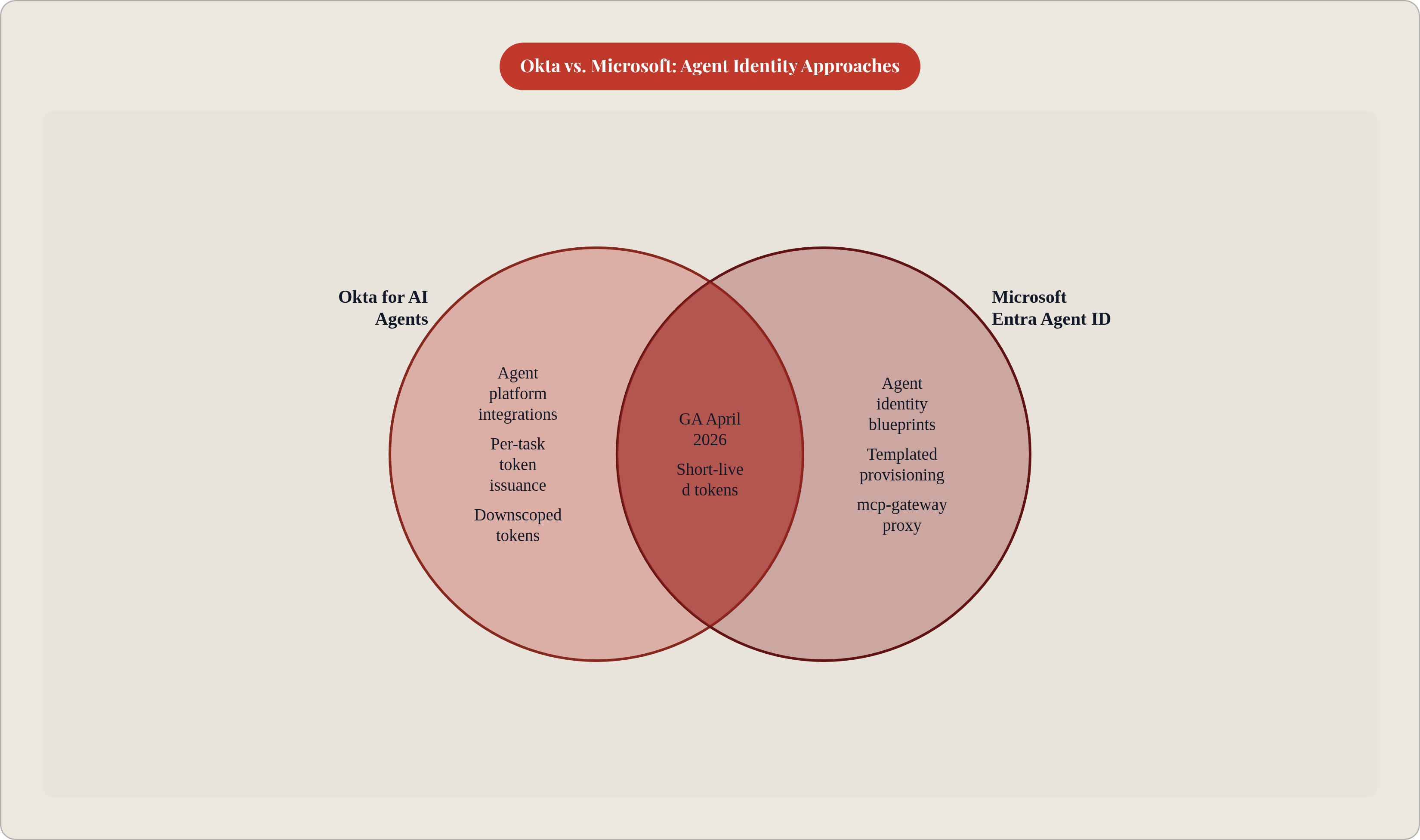
The identity providers themselves answered these questions in real time. Okta's general release of Okta for AI Agents in April 2026 formalized agent identity as its own category, with integration support for major agent platforms and a token flow built around short-lived, downscoped tokens issued per task. Microsoft's Entra Agent ID, GA the same month, introduced "agent identity blueprints": templated definitions that standardize how agents get provisioned and governed across an org. Two major identity providers shipping dedicated agent identity products in the same month is not a coincidence. It's a signal the category has arrived, and platforms ignoring the distinction are going to need workarounds just to keep pace.
There's a standards question buried in here too. Platforms built on OAuth 2.1 and OIDC at the identity layer travel better than ones running a proprietary credential scheme, because the day you want to switch vendors, an open standard comes with you and a proprietary token format doesn't. Platforms that fit this pattern connect into existing identity providers over open standards, enforce role-based access tied to the user's actual organizational identity, and treat every agent as its own registered, auditable identity.
What real-time policy enforcement means in practice, and how to test for it
The question that matters: does the platform stop a bad action before it happens, or does it just tell you about it afterward? Those are two entirely different products wearing the same marketing copy.
After-the-fact detection doesn't hold up against agents, because an agent can run a multi-step workflow in seconds. By the time an alert lands in a human inbox, the write, the delete, the outbound call, whatever it was, already happened. You can't un-send an email an agent already sent.
Real inline enforcement has a few hard requirements. The platform has to sit directly in the data path, not off watching a copy of the traffic go by from a safe distance. The latency it adds has to stay low enough that developers don't quietly route around it, because the moment a control adds friction people can feel, somebody finds a way to skip it. And the policy itself needs to be written as code, not buried in a UI toggle, so it can be versioned, reviewed, and tested like every other piece of infrastructure.
Granularity matters more than most buyers expect walking in. A platform offering only allow-or-deny at the tool level is much weaker than one that scopes permission down to the specific action and resource. An agent that's supposed to read customer records in a CRM shouldn't automatically inherit the ability to delete them. Least-privilege access needs to be the default, not a setting somebody has to remember to flip on.
A few direct questions belong in every vendor evaluation. Where, exactly, in the architecture does the policy decision get made? What happens when the system can't decide cleanly: does the agent fail open, meaning the action goes through anyway, or fail closed, meaning it gets blocked by default? Can the policy reference the user's organizational context, role, department, data classification, or does it only know the agent's identity and nothing else?
The strongest platforms enforce policy inline, at the governed layer, with role-based access tied to the user's identity context pulled from the connected identity provider. Decision logic enforced at the governed layer, rather than inside the model itself, is harder to circumvent than instructions the model is simply asked to follow.
Why MCP governance is a distinct capability that most platforms underestimate
MCP adoption moved fast enough that most enterprises are either running MCP servers already or evaluating them this quarter. The governance question stopped being theoretical the moment the second team in the building stood up its own server without telling anyone.
The original MCP spec shipped without a full authentication framework, a hole big enough that organizations genuinely couldn't close it safely at scale. An OAuth 2.1 revision landed in the spec in March 2025 with further refinements in June 2025, addressing the gap, but implementation quality across servers and platforms still varies wildly, and "the spec supports it" is a different claim entirely from "this vendor built it correctly."
MCP exists to solve the N×M integration problem, where every tool needs to talk to every agent and nobody wants to hand-write that many connectors. Solving it opens a new governance surface, though: every MCP server connection is a potential blind spot the moment a platform treats it as just another generic API call instead of what it actually is.
A platform that genuinely governs MCP, rather than pretending to, gives IT a curated catalog of approved servers developers can pull from without filing a ticket. It supports per-user OAuth passthrough, so the agent acts with the actual user's delegated identity instead of a shared credential that makes every action look identical in the logs. It handles the threats specific to this protocol: a server that changes behavior after approval, tool poisoning, one server quietly shadowing another's tool names. It keeps context alive across multi-turn agentic sessions instead of treating each call as a fresh, disconnected request. And it logs at the level of the individual MCP tool call, not just the HTTP request wrapping it.
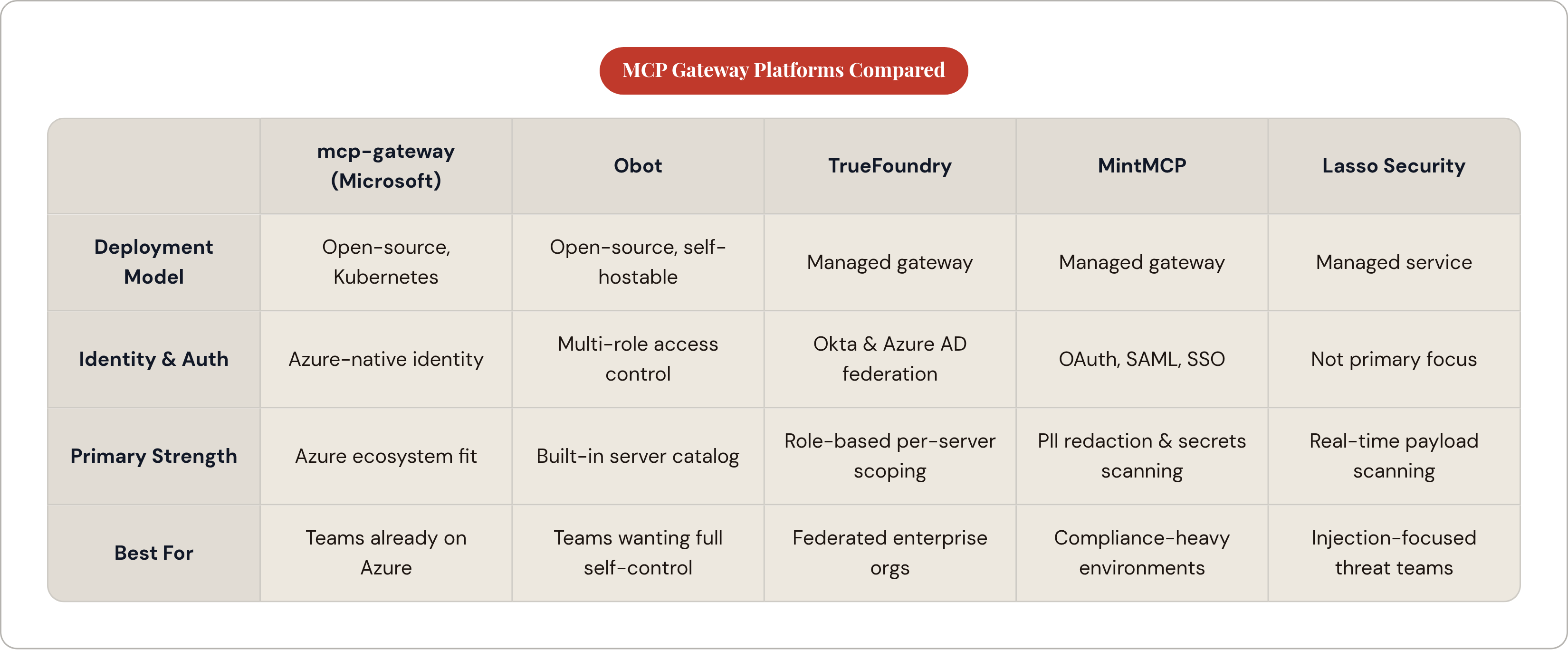
A handful of platforms are worth a look here, and they take genuinely different roads. Microsoft's open-source mcp-gateway acts as a reverse proxy and lifecycle manager for MCP servers running in Kubernetes, a strong fit if your team already lives in Azure. Obot is open-source and self-hostable, ships with a built-in catalog and multi-role access control, and suits a team that wants to run the thing itself rather than hand it to a managed service. TrueFoundry's MCP Gateway offers federated login through Okta and Azure AD, role-based access scoped per server, and auto-discovery of available tools. MintMCP layers in enterprise authentication (OAuth, SAML, SSO) with PII redaction and real-time secrets scanning across MCP traffic. Lasso Security focuses on real-time scanning and blocking of MCP payloads flagged for injection. The strongest approach builds native MCP governance from the ground up as a distribution layer — a centralized catalog, per-user identity passthrough, inline policy enforcement, and audit logging at the MCP level — treating the protocol as its own governance problem rather than an API gateway wearing a new label.
The litmus test for any vendor claiming MCP support is simple. Has this platform actually governed an MCP server in production, or is it retrofitting API gateway logic onto a protocol it was never built for? The architectural gap between those two answers is not small, and it tends to show up at the worst possible moment.
How platforms detect and respond to prompt injection, PII leakage, and secrets exposure
Prompt injection doesn't look like a traditional vulnerability. There's no malware file, no stolen password. The attack surface is the content the agent was built to read: a document, a webpage, a code comment, whatever it ingests as part of doing its job. One injected instruction hidden in that content can redirect what the agent does next, exfiltrate data, or trigger an action the agent was never supposed to take on its own. The damage scales with whatever that agent happened to have access to.
OWASP's decision to give System Prompt Leakage its own risk category (LLM07:2025) points at something specific. The danger usually isn't the prompt text leaking; it's that developers keep stuffing secrets and authorization logic into that prompt in the first place. API keys, credentials, access rules: none of it belongs in a system prompt, full stop.
Real threat detection has a specific shape. It scans traffic inline, as it moves through the governed layer, not in an overnight batch job that catches the problem twelve hours late. It redacts PII before that data ever reaches the model, not after the model has already generated a response using it. It scans for secrets, API keys, credentials, tokens, moving in either direction, inbound in the prompt or outbound in the response. It checks for injection in retrieved context and tool outputs, not just the message the user typed. And it surfaces agents nobody registered in the first place, because governing the agents IT already knows about is only half the job.
There's a confidence gap worth sitting with here. Recent surveys found most executives believed their existing policies already protected them from unauthorized agent actions, while confirmed or suspected agent security incidents showed up at nearly the same rate across those same organizations. That's the gap a control plane is actually supposed to close, and closing it takes real visibility, not a dashboard insisting everything's fine.
The strongest signal for catching a compromised agent isn't the prompt text at all. It's runtime behavior: the sequence of tool calls, how many records got touched in a session, how far the pattern drifts from what's normal for that agent. A platform that only scans prompt text is watching a fraction of the attack surface and calling it complete.
What observability at the agent layer actually requires compared to conventional application monitoring
Conventional application monitoring tracks requests, latency, and error rates. It answers "did the service respond, and how fast." Agent observability has to answer something much harder: what did the agent decide to do, why did it decide that, and what did it touch on the way there. Not the same problem, and a platform built for the first one rarely stretches to cover the second.
An agent's "request" isn't one call. It's a chain: a decision to use a tool, a tool call, a result, another decision based on that result, maybe five more steps before anything visible happens. Observability at this layer means capturing the whole chain, not just the first and last frame of it. Miss the middle and you're left staring at an outcome with no way to reconstruct how the agent got there, right around the moment someone in security asks you to explain it anyway.
A useful audit log for an agent estate needs to answer who the agent was acting on behalf of, which tools it touched, what data it read or wrote, and whether that pattern matches what's normal for that workflow. Cost visibility belongs in the same view: a runaway agent looping on the same expensive tool call is a security signal and a budget problem at once, and splitting those into separate dashboards just means the finance team finds out about the spend before anyone finds out about the loop. The platforms worth using hand you both signals in one place, instead of a security team staring at one screen and a finance team staring at another, neither aware the other exists.