Audit Logging Requirements for Agentic AI Systems
Agents need audit logs that capture reasoning, not just actions.

Start with concrete anatomy. A user, or another system, submits a goal to an agent. The agent plans a sequence of steps. Each step involves some combination of an LLM call to reason about what to do next, a tool call to execute something (search, write, delete, send), an API call to an external or internal system, a vector database lookup, or a call to a sub-agent. The agent evaluates the result and decides whether to continue, retry, or abandon. None of those intermediate decisions look like anything in a conventional log schema, because conventional logs were designed to record actions, not reasoning.
Multi-agent systems make this substantially harder. An orchestrating agent spawns specialist sub-agents, each of which runs its own multi-step sequence; the parent task branches into a tree of actions. A meaningful audit trail must capture the full tree, not just the leaf-level outputs. Logging only the final tool call is like reviewing a surgical report that lists the incision but omits every instrument, clamp, and hemostatic decision that got there.
Three specific failure modes define what logs must be able to reconstruct. First: an agent that took a destructive action, deleted a record or sent a customer-facing email, based on a misunderstanding of its goal. Second: a sub-agent that exceeded the permissions delegated to it by its orchestrator, acting with broader scope than the original authorization supported. Third: an agent manipulated by injected content in a tool's output that changed its behavior mid-sequence as a result. Without a log capturing reasoning, delegation chain, and tool inputs, none of those three scenarios is reconstructable after the fact. You are left staring at an outcome with no map of how it was reached — like arriving at the scene of a fire with nothing but ash and no record of what was burning.
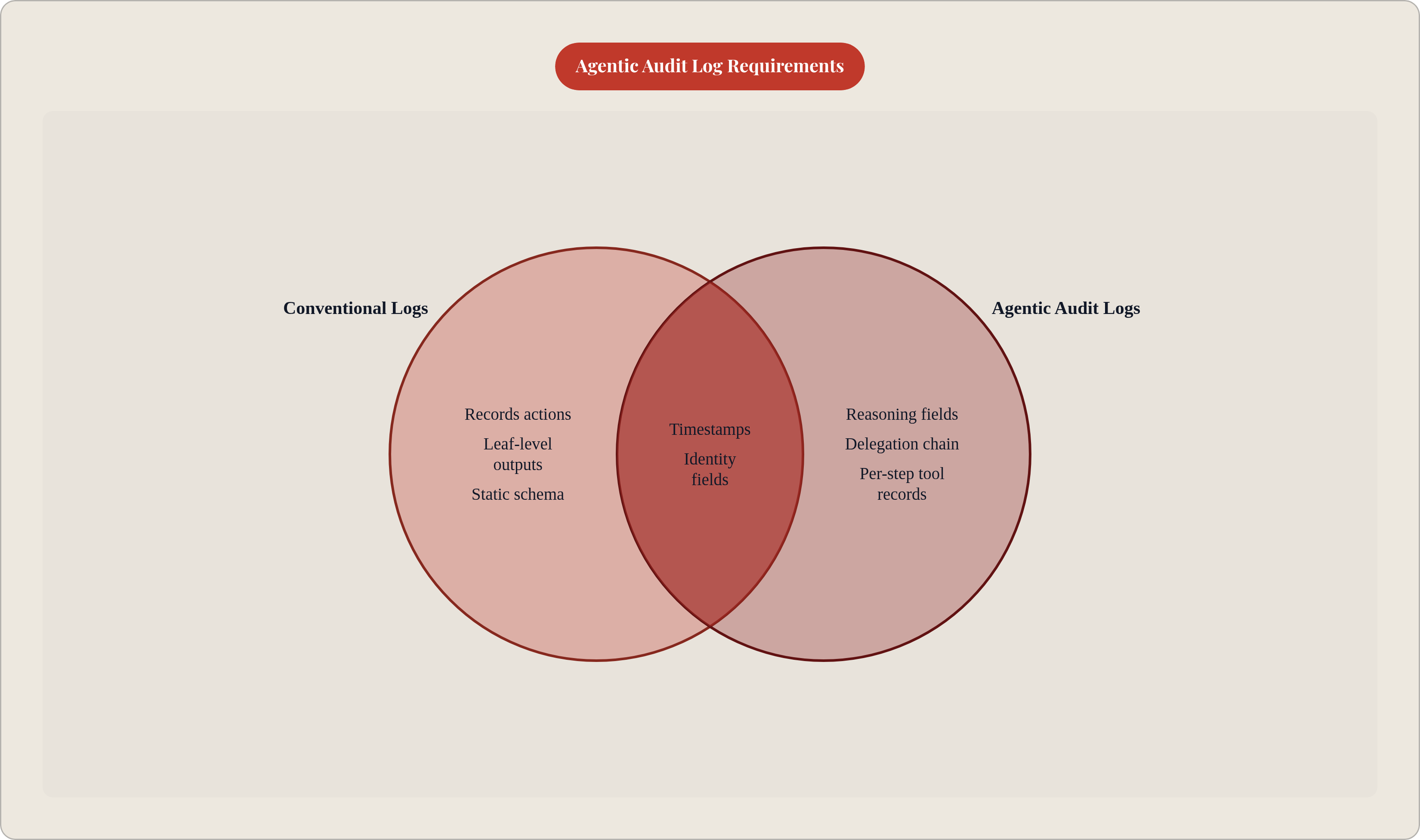
The fields a meaningful agentic audit log entry must contain
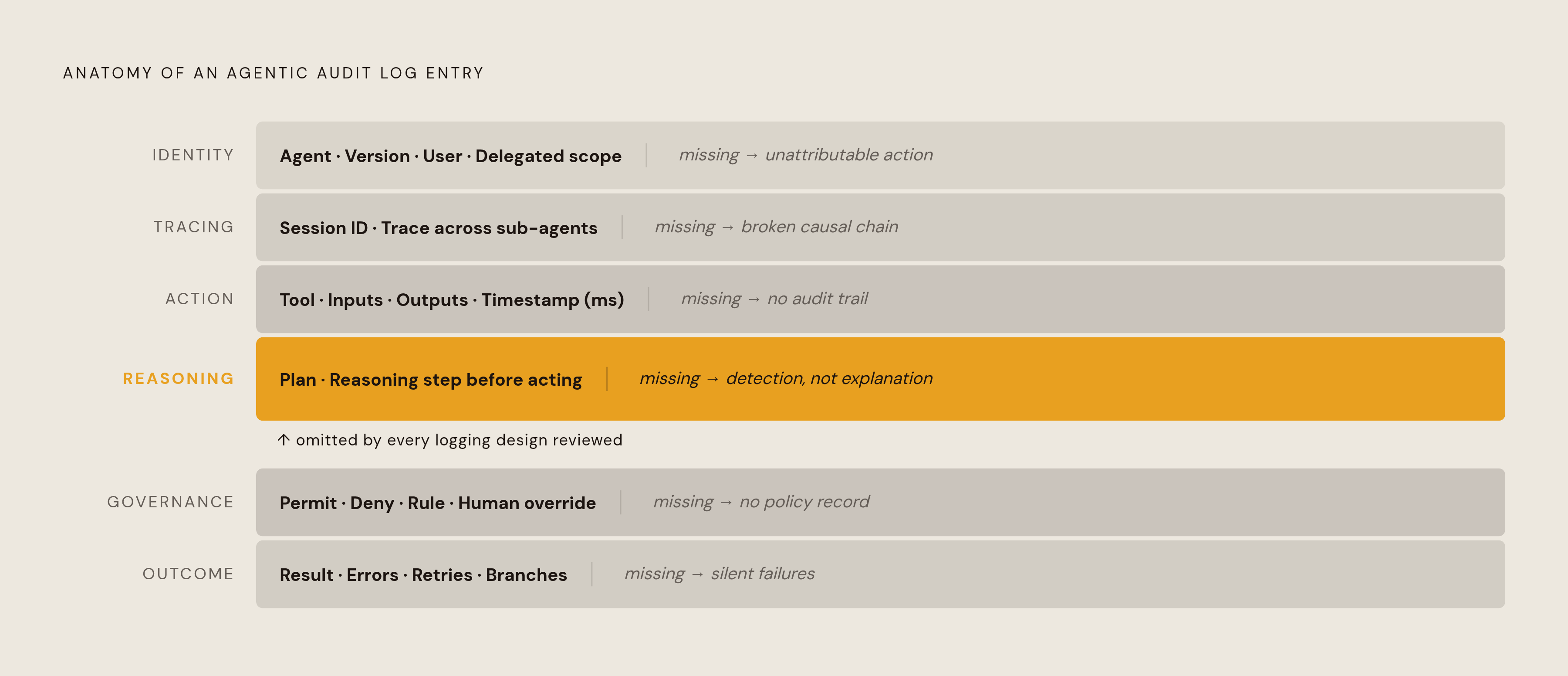
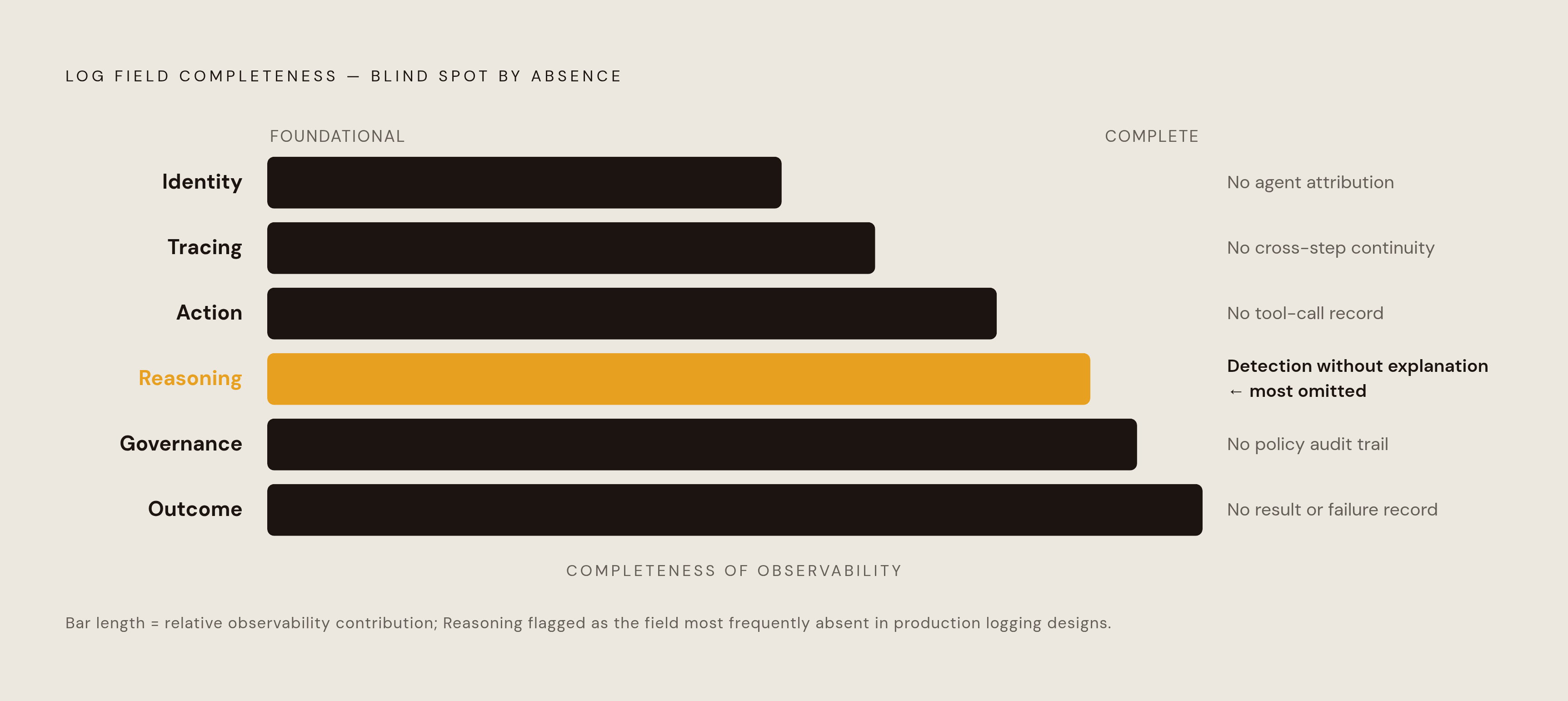
A useful log entry has specific fields, each carrying specific information, and the absence of any one of them produces a different category of blind spot. "Agent X ran" is not a log entry. "Agent X at version 2.4.1, operating under scope read/write on the CRM database on behalf of jsmith@company.com" is a log entry.
Identity fields must answer four things: which agent, running which version of its code, acting on behalf of whom, with what delegated scope. Tracing fields are what connect discrete events into a coherent sequence. A session or trace ID must persist across every step of the task, including sub-agent invocations. Without this propagation in multi-agent systems, you end up with a hundred log entries that look unrelated and share no common thread — like trying to read a novel where someone shuffled every page into a different book.
Action fields capture what actually happened at each step: the specific tool, API, or system invoked; the inputs the agent sent; the outputs returned; and a timestamp precise enough to reconstruct ordering. Millisecond-level timestamps matter when you are trying to determine whether a prompt injection preceded an anomalous tool call by 200 milliseconds or came after it.
Reasoning fields are the distinguishing requirement for agentic systems, and every logging design I have reviewed omits them. The reasoning step or plan the agent generated before acting must be captured. This is the difference between knowing an agent deleted a file and understanding why the agent believed deleting that file was the correct next step. Without reasoning fields, logs support incident detection but not incident explanation, and explanation is what compliance teams, legal counsel, and regulators actually want when they show up.
Governance fields record the policy decision at each step: permit or deny, which rule triggered, whether a human override occurred. Outcome fields capture final result, errors, retries, and unexpected branches.
One anti-pattern worth naming explicitly: storing full prompt text as indexed span attributes. It exposes PII in the logging backend, creates size limit problems at scale, and is operationally messy. Store prompt content in span events instead, where it can be filtered or dropped at the collector level without losing the rest of the trace.
How identity and permissions context must be threaded through agent logs
Agents act under delegated authority. The identity that matters in the log is not the agent alone; it is who authorized the agent to act, with what scope, and whether that authorization was ever reduced or revoked as it passed downstream through a multi-agent chain.
Every log entry carries the full delegation chain. That means the originating user or service account, the role or permission set delegated to the agent, and any further delegation to sub-agents along with whatever scope reduction, or conspicuous absence of scope reduction, occurred at each hop. If an orchestrator delegates full write access to a sub-agent that only needed read access, that failure should be visible in the log at the moment of delegation, not discovered retrospectively after something breaks.
Tying this to enterprise identity infrastructure is non-negotiable. Agent identity should be federated through existing identity providers: Okta, Entra ID, SAML/OIDC frameworks. The alternative is a separate credential store for agents, which becomes immediately unmanageable when headcount turns over and off-boarding leaves stale permissions floating around. When an employee is off-boarded or a permission is revoked, the agent's authority must be revoked with it, and that change must appear in the audit log. The failure mode this prevents is an agent operating with over-broad permissions long after the original authorization context changed, with no log evidence that the mismatch ever existed.
Role-based access control at the tool level, not just at session initiation, is the standard. A session-level permission check tells you almost nothing about what the agent was actually authorized to do at step seven of a fourteen-step task. Log entries must reflect which tools were within scope for a given execution and which requests were denied at the tool level, for every step.
Why MCP environments create specific tracing and logging gaps
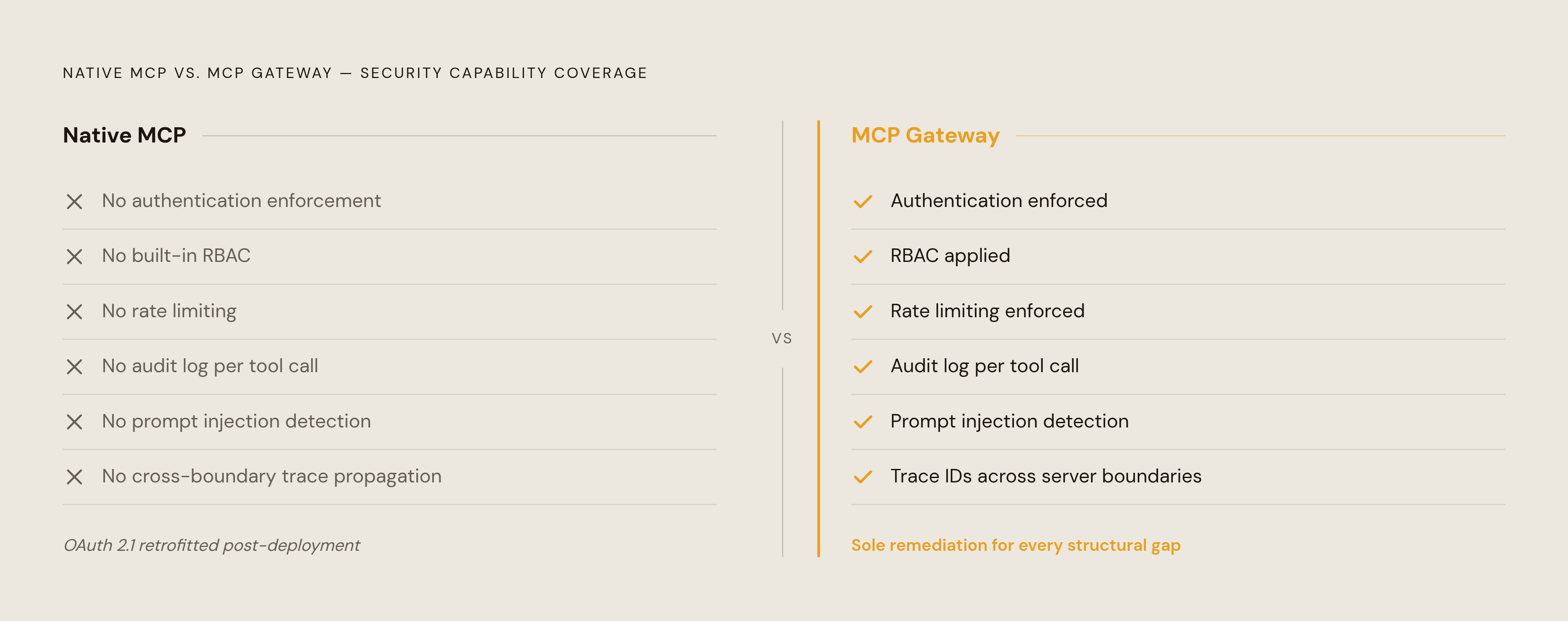
The Model Context Protocol has become a dominant mechanism for connecting AI agents to tools and external systems. The governance infrastructure has not kept pace, and that gap is structural rather than incidental.
Native MCP lacks built-in role-based access control. If an agent can connect to an MCP server, it can see every tool the server exposes, regardless of whether it should. There is no native usage tracking, no budget enforcement on tool calls, and no mandated audit logging of individual tool invocations. OAuth 2.1 support was retrofitted into the MCP specification after widespread initial deployment, meaning a significant portion of production environments were built before authenticated logging was even possible at the protocol level. You cannot instrument a gap that the protocol did not leave room for.
The credential exposure problem is concrete. Meaningful numbers of API keys, database connection strings, and other secrets have been found exposed in MCP configuration files in production environments, a signal that secrets management and logging around credential use are not being enforced consistently. An agent operating in that environment produces no reliable audit trail of which credentials it used or when.
The MCP gateway pattern is the practical remediation. A gateway sits between agents and MCP servers, enforcing authentication, RBAC, rate limiting, and generating audit log entries that native MCP does not produce. Every tool call routed through the gateway becomes a logged, policy-enforced event. The gateway also serves as the enforcement point for detecting prompt injection delivered through tool responses, which is otherwise invisible in a native MCP deployment. Trace ID propagation across server boundaries is especially critical here; without a shared trace ID carried across MCP servers, cross-server workflows become a pile of disconnected log entries that cannot be read as a sequence.
What compliance frameworks are beginning to require from agentic audit logs
The EU AI Act is the most specific framework currently in force for high-risk AI systems. It requires automatic recording of events over the system's lifetime, mandates logging sufficient to support post-market monitoring and human oversight, and imposes retention requirements signaling that regulators expect logs to survive well beyond the immediate incident window. The Act does not yet specify trace ID propagation to sub-agent invocations at a technical level, but the traceability and human oversight requirements functionally demand it in any multi-agent deployment.
The US regulatory posture is fragmented but directionally clear. State-level frameworks in Colorado and elsewhere are imposing requirements around high-risk AI decision-making that imply audit trail obligations. FTC enforcement posture has made plain that "we didn't know what our AI was doing" is not an adequate defense. Every engineering team I have spoken with that is waiting for federal-level specificity before building logging infrastructure is making a bet that has historically not paid off.
ISO/IEC 42001, the first certifiable international management-system standard for AI, requires internal audit, documented AI policies, and defined roles. All of that presupposes structured logging of the kind described here. NIST's AI Risk Management Framework communicates the same thing through its govern/map/measure/manage vocabulary: the measurement function requires data, and data requires instrumentation that someone deliberately built.
The safest architecture satisfies the most demanding jurisdiction: append-only storage, long retention, full delegation chain, per-step tool call records. Retrofitting this after the fact is significantly harder than building it in from the start, and compliance timelines do not accommodate architectural debt gracefully.
How shadow AI and ungoverned agents create audit blind spots
Shadow AI, meaning AI tools and agents in active use inside the organization that have never been inventoried, risk-assessed, or governed, produces no audit logs by definition. There is nothing to instrument because nobody knows it is running.
The scale of ungoverned usage is large. A substantial majority of enterprise employees use AI tools for work, and a significant share of that usage involves tools that no one in IT or security has reviewed. The blind spot this creates is total: no record of which data was sent to which external model, no record of what the agent was authorized to do versus what it actually did, and no basis for incident response when something goes wrong. Per IBM's 2025 Cost of a Data Breach Report, shadow AI breaches carry materially higher costs than standard incidents because the absence of logs extends both detection and response time.
Detection requires multiple signal sources working in concert: network-level identification of traffic to AI service endpoints, OAuth grant scanning, browser-level monitoring for AI extensions, and SaaS application inventory. DNS and firewall logs alone miss most of it because AI usage is browser-based and embedded within existing SaaS workflows, which look like normal traffic until they do not.
Discovery and governance must precede instrumentation. Prompt injection through ungoverned agents is particularly dangerous because there is no log to detect that the agent's behavior changed after encountering injected content. The attack is invisible by design, and an unmonitored deployment makes it permanent.
The storage and integrity requirements that make agentic logs legally defensible
Capturing the right fields is necessary but not sufficient. Storage architecture determines whether logs are trustworthy when it matters most, specifically during the kind of incident where someone is trying to determine whether the log was tampered with.
Treat agentic audit logs with the same integrity requirements as financial audit logs. That means write-once, tamper-evident storage with no delete or modify access for standard operators. Append-only architecture is the implementation pattern: new entries can be added, existing entries cannot be altered. Any changes to retained entries must pass through a controlled retention management process with its own audit trail. This is not a novel requirement; financial systems have enforced it for decades.
Access control on the logs themselves is non-negotiable. An agent that can write to its own log can falsify it, which renders the entire audit function decorative. The write path from agent infrastructure to log store must be separated from the read path used by security and compliance teams. Centralization matters because logs scattered across individual agent deployments cannot be correlated across a multi-agent workflow. A federated store with a unified query layer is the minimum prerequisite for cross-agent tracing.
Retention policy must be set to the most demanding applicable requirement and enforced by the governance program, not left to individual engineering teams who have other priorities and will make reasonable-seeming decisions that later turn out to be wrong. Queryability is where a lot of logging architectures collapse under real incident pressure. Logs that cannot be searched efficiently are not useful during an investigation running on a two-hour clock. Structured log fields, not free-text blobs, are the prerequisite for reliable querying by trace ID, agent ID, tool name, or policy decision. A log schema designed for human readability rather than machine queryability is a log schema optimized for conditions that never actually occur.
What a governed AI layer looks like in practice for agentic audit logging
The governed AI layer is an architectural pattern, not a single product, and its components are increasingly available in production-grade form.
At the enforcement layer, a gateway or proxy handles every interaction between agents and the tools or systems they access. Authentication is verified here, RBAC is applied, rate limits are enforced, and audit log entries are generated. Permit.io provides fine-grained authorization that operates at the tool invocation level, making it practical to enforce scope reduction at each hop in a multi-agent chain rather than relying on session-level permissions. Portkey and similar AI gateway tools add rate limiting, usage tracking, and observability across LLM calls, with the audit event generation that native model APIs do not supply. For MCP-specific environments, purpose-built MCP gateway implementations are emerging to address the authentication and logging gaps the native protocol omits.
At the observability layer, OpenTelemetry has become the practical standard for distributed trace collection. Its trace ID and span model maps reasonably well onto agentic execution trees when instrumented correctly, but only when instrumentation propagates trace context across every agent boundary, including sub-agent invocations and MCP server calls. LangSmith, Langfuse, and similar tracing tools built specifically for LLM applications handle agentic-specific fields, particularly reasoning steps and tool call inputs and outputs, that general-purpose observability platforms were never designed to capture. Arize AI and similar evaluation platforms extend this into the measurement layer, tracking model behavior over time in ways that support the post-market monitoring requirements the EU AI Act imposes.
At the identity layer, WorkOS and similar platforms manage agent identity as a first-class concept federated through enterprise identity providers, so agent credentials are subject to the same lifecycle management as human credentials. This is what makes the delegation chain in the log entry legally meaningful: the authorization traces back to a governed identity, can be revoked when appropriate, and can be verified after the fact by someone who did not build the system.
The integration across these layers is where most teams I have audited currently underinvest. Individual components logging independently produce the unconnected event fragments that create real problems during an incident: actions without reasoning, tool calls without delegation context, outcomes without the sequence that produced them. A single trace ID must flow from the originating user request through every agent invocation, every tool call, every sub-agent spawn, and every policy decision, landing in a write-protected, queryable log store that no agent can modify. The organizations that build this before an incident forces their hand are the ones whose audit trails will actually hold up in front of a regulator or a jury.