Prompt Injection Prevention in Production Agentic Pipelines
Agentic systems need defenses at all four injection surfaces, not just user input.
There is a useful asymmetry worth establishing before anything else. In a chatbot, a successful injection produces a bad output the user reads, winces at, and reports. In an agentic pipeline, it produces an action the system takes: a database write, an API call, a file exfiltrated, a message sent on your behalf. OWASP's Top 10 for LLM Applications ranks prompt injection as the leading vulnerability in this class of system, and the 2025 update helpfully distinguishes direct injection (jailbreaking via the user turn) from indirect injection (malicious content embedded in retrieved data or tool responses). The blast radius of each compounds with every step in a multi-step pipeline, because a single injected instruction can propagate through several tool calls before any human or system has noticed anything is wrong.
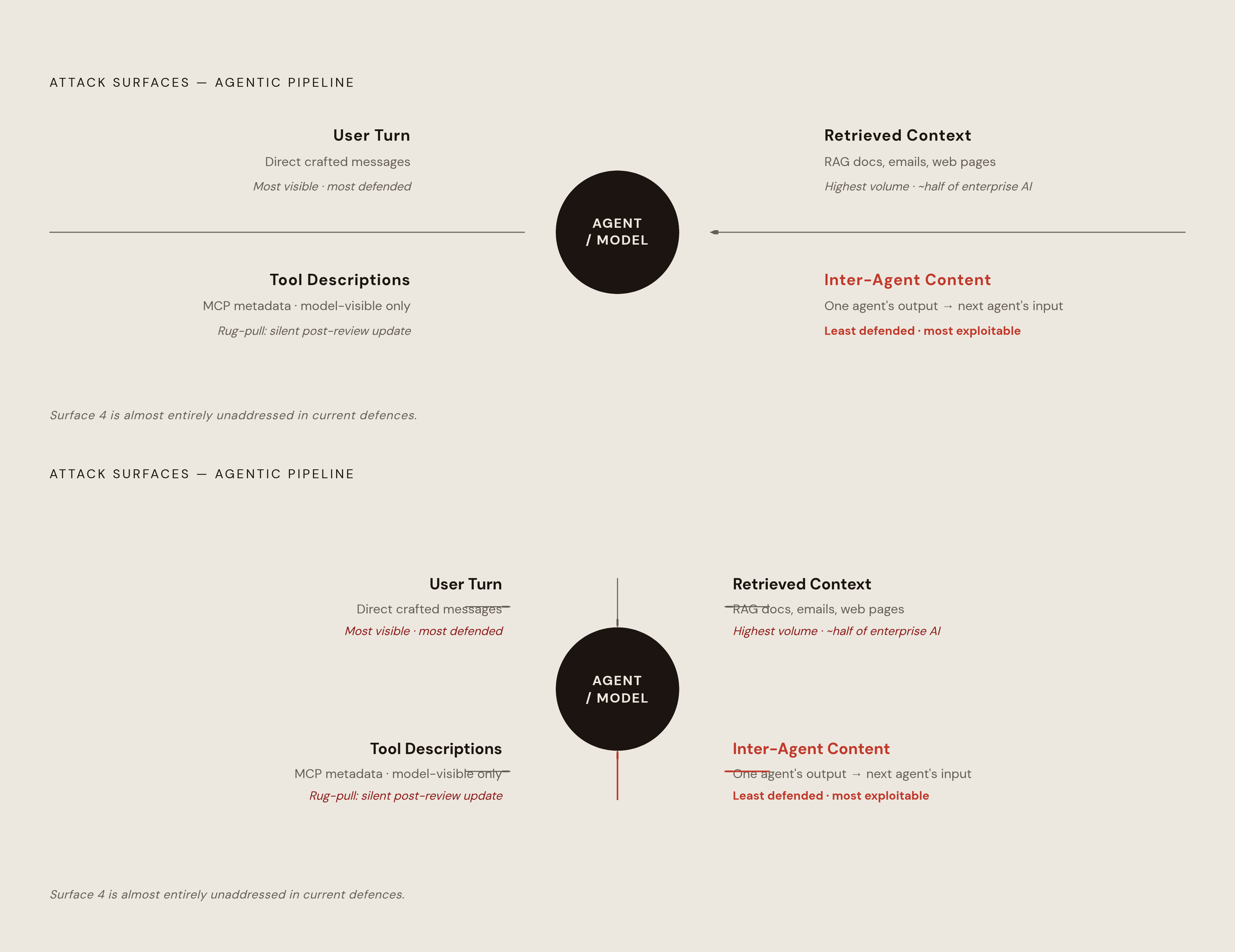
Four surfaces feed untrusted content into the pipeline. Each one requires its own controls, because they fail in different ways and at different points.
Surface 1: The user turn. Direct injection via crafted user messages. The most visible vector, and the one most teams have at least partial defenses for. It is also the surface attackers find least interesting once they discover the others are unguarded.
Surface 2: Retrieved context. RAG pipelines retrieve documents, emails, web pages, and database records, then insert them directly into the model's context window. Research into poisoned RAG pipelines shows that a small number of adversarially crafted documents embedded in a large corpus can achieve high attack success rates, because poisoned documents operate at the embedding level and evade human inspection entirely. Roughly half of enterprise AI deployments use RAG rather than fine-tuning, which makes this the highest-volume injection surface in production today. The model reads retrieved content and cannot reliably distinguish "this is a document I retrieved" from "this is an instruction I should follow." That is not a model bug. It is the fundamental architectural root cause, and no patch is coming.
Surface 3: Tool descriptions and MCP server metadata. The model reads tool descriptions to decide which tools to invoke. Malicious instructions embedded in those descriptions are model-visible and typically user-invisible. A class of attack named "tool poisoning" became clearly documented in 2025: proof-of-concept attacks hid instructions in calculator tool descriptions and caused coding assistants to exfiltrate private SSH keys. The more insidious variant is the "rug pull," where a tool passes an initial security review with a benign description, earns trust, and then the MCP server silently updates the description with malicious instructions after the fact. The model reads the new description. Nobody else does.
Surface 4: Inter-agent and tool response content. In multi-agent architectures, one agent's output becomes another's input. A compromised sub-agent or a malicious tool response can inject instructions upstream into the orchestrating agent. This surface is almost entirely unaddressed by teams focused only on user-facing input validation, which is precisely why it deserves the most careful attention.
Defending only the front door while three windows stay unlocked is not a security strategy. It is a comfort ritual.
Why Perimeter-Style Defenses and Model-Only Mitigations Fall Short
WAFs, TLS inspection, and API rate limiting are blind to prompt injection because injection operates at the semantic layer, not the network or application layer. This is not a criticism of those tools; they were built for a different threat model. The problem is when teams treat their existing perimeter as injection coverage and move on, satisfied.
Model-side mitigations, including instruction hierarchy, reinforcement from human feedback, and prompt hardening, reduce susceptibility without eliminating it. Attack success rates in agentic coding environments increase sharply with repeated attempts: what fails once often succeeds with iteration. Probabilistic resistance is not a sufficient control when the consequence of a single successful attempt is a tool invocation with production credentials.
System prompt hardening ("ignore all previous instructions") is well understood by attackers and trivially bypassed by indirect injection through retrieved content. The agent never sees the conflict; it just reads a document that happens to contain instructions. Output filters applied only at the final response miss injections that cause tool calls or memory writes mid-pipeline, before any output surfaces to the user. By the time the filter runs, the injection has already succeeded. The filter is reading the receipt.
The fundamental problem is architectural: defenses designed around a single trust boundary, user input in and model output out, do not map to a system with many trust boundaries and many action points. Controls must be placed at each ingestion surface, must act before actions execute rather than before responses are returned, and must operate as a coordinated system.
Input Validation and Content Sanitization at Each Ingestion Point
The governing principle is that untrusted content should be sanitized or structurally separated from instructions before it enters the context window. Once the model has read injected content, it has already had a chance to act on it. Filtering after the fact is optimism dressed as security.
Structural query separation, documented in USENIX Security research under the name StruQ, keeps instruction channels and data channels syntactically distinct so the model receives a clear signal about which portions of its context are authoritative. Not foolproof. Meaningfully harder to exploit.
For the user turn, pattern-based detection for known injection phrases is a floor, not a ceiling, since adversarial inputs are specifically designed to evade known patterns. A secondary LLM classifier deployed as a pre-filter provides better coverage: a smaller, purpose-built model evaluates whether the input attempts to override system instructions before the primary agent ever sees it. The attacker now has to fool two models instead of one.
For retrieved content, the operative word is "untrusted." Every retrieved document should carry structural delimiters, provenance metadata, and sanitization before insertion into context. Source allowlisting is the bluntest instrument and often the most effective: only retrieve from vetted, controlled sources, and quarantine everything else. Chunk-level provenance tagging gives every retrieved fragment a traceable origin, so when an anomalous instruction appears in retrieved content, the source is identifiable.
For tool descriptions and MCP metadata, validate and hash descriptions at registration time. Alert or block on description changes before re-admitting the tool to the pipeline. This directly addresses the rug-pull attack, which is otherwise nearly invisible. Human review of tool descriptions should be part of the onboarding workflow, not optional. What the tool is told it can do matters as much as what it can actually do.
PII and secret detection at ingestion functions simultaneously as injection defense and data leakage control: scanning content before it enters the context window prevents sensitive data from being inadvertently included in agent context and reduces the value of a successful exfiltration attempt. Two problems, one control placement.
Privilege Minimization and Short-Lived Credentials as Structural Injection Resistance
Here is the architectural insight that does not get stated plainly enough: if an agent cannot take an action, no injected instruction can cause it to take that action. Least privilege is a direct injection mitigation. Treating it as unrelated hygiene is a category error.
Agents operating on shared service accounts or broadly scoped long-lived tokens are a force multiplier for attackers. A single successful injection gains access to everything those credentials can reach. Every over-privileged system I have seen investigated had substantially higher incident rates than its least-privileged counterparts; the gap is large enough to make privilege minimization one of the highest-leverage controls available, independent of any injection-specific defenses.
Short-lived, task-scoped credentials should be issued per task, not per agent, expiring on the order of minutes rather than months. A poisoned tool attempting to reuse credentials outside the approved task scope finds them already expired or out of scope. The attack fails even if the injection succeeded.
Tool-level RBAC provisions agents with access only to the specific tools required for their assigned workflow. Tool filtering at the gateway prevents the model from even seeing tools it should not invoke, which means injected instructions pointing to out-of-scope tools fail at the gateway before producing any action. There is also a non-security benefit worth noting: agents with too many tools available make worse tool-selection decisions. Governance and capability quality overlap here in ways that make the case easier to argue internally.
Integration with enterprise identity providers is the piece most organizations are still avoiding. AI agents should be registered as first-class non-human identities in the organization's identity directory, with clear ownership, automated governance workflows, and access that can be revoked when behavior deviates from policy. The convergence in 2025 around OAuth 2.0 tokens combined with standardized agent protocols, MCP for tool access and A2A for agent-to-agent calls, means the identity infrastructure already exists. The gap is organizational adoption. Every AI deployment I have reviewed that lacked a formal strategy for managing non-human identities was running agents with unclaimed, unmonitored credentials. For systems with production access, that is a peculiar choice.
Gateway-Layer Controls at the MCP Boundary
APIs needed gateways before enterprises could govern them at scale. MCP servers present the same governance problem, and the gateway pattern solves it the same way: centralized policy enforcement without requiring each individual tool to implement its own security controls. The pattern is not novel. The application is.
The gateway enforces what individual MCP servers cannot. Authentication and authorization on every request, tied to the enterprise identity provider. Pre-tool guardrails that run synchronously before any tool is invoked: if the check fails, the tool does not execute. This is the correct architectural location to block tool-description-based injection before it produces an action, because it intercepts the invocation before the model's decision translates into system behavior.
Post-tool guardrails inspect tool outputs for PII, secrets, or policy violations before passing them back to the model, which directly addresses Surface 4. A compromised tool cannot inject instructions through its return value if those values are inspected before the model reads them. Description integrity checking validates tool descriptions against known-good hashes and blocks silently modified descriptions before the model encounters them.
Audit logging at the gateway captures every tool invocation with sufficient fidelity to reconstruct what an agent did and why, which is the foundation for incident response when an injection is suspected rather than confirmed. Emerging patterns including sandbox isolation and cryptographic tool signing tie tool execution to verified, signed artifacts: a modified tool cannot execute if it does not match its signature.
The vendor landscape for MCP gateways is active. Kong, AWS Bedrock AgentCore, Microsoft's Kubernetes-native MCP Gateway, and Lasso represent distinct architectural approaches, among others. Teams evaluating gateways should assess each against the specific injection defense capabilities that matter: pre- and post-tool hook availability, description integrity enforcement, output scanning for secrets and PII, and auditability of tool invocation parameters, not just authentication and routing.
Real-Time Behavioral Monitoring and Anomaly Detection During Agent Execution
Most organizations with prompt injection defenses focus on input validation. Very few have runtime monitoring of agent behavior during execution, which is precisely where a successful injection plays out. Input validation is the lock on the door. Runtime monitoring is noticing that someone is walking around inside your house.
Behavioral anomalies in an injected agent follow recognizable patterns: tool invocations outside the agent's declared scope for the current task; credential use against systems the agent has not previously accessed in a similar context; unusual output volumes, since exfiltration attempts tend to produce large structured outputs; action sequences that deviate from the expected workflow graph for a known pipeline. None of these signals are exotic. Most pipelines are simply not instrumented to surface them.
Multi-agent defense pipelines, documented in 2025 research, address this by deploying a dedicated monitoring agent that observes the primary agent's behavior and flags anomalous action sequences. The verification function is separated from the execution function so that a compromised primary agent cannot suppress its own alerts. Out-of-band signal defenses use signals external to the model's context to verify that behavior is consistent with authorized intent, separating the verification channel from the channel an attacker can manipulate.
Observability is a precondition for all of this, and it is not a given. Behavioral monitoring requires structured telemetry: tool call logs, action sequences, credential usage, token consumption, emitted in real time and queryable. Teams that have not instrumented their pipelines cannot do anomaly detection. They can only do post-incident archaeology, which is a less satisfying discipline.
When an anomaly fires, the response must interrupt the pipeline mid-execution, not log and continue. Gateway-level circuit breakers tied to behavioral signals are the mechanism. Shadow AI complicates detection: agents deployed outside official channels generate no telemetry in the organization's observability stack, so discovering and registering shadow agents is a prerequisite for monitoring them. Every organization I know that skipped this inventory ended up monitoring a subset of their exposure without knowing which subset.
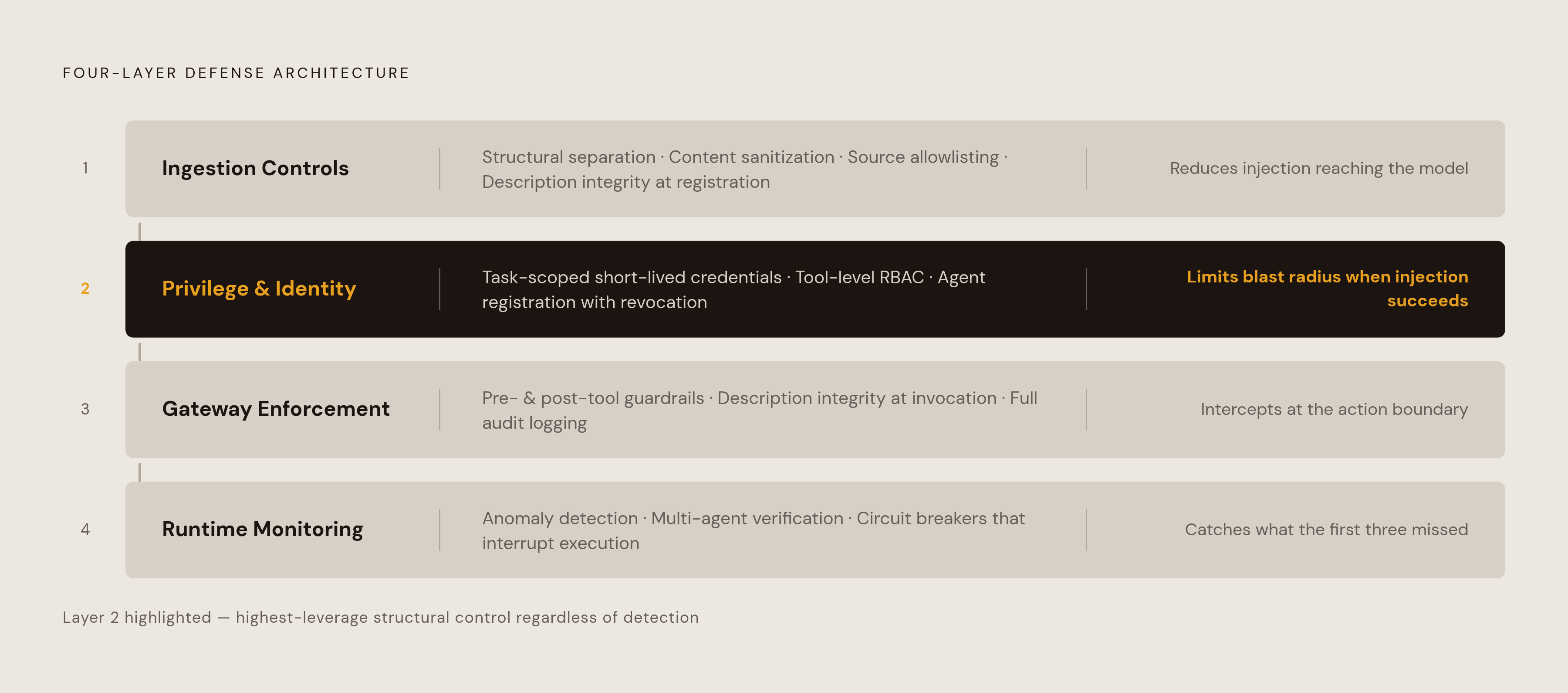
Assembling These Controls into a Layered Defense Architecture
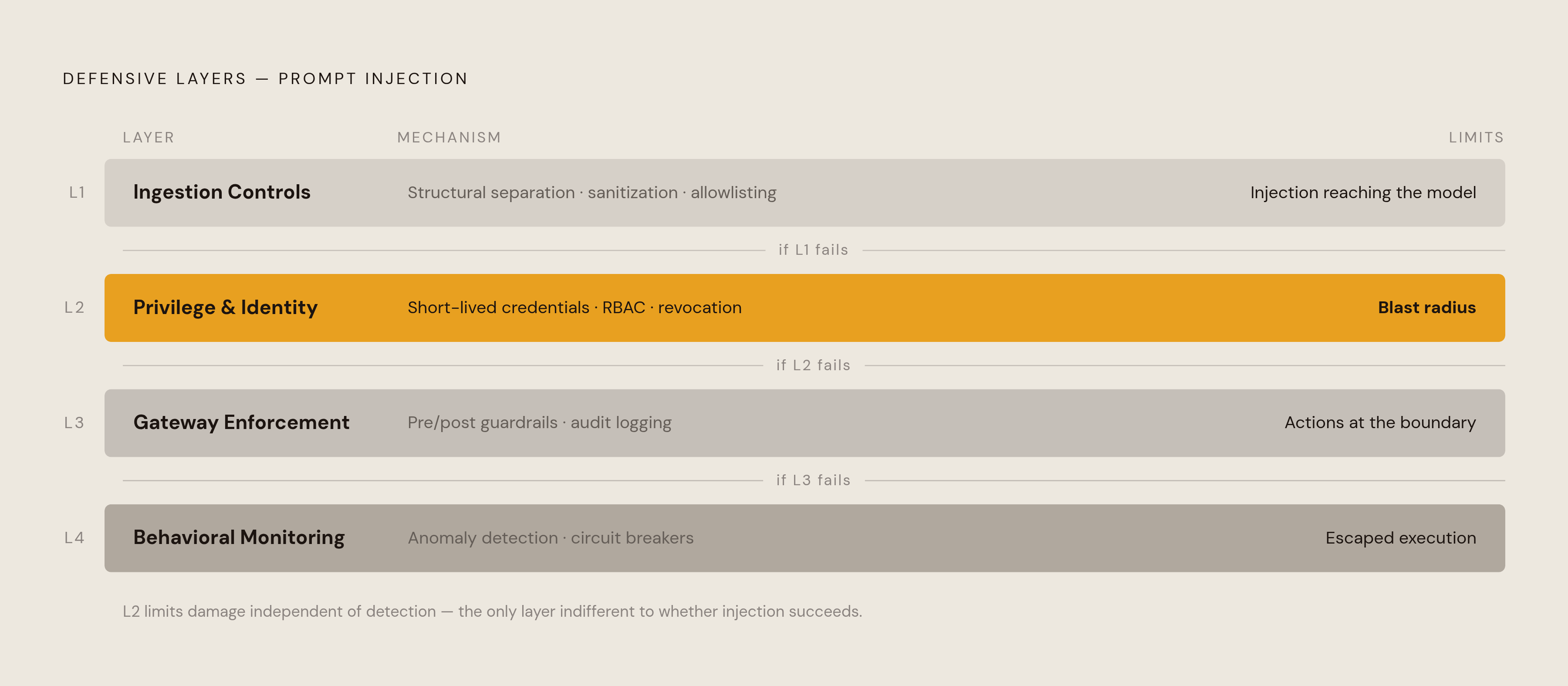
Each layer in this framework is designed with the assumption that the layer before it will occasionally fail. That is the honest design premise. The threat operates probabilistically and adapts to whatever controls it encounters; the only defensible response is a coordinated architecture where each layer compensates for the imperfections of the others.
Layer 1, ingestion controls: Structural separation of instructions and data, content sanitization, source allowlisting, tool description integrity verification at registration. This layer reduces the probability that injected content reaches the model with instruction-level authority.
Layer 2, privilege and identity controls: Task-scoped short-lived credentials, tool-level RBAC, agent registration in the enterprise identity provider with clear ownership and revocation capability. This layer limits what a successful injection can actually accomplish, independent of whether it is detected.
Layer 3, gateway enforcement: Pre-tool guardrails, post-tool output scanning, description integrity at invocation time, full audit logging of all tool calls. This layer intercepts injected instructions at the action boundary, between the model's decision and the system's execution.
Layer 4, runtime behavioral monitoring: Anomaly detection on action sequences, multi-agent verification pipelines, out-of-band verification signals, circuit breakers that interrupt execution rather than log it. This layer catches injections the previous three layers missed, in time to limit the damage.
The sequence matters because the threat does not arrive through a single channel and does not resolve at a single point. Real production incidents in 2025 and 2026, including critical-severity findings in widely deployed coding assistants and productivity copilots, were not exotic edge cases found in controlled research environments. They were the predictable consequence of treating injection as a model problem and deploying model-level defenses against a systems-level threat. The teams finding these vulnerabilities keep finding the same gaps. The gaps are not subtle.