Policy Enforcement at the AI Control Plane Layer
A control plane layer between identity and AI tools catches threats no single guardrail can stop.
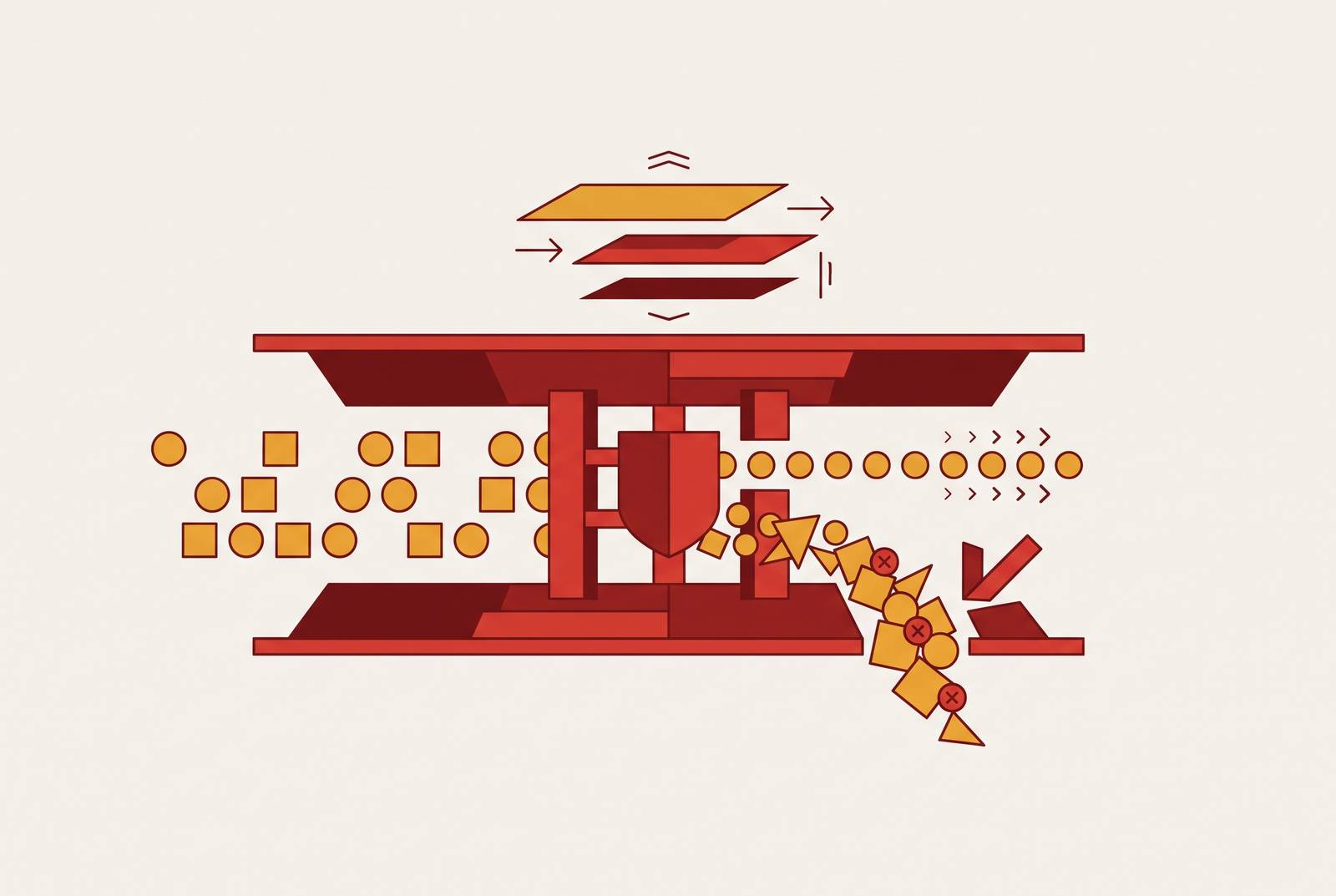
Policy enforcement for AI has a location problem. Most enterprises bolt guardrails onto applications or wrap prompt filters around a model, then wonder why an employee can still paste a client's medical records into a personal ChatGPT account. Worker access to AI tools has exploded, and governance maturity has not kept pace; Deloitte's 2026 State of AI in the Enterprise report puts that gap in stark terms. A better filter won't close it. The fix has to live in a different layer entirely, one that sits above every application and below every human, watching every request before it runs.
Here's the thing about firewalls, DLP appliances, and CASBs: they were built to watch traffic, not thoughts. They can block a domain. They cannot read a prompt, tell whether a user's role permits the query they just typed, or catch an instruction smuggled into a document an agent just ingested. Application-layer controls have the same blind spot from a different angle: a guardrail built into the app lives inside the thing it's supposed to police, so any way around the app is a way around the guardrail too. Add AI agents into the mix, chaining calls across APIs, SaaS platforms, and internal databases, and a single sloppy interaction can touch a dozen systems, each one assuming some other layer is doing the actual enforcing. Nobody's covering it because everybody thinks somebody else is. That's an architecture failure, and it traces back to one missing piece: a control plane.
What a control plane actually is and where it sits in the AI stack
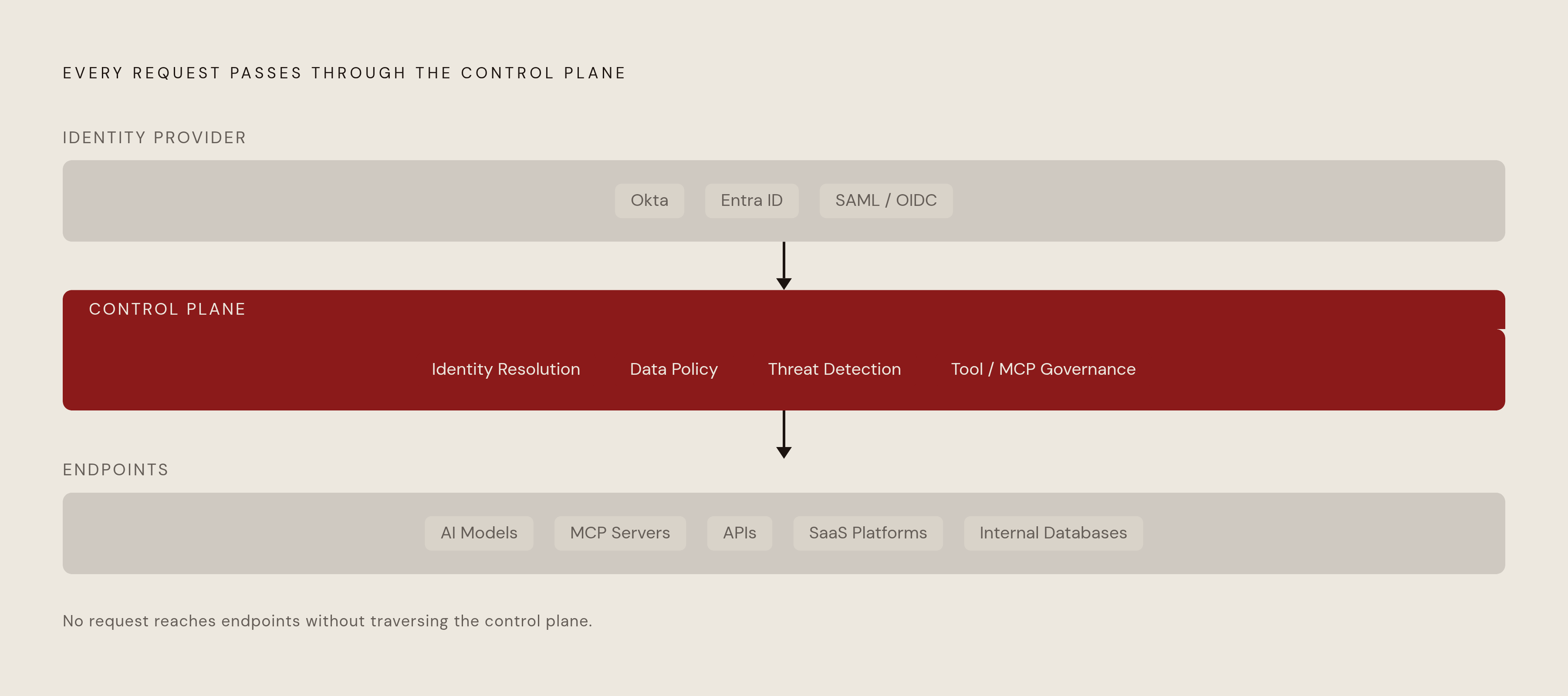
Borrow the term from networking and it still holds up. In conventional infrastructure, the control plane is the part that tells the data plane what to do: routing decisions, policy checks, identity resolution happen there, not scattered across individual services. Apply that same logic to AI and you get a layer that sits between the identity provider (Okta, Entra ID) and the actual agents, MCP servers, and tools employees use day to day.
Every request passes through that layer first. A prompt to a model, a tool call an agent fires off, a client connecting to an MCP server: all of it gets checked before it reaches the underlying system, not after the fact when the damage is already sitting in a report nobody reads. The control plane figures out who's actually asking, human or otherwise, checks that identity against the enterprise directory, and applies whatever role-based policy fits. It writes down what happened either way, approved, modified, or blocked, in a record nobody can quietly edit later.
There's a useful parallel here. API gateways became the standard way to govern service-to-service traffic because nobody wanted every microservice reinventing its own login logic. An ungoverned MCP server is the same problem wearing a new outfit: it's an internal endpoint with an attack surface, and treating it differently just because "AI" is in the name is how gaps happen. A guardrail baked into the model, a browser extension, a logging sidecar somebody wired in after launch because compliance asked nicely: none of these work as a control plane. All three sit downstream of the actual decision point, and all three can be walked around.
The specific policies a control plane must carry — and why each one requires this layer to enforce
Identity comes first, and it's non-negotiable. Every AI agent or tool call needs to be tied to an authenticated identity, human or not, before it gets an answer back. Role resolution happens at the control plane, checked against Okta, Entra ID, or whatever SAML or OIDC provider the enterprise already runs; none of that logic should live inside the model or the agent itself. Non-human identities, the service accounts running autonomous agents, need the same care as human ones: provisioning, scoping, rotation, and revocation when something goes sideways. Try enforcing that separately inside twenty different tools an agent might call, and you'll find out fast why that approach falls apart past a demo.
Data policy is the second load-bearing piece. The control plane reads the actual content of prompts and responses before they reach a model or come back to a user, catching PII, account numbers, health identifiers, and secrets like API keys or connection strings in transit. OWASP's LLM07:2025 entry on system prompt leakage names this exact failure mode: credentials and access logic embedded in system prompts, sitting there waiting to leak. Catching that means sitting at the boundary, not hoping the model behaves. Most of the exposure isn't even sophisticated, since A large share of sensitive data reaching consumer AI tools arrives via plain copy-paste into personal accounts, a move no corporate DLP tool sees coming because it never touches the corporate network in the first place.
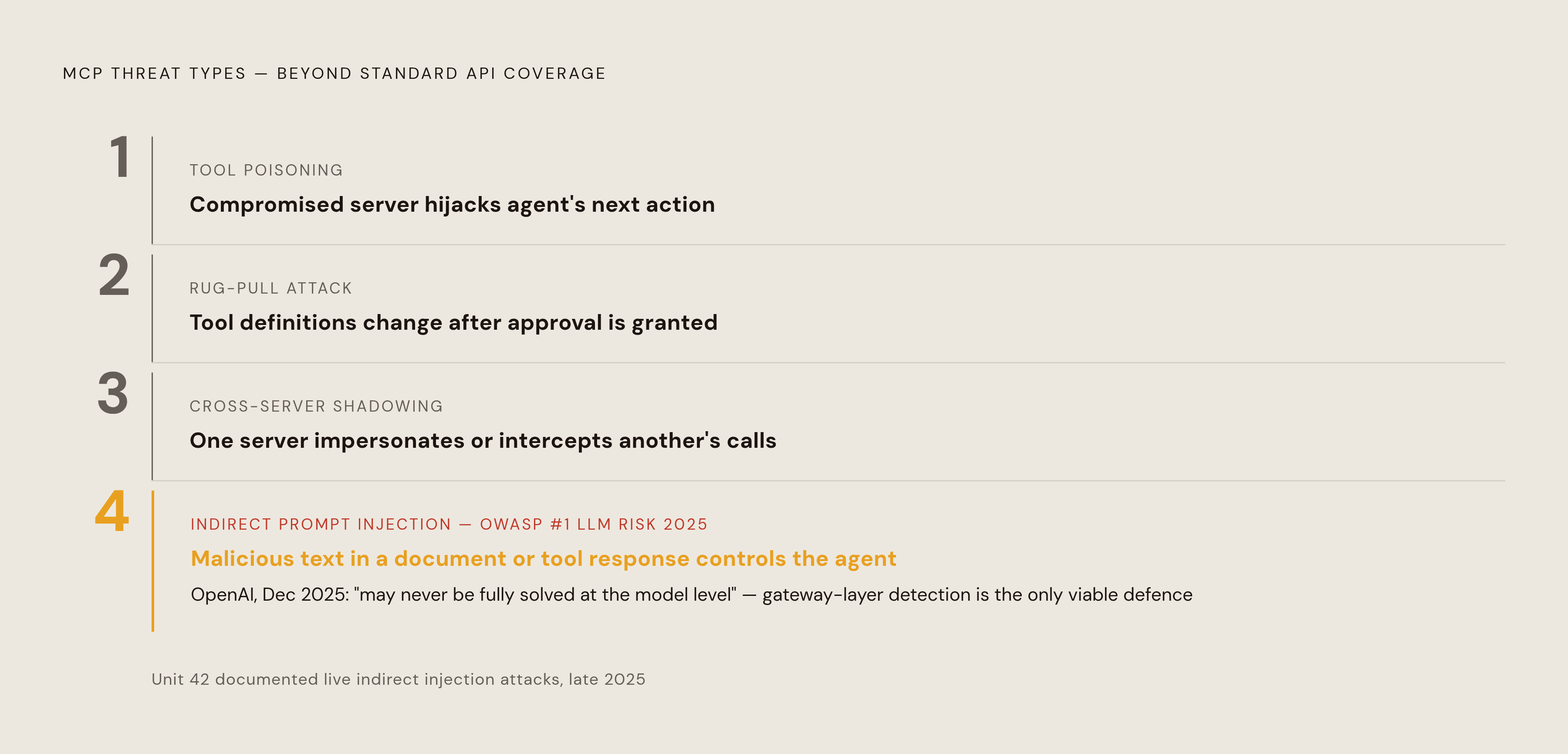
Threat detection is where things get genuinely hard. OWASP ranks prompt injection as the top vulnerability in LLM applications for 2025, and for good reason: the model can't tell the difference between an instruction from its operator and an instruction hidden in a webpage it just read. Indirect prompt injection is the meaner sibling: malicious text buried in a document, a search result, or a tool's response, waiting for an agent to read it and follow along. Palo Alto's Unit 42 documented real attacks of this kind against enterprise AI systems in late 2025, using indirect prompt injection methods with progressively higher-severity intents. By the time that instruction reaches the model, it's already being processed, so detection has to happen before, at the control plane, or not at all. Even OpenAI has said the quiet part out loud: its December 2025 acknowledgment that prompt injection in agentic browsers "may never be fully solved," followed by a February 2026 Lockdown Mode release, admits that fixing this at the model level was never going to be enough.
Tool and MCP governance rounds this out. Agents don't just answer questions; they call APIs, read files, write to databases, and every one of those actions is a decision that deserves explicit sign-off. The control plane keeps a catalog of approved servers and tools and enforces that agents only touch what their role allows. Skip that, and you inherit MCP-specific problems no ordinary API scanner catches: tool poisoning, rug-pull attacks where a server's permissions quietly change after the fact, cross-server shadowing where one server impersonates another.
None of this holds together without policy-as-code. A written policy document doesn't enforce itself; it just sits in a wiki collecting dust until an audit. Turning rules into machine-readable, version-controlled definitions means every change is auditable, every rollback is possible, and drift from the intended posture gets caught, instead of discovered six months later during an incident review.
Shadow AI as the enforcement gap that makes a control plane urgent rather than aspirational
Shadow AI isn't a hypothetical risk sitting on a five-year roadmap. UpGuard's 2025 State of Shadow AI report found a clear majority of employees now use AI tools their employer never approved, and among security and technical staff the number climbs even higher. That's the part that should keep a CISO up at night: the people who know better are doing it anyway.
Most people get something backwards about this problem: they treat shadow AI as an awareness gap, when it's actually a product gap. The exposure that matters most is the free-tier personal account, the one that generates zero enterprise telemetry. No CASB alert catches it, no DLP flag fires, no SIEM event logs it, and it's invisible by design. IBM's 2025 Cost of a Data Breach research backs up how expensive that invisibility gets: a significant share of organizations hit by AI-related security incidents had no AI access controls at all, and heavy shadow AI exposure lined up with meaningfully higher breach costs.
Training the workforce out of this wastes a training budget. Employees generally know a policy exists somewhere; the sanctioned tool is just slower, clunkier, or missing a feature the free consumer version has. This is shadow IT all over again, the same story enterprises spent years solving with MDM, CASB, and SSO enforcement for unsanctioned SaaS. AI needs that same layer, just extended to cover prompts, tool calls, and agent chains instead of file uploads and login events. A control plane gives visibility into what's actually running across the org, including the stuff nobody approved, and the ability to block or step up authentication in real time when a request routes somewhere ungoverned. Then comes the actual fix: surface the shadow usage, pull it into the governed catalog, and close the gap without telling employees to stop using AI, because they won't.
Why the regulatory environment now makes this architecture a compliance requirement, not a security choice
Regulators have stopped asking nicely. The EU AI Act's penalty ceiling for prohibited practices runs nearly double GDPR's, and the enforcement timeline has moved from abstract principles to binding obligations since February 2025, with high-risk system requirements phasing in through 2026 and 2027. The Act's reach mirrors GDPR too: a company headquartered in Ohio is still exposed if its AI system touches an EU citizen, which makes this a global problem dressed up as a European one.
The U.S. is messier but adding up fast. California's ADMT rules, in effect since January 2026, require risk assessments and opt-out mechanisms for automated decision-making. The SEC has issued AI-disclosure guidance, and the FTC keeps warning against deceptive AI claims, each one another lane of enforcement exposure. Meanwhile ISO/IEC 42001:2023, along with its 2025 companions 42005 for impact assessments and 42006 for audit certification, are building the auditable-controls scaffolding that both regulators and enterprise procurement teams will start demanding as table stakes.
Here's the gap all of it exposes: a policy document is not a control. What regulators actually want, whether they use these words or not, is a system that enforces, logs, and can produce a verifiable record of every AI interaction on demand. NIST's AI Agent Standards Initiative, launched February 2026, signals that agent-specific governance requirements are coming at the standards level. The organizations that build this infrastructure now won't be scrambling to retrofit it under a compliance deadline later.
What MCP gateway architecture reveals about enforcement at the agent layer
MCP has become the default way to connect AI agents to tools and data, and it's spreading through enterprises faster than any manual review process can keep up with. That's the uncomfortable part: adoption speed and governance capacity are moving in opposite directions.
An ungoverned MCP server is, structurally, an ungoverned internal API. It has an attack surface, it touches sensitive systems, and it leaves no audit trail unless someone deliberately built one in. The threats specific to MCP are ones standard API tooling was never built to catch: tool poisoning, where a compromised server feeds an agent instructions meant to hijack its next move; rug-pull attacks, where a server's tool definitions change after an agent already granted approval, letting it run actions nobody signed off on; and cross-server shadowing, where one server impersonates or intercepts calls meant for another.
The gateway model fixes this by putting authentication, authorization, catalog management, and threat detection between the agent and the server, instead of trusting either one to police itself. Gartner's emerging practices guidance points the same direction: govern MCP the way you'd govern any API surface, because the enforcement logic hasn't changed, only the protocol and the threat classes have. What credible MCP governance actually takes: a curated server catalog with self-service enrollment so developers aren't stuck filing tickets for weeks, per-user OAuth passthrough so an action traces back to an actual human and not just a shared service account, multi-role RBAC enforced at the gateway rather than reinvented inside every server, and detection tuned specifically for tool poisoning, rug-pulls, and shadowing.
How current platforms approach control-plane enforcement — and where the gaps remain
The vendor landscape splits roughly into three camps: gateways extending into MCP, MCP-native tools, and platforms built as a control plane from the ground up. Most buyers pick based on which camp they already have infrastructure in, which is exactly backward: the right question is which gaps you can live with, not which vendor looks familiar. Speakeasy, for instance, is built as an enterprise AI control plane that governs MCP servers and AI agents across teams rather than extending an existing gateway product.
Kong AI Gateway's v3.12 release in October 2025 added MCP support through a proxy plugin, OAuth 2.1 aligned with the June 2025 MCP spec, and MCP-specific metrics. It's a sensible move for teams already running Kong as their API layer, since MCP policy just sits alongside existing gateway rules instead of requiring a whole new system. TrueFoundry, named a Representative Vendor in Gartner's 2025 Market Guide for AI Gateways, takes a broader AI gateway approach rather than an MCP-specific one, which matters for teams trying to consolidate infrastructure under one roof instead of three.
Docker MCP goes a different route: container-native isolation, each server running in its own container with cryptographically signed images, which is good for supply-chain security in local development. It stops there, though: no RBAC, no audit logging, no centralized runtime access control, which makes it better suited to development than to production governance. Confusing the two is exactly how a demo turns into an incident report. Obot, by contrast, is purpose-built for MCP governance: open-source, self-hostable on Kubernetes or Docker, or available managed, with a built-in server catalog and multi-role RBAC from the start, a solid pick for teams with the staff to run their own infrastructure.ture.
Speakeasy takes the widest view, operating as an enterprise AI control plane spanning MCP server governance, agent management, and the broader AI layer altogether. It ties identity from Okta, Entra ID, or SAML and OIDC providers to every AI interaction, enforces RBAC, catches shadow AI and prompt injection as it happens, and surfaces cost and usage data across the org. The difference from a point solution is scope: one governed layer covering the entire AI lifecycle, rather than a gateway, a model wrapper, and a DLP tool stitched together after the fact. That matters most for enterprises that need coverage beyond just the MCP layer or just the model API.
Even with all that, two gaps persist across the whole category, and pretending otherwise is the mistake most buyers make. Non-human identity management, the actual lifecycle of service accounts tied to autonomous agents, remains underbuilt almost everywhere; every vendor above treats it as a roadmap item, not a shipped feature. Indirect prompt injection inside multi-step agentic tool chains is still an open research problem, and no platform on the market has solved it at production scale, so anyone who tells you otherwise is selling something.