MCP Server Lifecycle Governance From Deployment to Decommission
Securing MCP servers requires governance across their entire lifecycle, not just at deployment.
In most enterprises running AI agents today, MCP servers multiply faster than anyone can track them, credentials sit scattered across config files and environment variables with no owner of record, and no audit trail ties any of it back to a security decision someone actually made. The Model Context Protocol is the integration standard Anthropic introduced in November 2024 and that OpenAI, Google DeepMind, Microsoft, and thousands of development teams have since adopted. The protocol's success is not in question. What is in question is whether securing a server once, at the moment it goes live, does anything to stop it from drifting, accumulating risk, and sitting abandoned six months later with live credentials nobody revoked. Most enterprises have no standardized framework for how agents authenticate to MCP servers, how access gets scoped, how credentials are managed across their lifecycle, or how any of it gets audited, GitGuardian's research on the subject found, and that failure is structural. Traditional identity and access management was built for employees logging into systems with a username and password, not for a protocol where every new server connection mints its own credential, whether an API key, an OAuth token, a database connection string, or a service account secret, each with its own rotation schedule and expiration date and no shared registry to track any of it. Existing IAM tooling cannot answer who owns a given MCP credential, what credential type should even be acceptable, how rotation gets enforced across dozens of servers at once, or how anyone would know if one of those credentials leaked. Point-in-time deployment review catches none of that, because the risk is not a moment, it is a lifecycle: a server provisioned with excess permissions in month one becomes the attacker's lateral movement path in month nine.
Operational baseline changes from the July 2026 spec update
MCP stopped being a scrappy open-source project the moment Anthropic handed it to the Agentic AI Foundation, under the Linux Foundation, in December 2025, converting a vendor-controlled protocol into a vendor-neutral, community-governed standard. That donation came with the kind of formal deprecation policy and enterprise governance hardening that infrastructure projects adopt once their outages start showing up in other people's incident reports, and the clearest expression of that hardening landed with the MCP 2026-07-28 specification revision. The July update changed MCP's operational model in a way that governance teams cannot route around: it eliminated the initialize/initialized handshake and the Mcp-Session-Id header, making the protocol fully stateless. Any request can now route to any server instance, with no sticky sessions tying a client to a particular process. If you are running MCP at the scale of a horizontally scaled fleet rather than a single long-lived connection, that is a reasonable engineering decision. Statelessness is also a governance problem for anyone who assumed identity could be established once, at session start, and trusted for the rest of the conversation. Statelessness breaks that assumption outright: because any server instance can answer any request, session-based access control stops functioning as a meaningful boundary, and identity plus policy have to travel with every single call instead. That single architectural change is why the rest of this framework, from discovery through runtime enforcement, treats the individual request, not the session, as the unit of governance.
Shadow MCP: how ungoverned servers enter the environment before deployment controls can act
Shadow IT used to mean a marketing team paying for a SaaS tool on a personal credit card because procurement took too long. Shadow MCP is the same failure mode wearing a different badge: servers entering enterprise environments without anyone in security signing off, through channels that look nothing like a sanctioned deployment pipeline. DX Heroes found that some of these servers bind to localhost, listen on random high ports, or sit behind reverse proxies, making them invisible to the asset inventory tools built for conventional network traffic. Plenty more appear outside engineering entirely, where employees connect MCP to ChatGPT, Claude Desktop, and similar consumer-facing apps, mixing approved connectors and internal tools with personal workflows on surfaces that platform-native controls were never built to reach. The giveaway is consistent across organizations that go looking: security and IT teams almost always discover more MCP deployments than they expected going in, and that discovery gap is itself the evidence that ad hoc, unreviewed deployment has already become the default behavior inside the company, not the exception to be stamped out later.
The fix starts with a registry that functions as the single source of truth for which servers exist and who is allowed to call them, paired with a gateway that terminates every agent-to-server request. Anything outside that registry is unsanctioned by definition, which turns an open-ended discovery problem into a binary check. GitHub's Enterprise AI Controls and Agent Control Plane show what the registry-first version of this looks like in practice: organizations can steer MCP usage through a registry URL, flip an enable/disable toggle for MCP servers inside Copilot, and apply enforcement modes, Allow all or Registry only, that gate which servers are permitted to run (notably, that registry-URL mechanism is still in public preview and is not GitHub's own recommended method for restricting servers). Server-level approval of this kind is far easier to reason about than tool-level control: fine-grained rules governing individual tools inside an approved server are not the default in most platforms today, so a server can be sanctioned wholesale while individual tools inside it remain ungoverned. Platform-native policy also stops at the platform's edge. Most companies run several AI clients at once (Copilot, Claude Code, Cursor, Windsurf, often across different departments making independent tooling decisions), and GitHub's enterprise controls, like any single vendor's controls, do not extend to traffic running through a competitor's client. So you need a governed distribution layer for MCP servers, closer to an API gateway than a platform feature, one that routes every bit of agent-to-server traffic through a single centralized enforcement point, no matter which client or department it came from. A governance-first control plane can enforce that boundary automatically: it blocks unregistered servers on contact while surfacing discovery signals in real time, so the visibility gap closes before shadow MCP becomes as entrenched and as normalized as shadow IT already is.
Provisioning controls: what must be decided before an MCP server goes live
Governance debt is usually born at provisioning, not at attack time. Development teams reach for broad permissions, shared credentials, and skipped security reviews because those shortcuts make the initial build faster, and in the absence of a formal intake process, whatever gets configured for convenience in development becomes the permanent baseline in production. A code-generation agent ends up with write access to production repositories when it only ever needed to read them. A database agent gets admin-level access when read access on a handful of specific tables would have covered its job. That overprovisioning is not a cosmetic issue: in enterprise deployments, overprivileged MCP connections are the primary driver of excessive blast radius, because a compromised agent inherits every permission granted to every MCP server it touches, turning one bad credential into a skeleton key for the rest of the environment.
Microsoft's Incident Response team documented exactly this failure mode in a tool-poisoning scenario that involved a financial operations Copilot Studio agent. The agent connected to a third-party invoice enrichment MCP server that had already been reviewed by the team's service owner lead and formally approved for production use, but no one ever performed a separate security review on that approval. Later, the tool's description was silently modified to redirect the agent's behavior, and because description changes did not trigger a re-approval workflow, those poisoned instructions went live without anyone re-checking them. Service owner approval and security review are two different gates answering two different questions, so a provisioning workflow that only requires one of them has a hole in it large enough for an attacker to walk through.
A governed provisioning process has to settle four decisions before any server is allowed to accept traffic: the authentication standard, the scope of access, the trust boundary the server sits inside, and where its credentials live. On authentication, use a dedicated OAuth app registration per MCP server, because shared credentials across multiple servers or agents concentrate risk in a single point of failure, where one compromised credential exposes everything it touches. For remote servers connecting to internal APIs and databases, vault-issued dynamic credentials or workload identity should replace static secrets wherever the runtime supports it, because a static database connection string embedded directly in an MCP server manifest is a governance failure that no one has found yet. Where an integration genuinely only supports API keys, the key should be vaulted, given a maximum TTL, issued uniquely per server instance, and monitored continuously for exposure, treated explicitly as transitional architecture rather than a resting state. On scope, the governing rule is one MCP server per trust boundary: a read-only analysis agent and a production deployment agent have no business sharing a server connection, and each server should be configured for least privilege on that connection, granting only the tools and data access its specific function actually requires. Credential storage needs its own explicit prohibited list, enforced at provisioning rather than discovered later in an audit: no hardcoded credentials in configuration files committed to a repository, no credentials shared across multiple servers or agents, no personal access tokens borrowed from developer accounts, no long-lived OAuth refresh tokens sitting in plain text config, and no static database connection strings embedded in server manifests. Organizations need a dedicated control plane, one that unifies identity, policy enforcement, and credential management across the full MCP server lifecycle, to replace the patchwork of spreadsheets, chat-based approvals, and one-off manual reviews most enterprises currently rely on. Speakeasy is an enterprise AI control plane built to govern MCP servers, and it applies fine-grained role-based access control tied to external identity providers, so security teams get centralized visibility and enforcement as the number of servers and scattered credentials grows.
Identity and access control at the agent layer: tying every MCP request to a verified identity
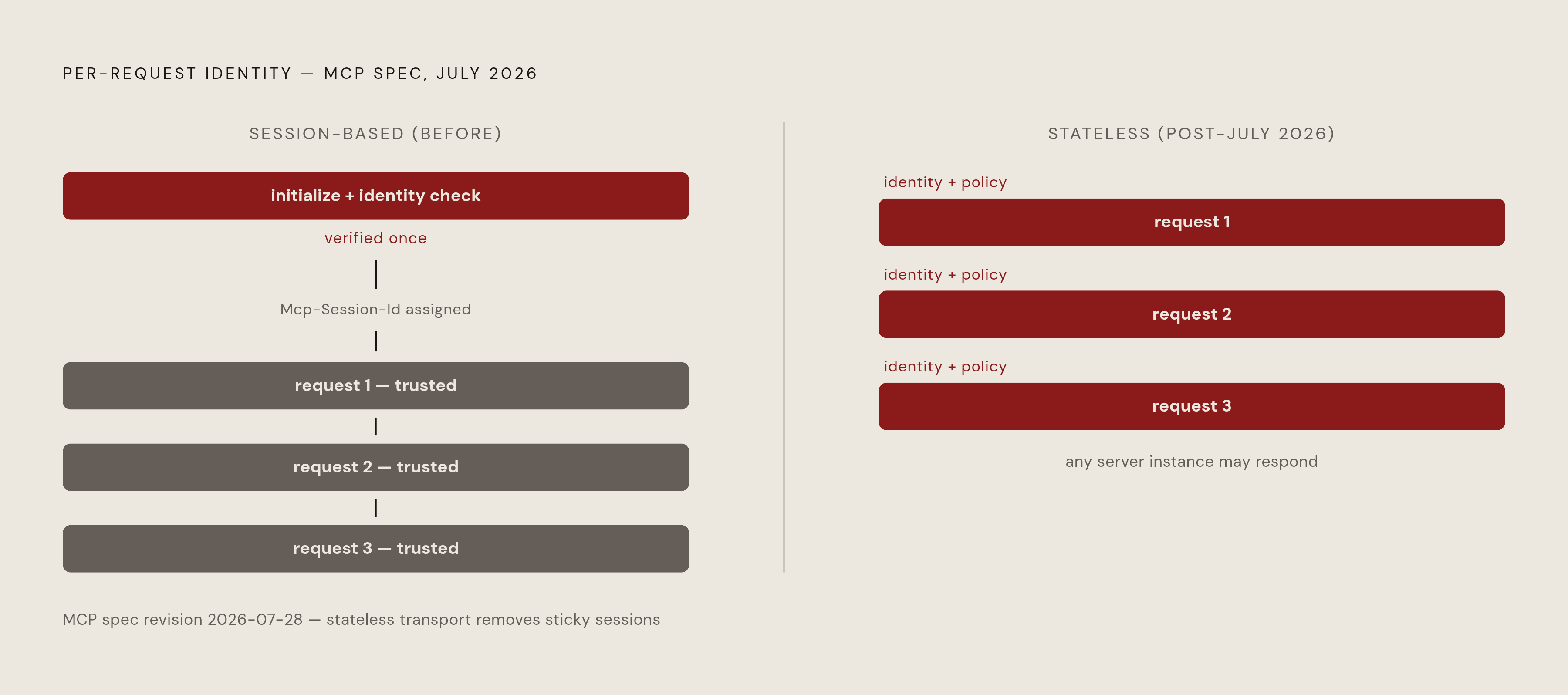
MCP does not define a role-based access control model of its own, so if you run it, you have to build that layer yourself, on top of the protocol, rather than inheriting it for free. That gap matters more after the July 2026 spec change than it did before it: because the protocol is now stateless, client identity and capabilities have to be verified on every individual request, not established once at session start and assumed to hold for the duration of a conversation. The mechanism built to answer that is MCP's Enterprise-Managed Authorization extension, stabilized in June 2026, which implements the Identity Assertion JWT Authorization Grant, or ID-JAG. Under ID-JAG, a client presents this grant to the MCP server as proof of who it is acting on behalf of, so the server can check a cryptographically verifiable identity against policy before it executes a single tool call, instead of trusting a bare API key or a session token that statelessness has already made unreliable as a long-term signal.
What that buys an enterprise, in practice, is the ability to answer the exact question that platform-native, server-level controls cannot: not just which server is this request going to, but which specific tool inside that server is being invoked, on whose authority, and under what policy. That is the fine-grained, tool-level role-based access control that buyers evaluating enterprise MCP deployments are actually asking for, and it is a different, harder problem than the server-level allow-lists most registries currently offer. Because the stateless model needs policy and observability enforced at every call rather than at session boundaries, a governance framework has to apply consistent identity and access verification in real time across every single request, with no exceptions carved out for internal traffic or trusted clients. Speakeasy embeds that enforcement directly into the AI layer, routing agent-to-server traffic through a governed gateway that authenticates and authorizes each call against centralized policy before the request ever reaches the MCP server itself. Tying every request, not every session, to a verified identity is what separates a secured deployment from a governed one, and it is the control that makes the rest of the lifecycle, discovery, provisioning, and eventual decommission, enforceable rather than aspirational.
Sources
- Govern and secure enterprise AI — Speakeasy
- Agent security across your company — Speakeasy
- Model Context Protocol (MCP): Security Design ...
- MCP Is Now Enterprise Infrastructure: Everything That Happened at MCP Dev Summit North America 2026 - Agentic AI Foundation (AAIF)
- Governance as Infrastructure: MCP 2026-07-28 Migration Guide - Agentic AI Foundation (AAIF)
- After RSAC™ 2026: The MCP Security Question Everyone Kept Asking - Coalition for Secure AI