MCP Gateway Architecture for Enterprise MCP Server Distribution
Enterprises deploying MCP agents face a governance gap that traditional API gateways cannot fill.
MCP went from Anthropic side project to Linux Foundation citizen in about thirteen months, and the plumbing underneath it never caught up, leaving governance the real problem the growth exposed. Anthropic shipped the protocol in November 2024. By December 2025, it belonged to the newly formed Agentic AI Foundation, a vendor-neutral body under the Linux Foundation with Google, Microsoft, AWS, Cloudflare, Bloomberg, Anthropic, Block, and OpenAI as Platinum members. Kevin Scott, Microsoft's CTO, called it "the HTTP of the agentic web" at Build 2025, and the growth since has made that line sound like an understatement rather than hype.
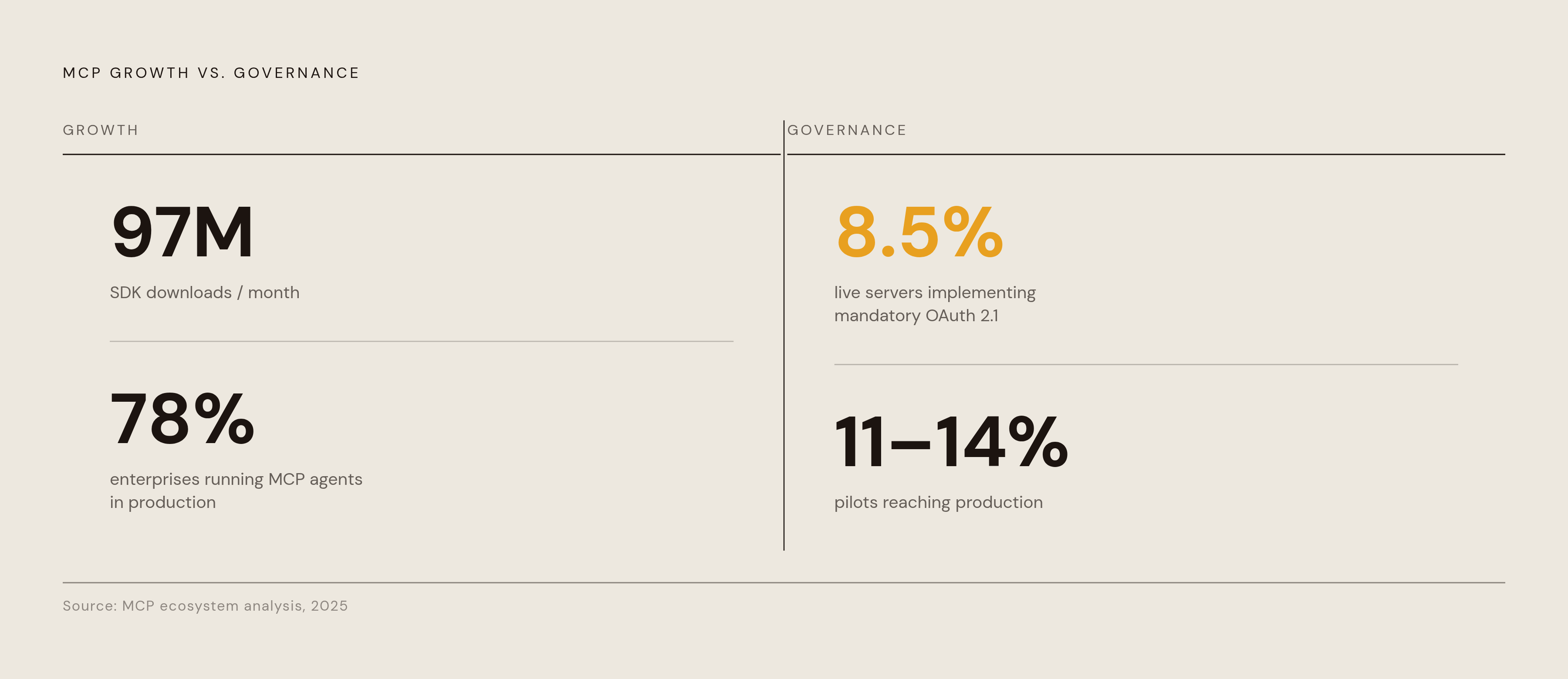
The numbers back him up, mostly. SDK downloads hit 97 million a month by early 2026. The public MCP server registry grew nearly eightfold year over year, past 10,000 active servers. Among enterprise AI teams with 50 or more practitioners, 78% now run at least one MCP-backed agent in production, up from 31% a year prior. None of that trend line explains why only 11 to 14% of pilots make it to production. Security gets blamed most often, and the numbers back that up too: just 8.5% of live MCP servers implement OAuth 2.1, a standard the protocol spec marks as mandatory. Adoption speed and governance readiness are running on two entirely different clocks, and the rest of this piece covers the layer built to close that gap: the MCP gateway.
What MCP leaves ungoverned at enterprise scale
MCP itself is a narrow contract. It standardizes a JSON-RPC 2.0 handshake, tools/list to discover what a server can do, call_tool to actually do it, whether the backend on the other end is GitHub, Salesforce, a Postgres instance, or some internal API nobody outside the platform team has heard of. That's the whole job. The protocol's own 2026 roadmap names what still needs to be built around it: audit trails, enterprise-managed authentication, and gateway and proxy patterns, leaving open the questions of who can call what, under whose identity, with what limits, and at what cost.
That's not an oversight. Keeping governance out of the spec is what let MCP move fast enough to rack up 97 million monthly downloads. But a design choice that makes sense for a protocol spec turns into an operational hole the moment ten agents each need to talk to five tools apiece. That's fifty separate integration points to secure and watch, just for a small example. Scaling it to what large enterprises actually run turns a direct-connection architecture into an audit team's fever dream, because every one of those connections is now a separate point of failure.
Unaddressed, this gap produces three failure modes: unmanaged secrets, unmonitored agent behavior, and boundaries nobody enforces. GitGuardian's research found 24,008 unique secrets exposed in MCP configuration files across 2025 alone, including live Google API keys and Postgres connection strings sitting in plain text. MCP also has no native role-based access control: if an agent can connect to a server, it can see and call every tool that server exposes, full stop. Engineers on the MCP-Scanner Hacker News thread compared the pattern to installing apps on a phone with zero regard for permissions, everyone grabbing broad access because nobody scoped it down. And without a central point where traffic converges, there's no unified execution timeline, no way to trace a multi-step workflow end to end, no cost attribution, and no baseline against which anomalies would even register.
Then there's shadow IT's agentic offspring. A developer spins up a local MCP server to connect a coding assistant to a staging database, or worse a production one, and security has no visibility into how many of these servers exist, what credentials they hold, or what data quietly moves through them. The gateway exists to answer for exactly this space, the one the protocol left open on purpose and no enterprise can afford to leave empty.
Traditional API gateways as substitutes for a purpose-built MCP gateway
Routing MCP traffic through an existing API gateway sounds sensible on paper. It's HTTP traffic, the enterprise already owns gateway infrastructure, so why build something new? Because traditional API gateways were built for a deterministic world: System A calls System B along a fixed route, with a fixed credential, and the gateway checks whether that specific caller can hit that specific endpoint. AI agents don't work that way. They chain tool calls dynamically, each one shaped by the output of the last, deciding in real time which system to touch next based on context a static router was never built to read.
Lay the two models side by side and the mismatch gets concrete fast. Traffic on a legacy gateway is app-to-app and predictable; on an MCP gateway it's agent-to-system and genuinely unpredictable. Authentication used to mean static API keys and a whitelisted IP range; now it means short-lived tokens and OAuth delegated per user, expiring on a clock measured in minutes. The unit being controlled shifts too, from a URL endpoint and a rate limit to a tool parameter, a slice of prompt context, and a user's session identity. Even the threat model changes shape: SQL injection and broken auth are old problems, while tool poisoning, context leakage, and indirect prompt injection are new ones a legacy gateway has no vocabulary for. Where an old audit log captured request and response metadata, a log built for agent traffic has to capture the agent's full trajectory, including the tool calls it considered and the ones the gateway blocked.
The question each system answers gives the game away. A traditional API gateway asks whether this client can hit this endpoint. An MCP gateway has to ask whether this specific agent can run this specific tool, with these specific parameters, on behalf of this specific user, right now. That last part carries the whole difference. An agent can take an innocuous prompt and turn it into a data export, a database write, or a deletion, and the authorization decision has to account for what's about to happen at runtime, not just what the request looks like on paper. Gartner's own forecasts treat MCP gateway integration as a distinct capability wave, precisely because the agent interaction model doesn't fit the old mold. Bolting agent traffic onto infrastructure built for app-to-app calls is a gap dressed up as a solution. It's a gap dressed up as a solution.
The five architectural pillars every enterprise MCP gateway must provide
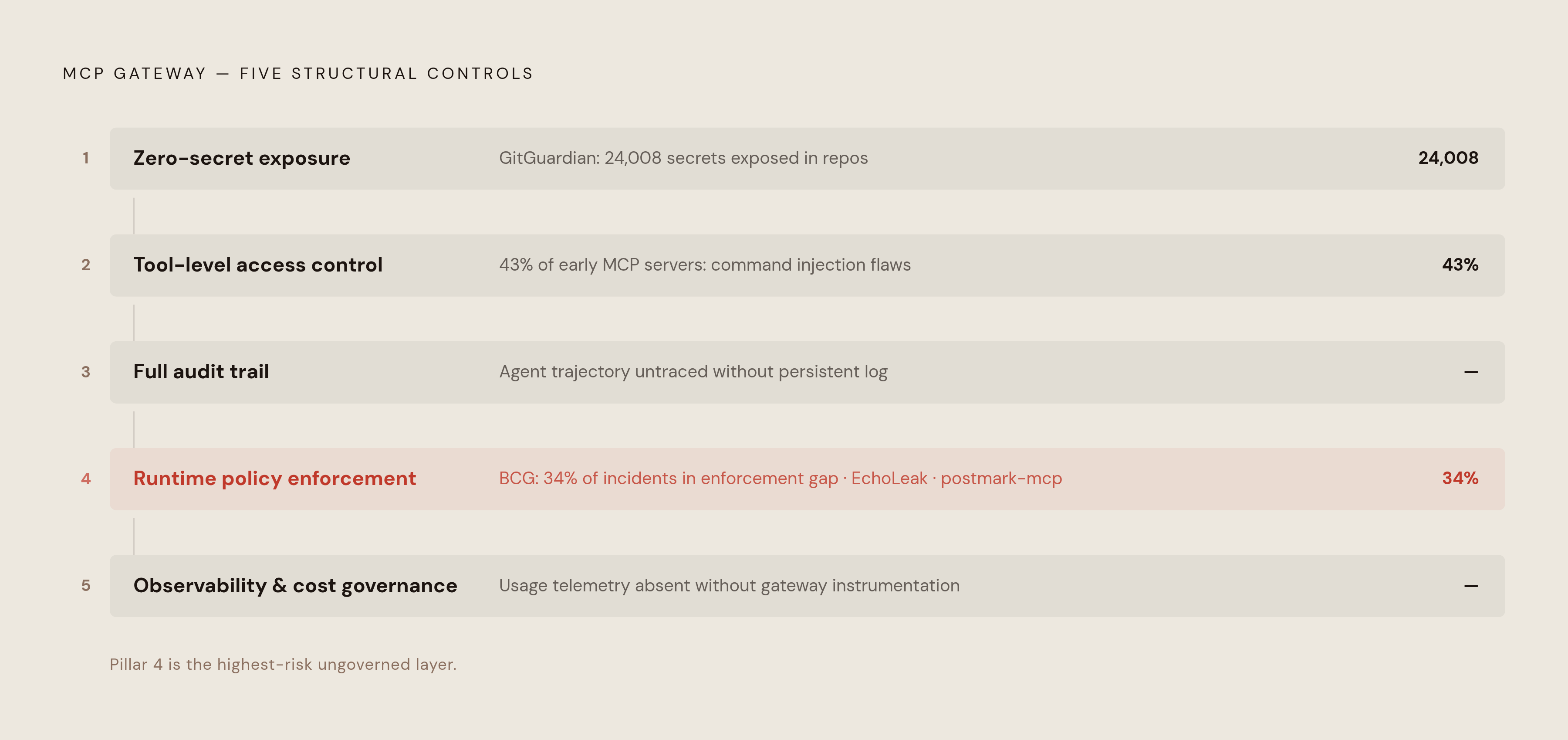
Strip away the vendor marketing, and five structural jobs remain, each one answering a failure mode described above.
Zero-secret exposure and dynamic identity come first, and this is the pillar most vendors get wrong by treating it as a vault problem instead of an architecture problem. A static token hardcoded into a local agent's config file is a liability the moment that file gets copied, logged, or committed by accident, and GitGuardian's 24,008-secret count from 2025 says this isn't rare. The gateway intercepts the tool call at runtime and injects a credential the agent never actually holds, so the agent acts with the authority it's been granted without ever possessing the underlying secret. It literally cannot leak what it never had. Credentials built this way should expire in minutes rather than months, get issued per task rather than per agent, and trigger an alert the instant something tries to use them outside its approved scope. OAuth delegation extends the same idea to identity: when an agent calls a tool, the gateway scopes that action to the specific human it's acting for.
Tool-level access control comes next, and it has to go deeper than most teams assume. Access control at the level of the connected system isn't good enough; RBAC has to reach down to the individual tool, so connecting to a server doesn't hand an agent visibility into everything that server can do. Allow-lists and deny-lists per team, environment, and consumer are how least privilege gets enforced instead of just written into a policy doc nobody reads. Virtual MCPs push this further, letting an organization stand up separate governed endpoints over the same underlying connector, so engineering and sales see entirely different tool sets without anyone duplicating infrastructure. None of it works without tying it to an identity provider the organization already runs, Okta or Entra ID or plain SAML/OIDC, rather than inventing a second permission system nobody will maintain. Okta for AI Agents, generally available at the end of April 2026, brings identity governance to the agent layer and enforces access accordingly.
A full audit trail across the agent's trajectory is the third pillar, and it needs to record more than most logging setups think to capture. Logging the HTTP layer tells an investigator almost nothing useful after the fact. What matters is the agent's intent, the tools it chose, the parameters it passed, the outcome, and the attempts the gateway blocked. Every suggestion, approval, and execution needs a record that correlates across a multi-step workflow, and in regulated industries that record needs to be tamper-evident. Without this layer, a CISO asking who can see what tools the agents are calling has no answer to give, and reconstructing a workflow after an incident turns into manual archaeology instead of a database query.
Runtime policy enforcement is the fourth pillar, and it's where most current deployments fail. Telling an agent its boundaries inside a prompt is not enforcement; it's a suggestion with good intentions. BCG's research found that 34% of incidents happened precisely in that gap, where the instruction existed but no programmatic check backed it up. Three attack patterns recur. Tool poisoning lets a malicious tool definition enter an agent's context, and security assessments of early MCP servers found the problem far from rare. Indirect prompt injection hides instructions in content the agent processes to hijack its behavior, confirmed against Slack AI, Microsoft 365 Copilot, Cursor, and GitHub MCP, with the EchoLeak exploit against Copilot in mid-2025 pulling off zero-click data exfiltration. A compromised server can quietly interfere with trusted tools already in the agent's toolchain. Security audits of early MCP servers found 43% carried command injection flaws, a third allowed unrestricted URL fetches, and 22% had path traversal bugs, so the server population can't be assumed safe by default. The postmark-mcp incident makes the supply-chain risk concrete: fifteen clean version releases went by before a single line of exfiltration code got slipped in. Gravitee.io's State of AI Agent Security Report found 88% of organizations had a confirmed or suspected AI agent security incident in the prior year, with over a third admitting they couldn't shut down a rogue agent if one appeared, leaving an open door with a welcome mat out front. That's an open door with a welcome mat out front.
The fifth pillar covers observability, cost governance, and usage telemetry, none of which MCP tracks natively. An agent can call a paid API in a loop with no budget ceiling anywhere in the protocol to stop it, which turns runaway usage into a finance problem as much as a security one. The fix here is unglamorous: metrics, logs, distributed traces, cost attribution down to the agent or team, rate limits, budget ceilings. OpenTelemetry compatibility matters because it plugs into observability stacks enterprises already run, instead of forcing a parallel system nobody wants to maintain. Usage data is the baseline that makes anomaly detection possible. Nobody can scale any of this with a straight face without it.
The gateway's fit into enterprise architecture: transport, federation, and protocol bridging
Transport for MCP has mostly settled. Streamable HTTP became the preferred transport for new MCP integrations in early 2026, replacing the SSE-only model that the March 2025 spec update deprecated (SSE itself traces back to the original 2024-11-05 spec). SSE hangs around for legacy deployments, so any gateway worth deploying needs to speak both during the transition instead of forcing a hard cutover.
The July 2026 spec revision (2026-07-28) pushes the architecture toward something stateless, cacheable, and routable at global scale, and it locks in a formal extensions framework that ships MCP Apps and Tasks alongside Enterprise-Managed Authorization, now a stable extension in its own right. Authorization got harder-edged in the same update: RFC 9207 issuer validation is now expected, and Dynamic Client Registration is giving way to client metadata documents as the standard pattern. A gateway built against the old approach is already behind, full stop.
Deployment topology depends heavily on what an enterprise has to prove to regulators. Self-hosted and on-premises setups fit organizations with hard data residency rules. In-VPC deployment is the common pattern for keeping traffic off the public internet without going fully on-prem. Air-gapped environments show up in defense, financial services, and healthcare, where isolation isn't a preference but a mandate. Managed offerings deploy fastest but typically can't satisfy strict residency requirements, which rules them out for exactly the industries that need governance most.
Global enterprises running multiple regions or clusters need gateway instances that find each other, merge their tool registries, and behave as one coherent system rather than a pile of disconnected silos. Protocol bridging matters just as much on the backend side: legacy REST and gRPC services can be exposed as MCP tools without anyone rewriting them, with the gateway absorbing the translation instead of forcing a backend refactor. An OpenAPI spec, or even a cURL command, is often enough to onboard an existing enterprise API as an MCP tool, which beats reengineering a decade of internal services from scratch.
Gartner projects that 75% of gateway vendors and 10% of iPaaS providers will build MCP support directly into their existing products. That's the real signal here. The MCP gateway is converging with the API management and identity stacks already running. It's converging with the API management and identity stacks already running, and anyone evaluating this now should ask how MCP governance slots into what's already in place, not whether to rip it out and start over.