RBAC Design for AI Agents in Enterprise Systems
Traditional access controls weren't built for machines that operate autonomously at scale.
Every enterprise now has more machines asking for access than people asking for access, and almost nobody redesigned the locks. AI agents don't fit the old permission models because they don't act like the humans those models were built for. They run without a person clicking "confirm" at each step, they hold context across sessions, and they chain tool calls in sequences nobody explicitly approved. Applying human-shaped roles to a non-human actor that operates at machine speed is a structural mismatch, and the numbers already show it.
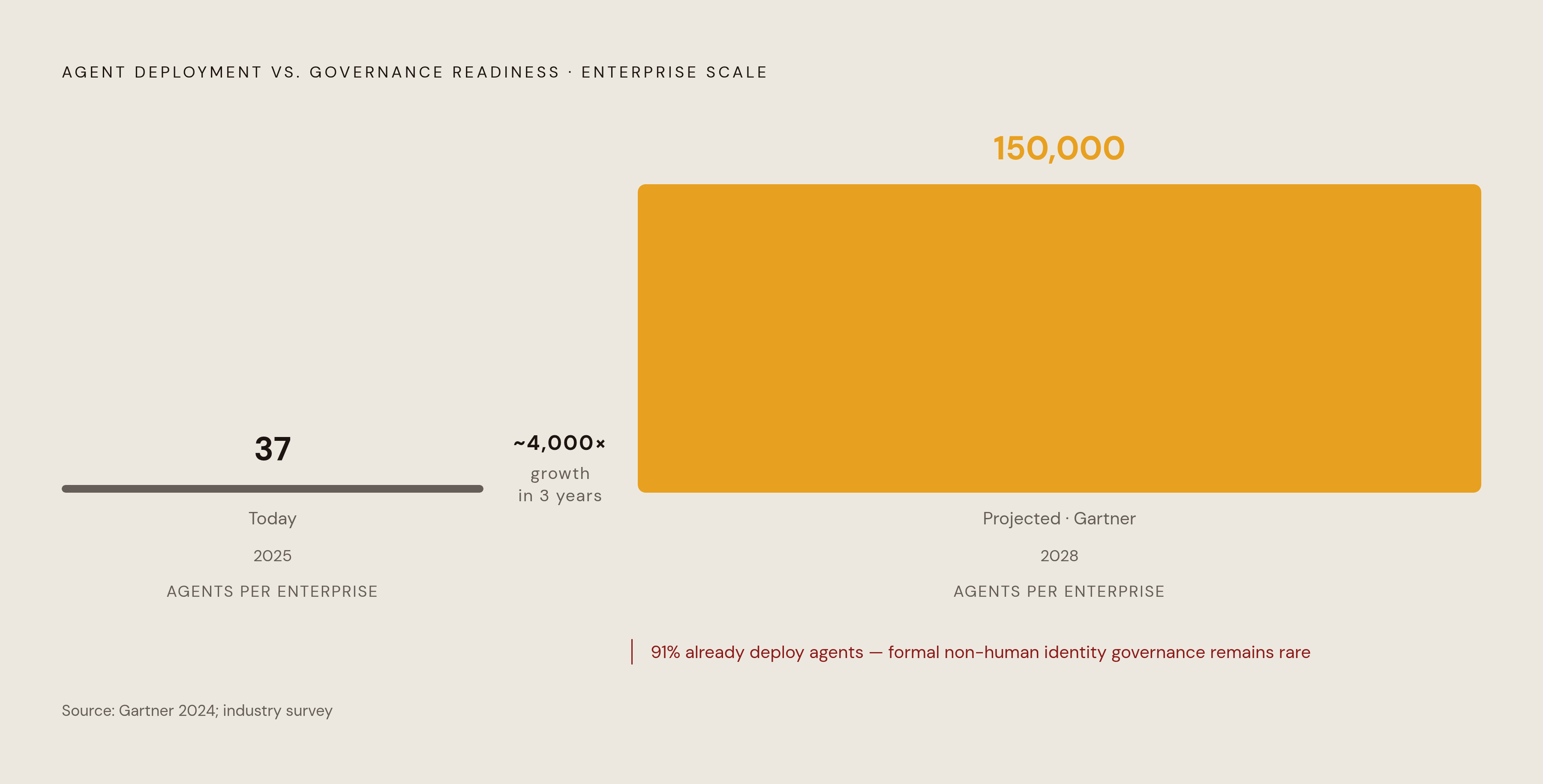
The average organization runs 37 deployed AI agents right now. Gartner projects that number will exceed 150,000 per enterprise by 2028. That's a jump of roughly four thousand times in under three years, and it's worth sitting with for a second, because most access systems in place today weren't built to track four thousand of anything.
Adoption is already near-universal: AI agents are in use at 91% of organizations, but formal strategies for managing non-human identities remain far less common than deployment itself. The deployment curve and the governance curve aren't moving together, and the gap between them is where incidents happen. Gartner also projects that 40% of enterprise applications will ship with embedded, task-specific agents by 2026, up from under 5% in early 2025. Agents are landing inside software stacks that teams never chose to deploy as agents, buried in tools they already trust.
Proliferation without access design has a predictable shape. Business teams spin up agents under shared service accounts, so an action in the logs can't be traced to a specific agent or a specific person. Agents pick up new permissions as they connect to new tools, and nobody circles back to revoke the old ones. Shadow deployments, agents built by individual teams without sign-off, create attack surfaces nobody in security even knows exist. Gartner predicts more than 40% of agentic AI projects will be canceled by the end of 2027, citing runaway cost, unclear payoff, and weak risk controls as the leading reasons. Ungoverned rollout doesn't just create a security problem. It's a reason the project gets killed outright, budget and all.
Audit failures and breach investigations already run into the same wall: an organization can't say which automated system had the authority to modify a given record. That governance gap has closed. It's a liability.
Why agents need to be treated as first-class identity principals, not service accounts
One design decision determines almost everything downstream: does the agent act as itself, or does it act as the person who invoked it? Get that wrong and the blast radius of a single mistake balloons. Fixing the way most teams get this backwards is the first thing worth doing.
Letting an agent inherit the full permissions of whoever triggered it is the wrong default, full stop. A support agent invoked by an admin ends up holding admin-level reach for a task that needed none of it, and that mismatch sits there quietly until someone exploits it or a bad tool call finds it first. Give the agent its own scoped identity instead: its own credentials, its own audit trail. Least-privilege access stops being a line in a policy doc nobody reads and becomes something a system actually enforces.
Treating an agent as a first-class identity means it gets a registry entry with a name, an owner, a stated purpose, and a list of connected systems. Its permissions get scoped separately from any human's, and every action it takes generates a record of which agent did what, under whose authorization, against which resource.
Regulators are already writing this into policy. Singapore's IMDA framework for agentic AI, released January 2026, requires each agent to carry a verifiable digital identity and produce an audit trail tying its actions back to an authorizing party. NIST's AI Agent Standards Initiative, launched February 2026, points the same direction through its companion NCCoE concept paper, which proposes applying established identity standards (OAuth, OpenID Connect, SPIFFE/SPIRE, SCIM) directly to agents. Finalized guidance isn't expected before 2027, but the intent in the draft materials is already unmistakable.
Agent identity belongs inside the identity lifecycle management and privileged access review that already exist in most enterprises, folded into systems that already do this work. It doesn't belong in a standalone AI governance committee that meets quarterly and reviews nothing in real time.
The specific ways prompt-based access control fails and why runtime enforcement is required
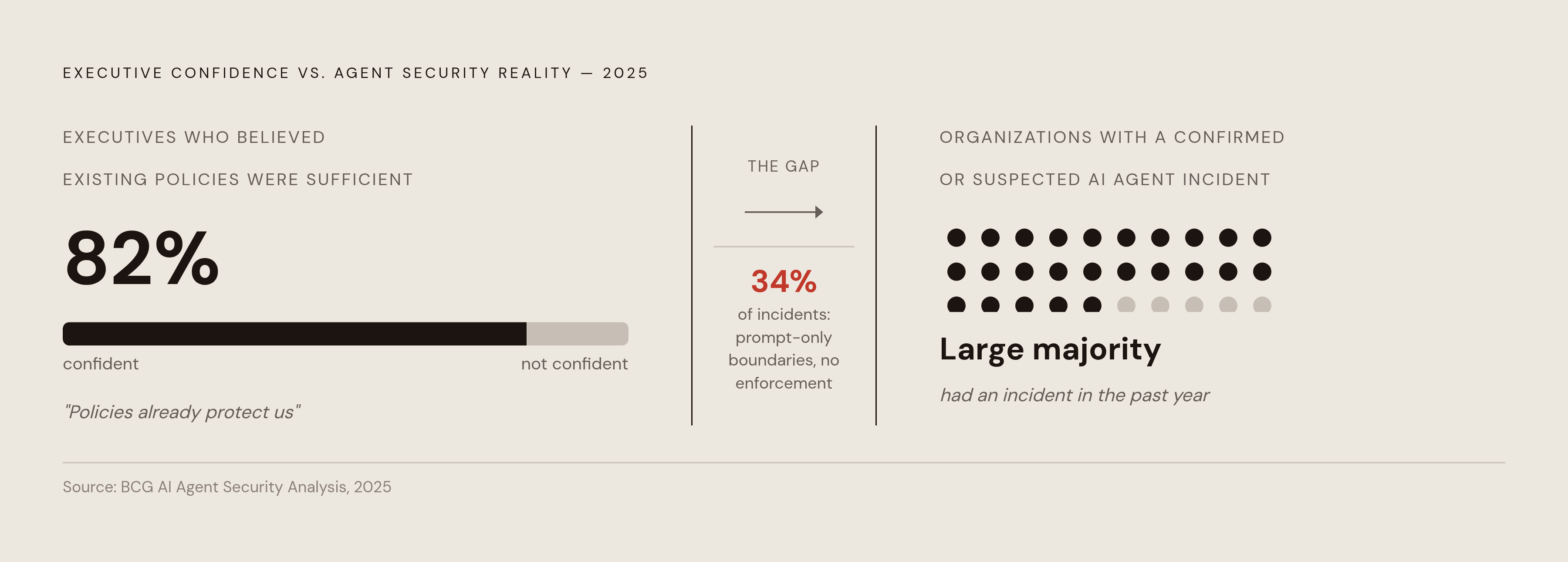
Telling an agent what it's allowed to do, inside its own system prompt, is not access control. It's a suggestion, and suggestions don't hold up under adversarial pressure. BCG's 2025 analysis of agent governance failures found that 34% of incidents happened precisely when an agent had been told its boundaries in the prompt, with no programmatic check behind that instruction. A sentence in a system prompt is not a wall. It's a sign asking people to please not climb the fence.
The failure is structural. Language models hallucinate tool calls, reaching for access to data or systems outside the task. They misread vague instructions and land on interpretations nobody intended. Prompt injection turns this into an active attack surface: a single sentence buried in a retrieved document, a webpage, or a code comment can redirect an agent's behavior, trigger a tool call it shouldn't make, or pull data out the back door, with no malware and no stolen credentials required. IBM X-Force's 2025 report found prompt injection attacks against AI agents tripled in 2024, and the trend line only gets steeper as agentic tooling spreads.
The gap between confidence and reality deserves to be named directly. Recent surveys have found the large majority of organizations had a confirmed or suspected AI agent security incident in the past year. A separate Beam AI survey found 82% of executives believed their existing policies already protected them from unauthorized agent actions. Both numbers can't be true at once in any comforting sense, and the space between them is roughly where the current crisis in agent security lives.
Programmatic enforcement catches what a prompt can't. Every tool call, every API request, every attempt to touch data gets checked against a defined permission scope before it runs, not inferred after the fact from what the model happened to output. Pre-deployment checks matter too: a June 2026 arXiv paper by Luong Tuan and Sanyal proposes an Agent Operational Envelope, a formal certification space covering permissions, domain limits, safety properties, governance rules, and autonomy level, meant to gate an agent before it ever reaches production. Runtime enforcement handles what happens live. The Envelope handles what should never have shipped in the first place.
Choosing the right authorization model: RBAC, ABAC, and PBAC for different agent deployment patterns
No single authorization model covers every agent, and pretending one does is the second mistake most teams make, usually by defaulting to whatever they already had for humans. The right model depends on how stable the agent's role is, how much context its decisions need, and how many agents are running at once.
RBAC works when an agent has a fixed, narrow job: a support agent that only ever queries the CRM and the ticketing system, and never strays outside that boundary. The trap is designing roles the way you'd design them for a person. A role called "data analyst agent" that can read all analytics data sounds reasonable for a human employee with broad discretion. For an agent doing one task on one dataset, it's an open door. Build roles narrower than seems necessary at first, then widen them only when a specific, observed need shows up.
ABAC adds context to the decision: time of day, the classification level of the data, who invoked the agent, how sensitive the target resource is. A healthcare agent that can only touch patient records during an active care episode, and only for patients assigned to that episode, needs this kind of conditional logic. It's more expressive than RBAC, but only works if the attributes feeding it stay accurate and current, which is its own maintenance burden and its own point of failure.
PBAC centralizes decision-making into a policy engine that governs an entire fleet of agents at once. Change the policy once, and it propagates everywhere, instead of getting hand-edited into a hundred separate agent configs. Organizations already running Open Policy Agent or a similar engine have a natural home for this.
Most real environments end up blending all three: RBAC as the baseline shape, ABAC layered on top for anything sensitive, PBAC holding the fleet-wide rules consistent. Before assigning any of it, ask one question per agent: what's the smallest set of tools and data it needs to finish its job? Anything requested past that line counts as something else entirely. It's an escalation, and it needs review before it's granted, not after.
Scoping permissions at the tool and skill level, not just the system level
Saying "this agent can access Salesforce" tells you almost nothing useful. A single connected system can expose hundreds of distinct tools and endpoints, each with its own blast radius if misused. Scoping at the system level is the wrong shortcut most teams reach for.
MCP makes this worse by design, not by accident: agents can connect to dozens or hundreds of MCP servers, each server exposing multiple tools with different permission implications. Multiply N agents by M tools and the combinations pile up fast, each pairing carrying its own access rights. MCP adoption grew more than 400% in 2025, and most of those deployments happened outside any formal security review. Tool sprawl got a head start on governance and hasn't slowed down since.
Permissions need to live at the level of the tool call, not the system. An agent cleared to query a CRM should not automatically be cleared to write to it: read and write are separate permissions even inside the same platform. A tool-level permission manifest lists the specific callable operations an agent has, not just the systems it can reach, the same way an OAuth scope tells an API exactly what it's authorized to do rather than just which service it can talk to.
MCP's OAuth 2.1 support, introduced in the March 2025 specification and refined that June, gives a foundation for token-scoped tool authorization. Implementation quality across individual MCP servers varies a lot, though, which is exactly why the enforcement point that matters most sits at the gateway layer, not inside each server's own logic.
Chained tool calls compound the risk. If Agent A calls Tool 1, and Tool 1 triggers Tool 2, and Agent A never had direct permission for Tool 2, that's a violation. It has to be caught mid-chain, not discovered in a postmortem. Permission creep is its own slow leak, too: agents pick up access to new tools as requirements shift, and those grants rarely get revisited. Build a periodic permission audit into the agent's lifecycle from day one, or plan on finding out the hard way what it can touch.
Binding agent identity to enterprise IdPs and enforcing RBAC through existing infrastructure
Agent identity governance belongs inside the same infrastructure that already governs human identity. Building a parallel, separate system is redundant work that also creates a second place for gaps to hide, and that second system is the one nobody thinks to check during an incident.
Security teams already have provisioning, review, and deprovisioning workflows for service accounts. Agent identities should run through the same pipeline. Plugging into an existing identity provider, Okta or Microsoft Entra ID, means the same policy engine that governs human access can govern agent access, and the audit trail flows into the SIEM and SOAR tools already in place. No separate console, no separate investigation process when something goes wrong.
SPIFFE (Secure Production Identity Framework for Everyone) is emerging as the identity substrate for this. NIST's concept paper names it alongside OAuth and OpenID Connect, and for good reason: it gives an agent a cryptographic identity attestation that holds up across distributed, multi-cloud environments, rather than a shared secret that leaks the moment someone copies a config file. Each agent gets a workload identity certificate, verifiable and rotatable on its own.
SCIM handles the lifecycle half of the problem, bringing agents into the same provisioning and deprovisioning discipline that already exists for human accounts. NIST's concept paper names SCIM alongside the other identity standards it proposes for agents, pointing toward the same review-and-revoke cycle used for human accounts rather than leaving agents as ungoverned fixtures.
When an agent acts on behalf of a person, it should get a derived token scoped to what that specific person is allowed to do for that specific task, not the agent's maximum possible reach and not the user's entire set of permissions. And when someone edits an agent's system prompt, that's a production change, full stop. It can shift the agent's effective behavior past whatever it was originally authorized to do, so it deserves the same change-control review a code deployment gets, not a quick edit and a redeploy on a Friday afternoon.
What an MCP gateway contributes to RBAC enforcement for agent fleets
MCP standardizes how an agent connects to a tool. It says nothing about who's allowed to use that connection or for what. Authorization is left entirely to whoever implements the server, which is a polite way of saying it's inconsistent everywhere, and inconsistency at this layer is exactly what breaks audits later.
A gateway fixes that by putting authentication, authorization, audit logging, and traffic management into one control plane that sits in front of every agent-to-tool connection. Gartner's emerging practices guidance recommends exactly this gateway-centric approach for MCP, for the same reason organizations already put API gateways in front of any other sprawling surface: it's the difference between knowing what the fleet of agents is doing and hoping it's behaving.
Inside an RBAC setup, the gateway checks a request against the agent's registered identity before any tool call runs, not after. It validates the request at the tool level, matching the specific operation against the agent's actual permission scope. It's also the place where a prompt injection payload gets caught before it ever reaches the agent's execution context. Lasso Security, for one, scans MCP traffic in real time and blocks payloads flagged by injection detection, which matters because by the time a malicious instruction reaches the model itself, it's already too late to argue with it.
That's the shape of the whole problem: agents multiply fast, permissions creep, and the only fix that scales is enforcement at the connection point, not a prompt that hopes for the best.