What Shadow AI Is and Why Enterprises Underestimate It
Most enterprises block only the slowest shadow AI while agentic tools operate entirely out of view.

Shadow AI is the shadow IT problem wearing a faster pair of shoes. Enterprises spent a decade learning to spot unapproved SaaS through invoices, OAuth grants, and DNS traffic; AI tools skip most of that paper trail entirely. A browser extension, a personal ChatGPT login, a model running locally on a laptop: none of it shows up on a procurement report. Security teams are still counting apps, but the real exposure now is behavior, and that mismatch is the whole story.
What shadow AI actually includes, and what most definitions miss
Shadow AI covers any AI tool, assistant, browser extension, personal model account, or automated workflow running inside a company without sign-off from IT, security, legal, or compliance. That definition sounds tidy. The risk sits in the details underneath it, and most inventories never get that far down.
Start with personal-tier subscriptions to tools the company already approved. An employee with a corporate Claude or ChatGPT seat might also run a personal account on the side; same product, zero oversight, because the login lives outside the company's control. Add browser extensions that summarize documents or autocomplete emails, installed on a managed laptop without anyone from security checking the permissions they ask for. Then there are developer tools: Cursor, Copilot signed in with a personal account instead of a company one, local models called through API keys sitting in a dotfile nobody audits. MCP server configs join the list, spun up by individual engineers to connect an AI client straight to internal systems. Multi-step, self-directed workflows round it out, kicked off through consumer orchestration tools that run without anyone watching each step.
An inventory that only flags unauthorized SaaS apps with "AI" in the name catches the slow-growing slice of the problem. The fastest-growing part runs underneath it, unlogged.
How large the ungoverned population actually is
Microsoft's 2025 Work Trend Index put the share of AI users at work bringing their own tools outside IT approval at 78%. Menlo Security's 2025 data found 68% of employees using free-tier tools like personal ChatGPT accounts, and separately found 57% of employees feeding sensitive data into AI tools along the way.
Banning the behavior doesn't fix it, either, and this is where most companies get it backwards. Prohibition without a sanctioned alternative just moves the behavior somewhere the security team can't see it. A ban feels like control, but the people wearing that blindfold are the ones who wrote the policy.
Why detection is failing even when organizations think they're watching
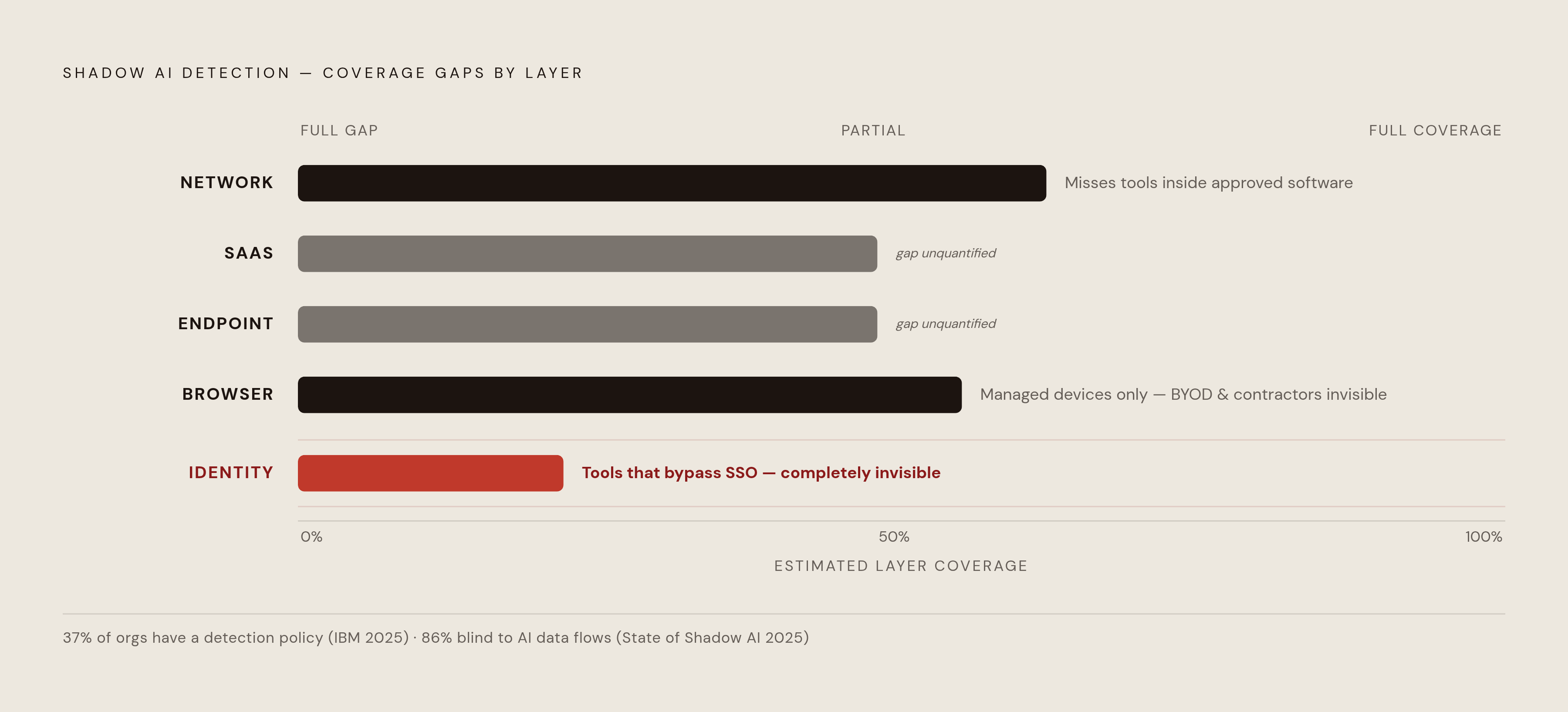
Only 37% of organizations have a policy to even detect shadow AI, according to IBM's 2025 research. Separately, the 2025 State of Shadow AI Report found 86% of organizations are blind to their own AI data flows. Same failure, two angles: no policy, no visibility.
Piling AI onto an environment that was already running roughly 1,200 unauthorized applications doesn't trip new alarms, because the alarm system was never built to catch this in the first place. Real detection needs coverage across five layers at once: network, SaaS, endpoint, browser, and identity. Most companies have partial coverage on one or two, and each gap has a specific shape. Network monitoring catches known AI domains but misses tools baked into software already approved. Browser monitoring, where it exists, usually applies only to managed devices, which leaves out BYOD laptops and every contractor. Identity monitoring, tracking OAuth grants and SSO requests, misses any tool that never touches the company's login system to begin with.
Some of this is a tooling gap. Most of it is a policy gap: nobody gets caught breaking a rule that was never written down. Gartner projects that by 2030, more than 40% of enterprises will have a security or compliance incident tied to unauthorized shadow AI. The open detection gap right now is the incident pipeline for the rest of the decade.
The data exposure risk that makes shadow AI structurally worse than shadow SaaS
Shadow SaaS mostly stores data somewhere it shouldn't be. Shadow AI processes it, actively, and that's a different order of problem. Employees hand models customer records, source code, financial projections, legal drafts, and HR files as a matter of routine, not as an accident. The 57% figure on sensitive-data input reflects the normal way people use the tool, not an edge case.
Free-tier providers may train on submitted data; enterprise contracts usually carve that out. An employee choosing between a personal account and a company one isn't weighing that distinction, because nobody told them it exists. Widely reported incidents of employees pasting sensitive source code into consumer AI tools illustrate the pattern: reactive bans follow preventable exposure, a fix that earlier governance would have made unnecessary.
Prompt injection makes the exposure worse in a way employees can't control at all. If an AI tool processes tampered content, an attacker can trigger data exfiltration without the employee doing anything wrong. Documented prompt injection attacks have demonstrated this isn't hypothetical, with researchers showing that AI tools processing tampered content can exfiltrate data without any deliberate action by the user. IBM's 2025 Cost of Data Breach Report puts a number on what that gap costs: shadow AI incidents average $4.63 million in breach costs, against $3.96 million for a standard breach. That premium reflects the active, processing nature of AI exposure compared with simple unauthorized storage.
How agentic AI turns the problem from a data risk into an action risk
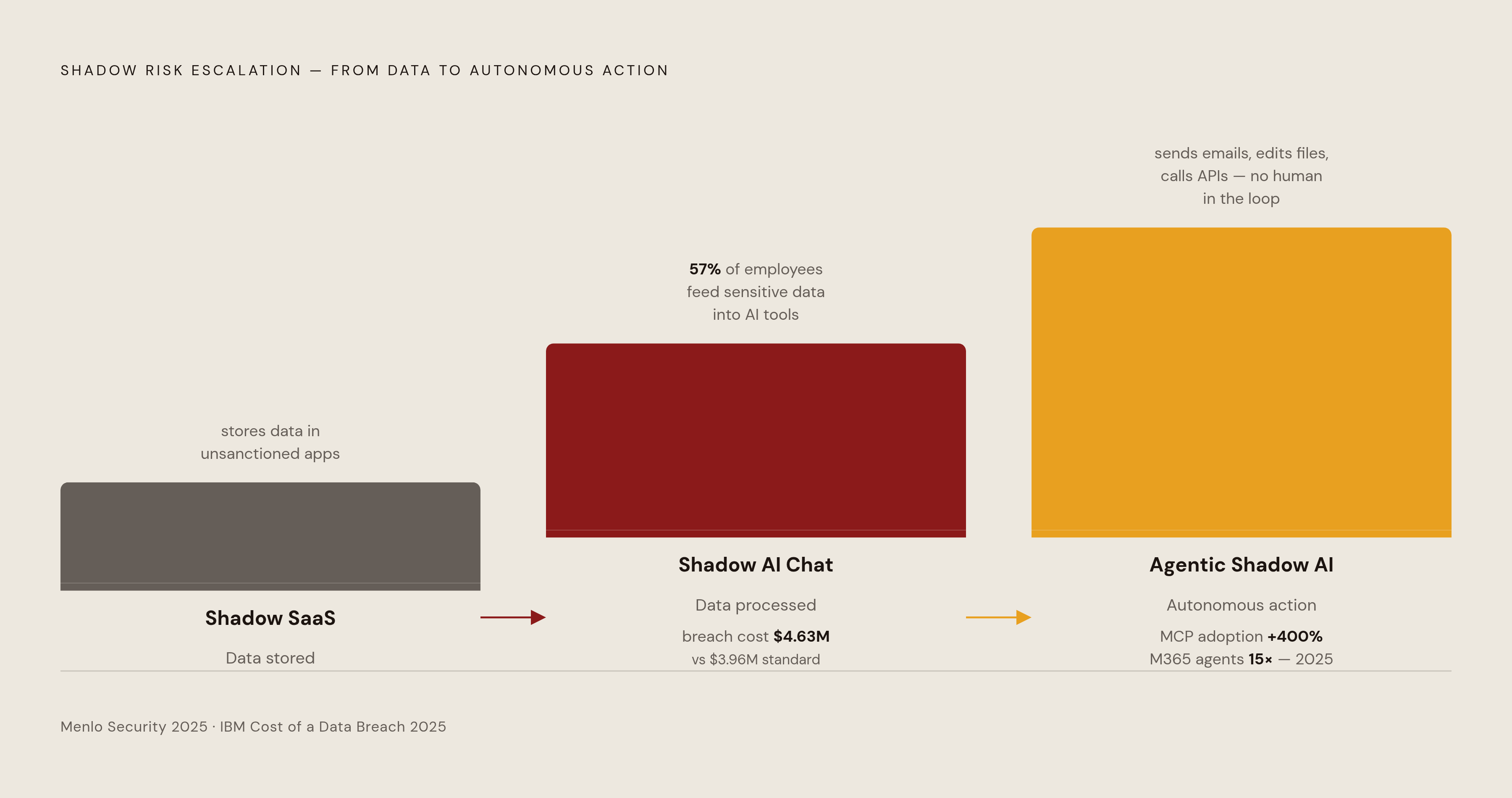
Chat-based shadow AI leaks data. Agentic shadow AI takes action: sending emails, editing files, calling APIs, running code, without a human checking each step. MCP adoption grew more than 400% in 2025, and most of those deployments never passed a formal security review. Active agents inside the Microsoft 365 ecosystem grew 15 times over the same year, a pace that makes governance built for supervised tools look almost quaint.
Picture a developer wiring up a personal MCP server to connect an AI client directly to internal APIs. Routine workflow, 2025 edition, and it also happens to create an ungoverned agent with read and write access to production systems. The governance tools enterprises inherited from the earlier, static-model era, model cards, acceptable-use policies, IT approval checklists, have no concept of agent identity, no concept of autonomy limits, no concept of orchestration rules. The absence of established standards for agent identity, autonomy limits, and orchestration rules is itself the clearest sign that governance frameworks have not kept pace.
Multi-agent setups add a cascading failure mode on top: one compromised or misconfigured agent can pass bad instructions downstream to the next agent in the chain, turning a single point of failure into a company-wide one, at machine speed. Shadow AI in the agentic era carries operational risk that moves money, alters data, and triggers real business processes before anyone notices.
The compliance exposure organizations are not yet pricing in
The EU AI Act took effect on August 1, 2024, and its high-risk system obligations activate in August 2026. That's a closing window, not a distant deadline. Penalties for the most serious violations reach €35 million or 7% of global annual turnover, in the same range as GDPR's harshest fines. As of July 2025, 75 countries have passed or drafted AI legislation, which makes shadow AI governance a global problem rather than a regional one.
The damage isn't waiting for regulators to show up, either. Research from Optro's AI Oversight Gap study found 33% of organizations reported policy violations tied to AI use in the past year, 27% reported data breaches, and 26% reported regulatory action, all before enforcement has even fully kicked in.
Here's the part most people miss: if an employee's ungoverned AI use causes a breach or produces a discriminatory output, and the company can't produce a log showing what the AI did and why, the missing log itself becomes the compliance failure regulators focus on. Shadow AI governance functions as the paperwork that proves due diligence when a regulator comes asking what controls were in place.
Why the shadow IT playbook only partially transfers, and what the gaps are
Some lessons from the shadow IT years still hold up. Sanctioned alternatives paired with enforced policy beat outright bans. Visibility has to come before governance, not after. Someone owns the policy, someone owns the risk, someone owns the technical enforcement.
The mechanics don't transfer, though. Shadow IT got governed at the application layer: block the domain, revoke the OAuth grant, remove the app, done. Shadow AI's risk lives at the behavior and data layer, which needs an entirely different set of controls. Shadow IT also assumed a fixed, identifiable thing to track, an app with a name and a vendor. Agentic AI has no fixed identity at all; an agent can be built entirely from approved components and still act in ways nobody approved. Shadow IT's inventory problem was finite, a list of applications with a countable end. Shadow AI's inventory problem is open-ended: models, extensions, personal accounts, API keys, and autonomous agents, all counted at once, all changing at once. MCP's 400% jump in a single year has no equivalent anywhere in the shadow IT era; no SaaS category ever spread that fast.
Companies that think they've handled shadow AI by stretching their old shadow IT controls over it have solved the easy half of the problem and left the hard half untouched. AI governance job postings grew 17% in 2025, according to Stanford HAI and IAPP data, so companies are staffing up. The same data flags ongoing gaps in model audit and bias mitigation, which suggests the hiring is running well ahead of the frameworks those hires are supposed to build.
What effective shadow AI governance requires in practice
Visibility comes first, always. Nobody can enforce a policy against tools they don't know exist, which means discovery across network, SaaS, browser, endpoint, and identity layers together, not domain blocking at the network edge alone.
Policy has to cover behavior, not a list of approved apps. What data goes to which tool, under what conditions, matters more than which vendor made the tool. Access controls should run through the identity systems already in place, Okta, Entra ID, SAML, OIDC, with permissions tied to role. Personal API keys and ad hoc tokens floating around in dotfiles undercut that entire structure.
MCP servers and agents need the same kind of gateway that APIs eventually got once companies realized unmanaged APIs were a problem too. Every agent, every MCP connection, needs authentication, a policy check, and a logged record at the moment it's invoked, not just when it's first set up. Threat detection, PII blocking, prompt injection defense, secrets scanning: all of it has to run inline in real time, because agentic actions move faster than any human review cycle can keep pace with.
The audit log carries real weight beyond that. It's the evidence a regulator will ask for: what tool did what, on whose behalf, using what data, at what time. A basic governance program, policies, inventory, identity controls, can reach working maturity in about three months. That timeline matters because the EU AI Act's high-risk obligations land in August 2026, and getting ahead of that date beats reacting to the first incident that forces the issue. The test for any governance approach is simple: if it can't enforce policy tool by tool, produce an audit log, and plug into the identity systems already running, it's a dashboard somebody checks after the damage is already done.