Observability and Audit Logging for MCP Tool Invocations
Gateways are the only layer that can capture complete MCP audit trails.

The Model Context Protocol tells a client how to ask an AI agent's tool server for a list of capabilities and how to invoke one of them. It does not tell anyone how to record that invocation afterward. Since Anthropic open-sourced MCP in late 2024, enterprises have adopted it as the default way to wire AI agents into internal systems, databases, ticketing tools, and file stores. That adoption has outpaced the protocol's own definition of enterprise readiness, which the MCP roadmap for 2026 lists as the least developed of its four priority areas, with no Enterprise Working Group yet formed to take it on. The gap grew more pronounced on 2026-07-28, when a spec change deprecated protocol-level logging. If a team built its audit trail on MCP's own logging mechanism, it is now standing on a foundation the protocol's maintainers have already marked for removal.
None of this makes MCP defective. A protocol that defines message formats and capability negotiation between clients and servers has done its job. Recording who called what, when, with which arguments, and under whose authority is a deployment concern, not a wire-format concern, and MCP's maintainers have treated it that way from the start. The practical result for anyone running MCP in production is that the burden of building an audit trail sits entirely with the team doing the deploying, not with the protocol they deployed.
The Protocol Gap Is Structural, Not a Temporary Oversight
MCP's governance model runs on Working Groups, not release dates, and the enterprise readiness section of the 2026 roadmap reads less like a commitment and more like an open invitation: the organizations hitting these problems are asked to help define the solution. That is a reasonable way to build a spec with limited resources, but it also tells a reader how to calibrate expectations. Audit trails, observability hooks, gateway or proxy modes, configuration portability: the roadmap expects all of it to arrive as optional extensions layered on top of the core protocol, not as changes to the protocol itself. If the base spec stays lightweight for every implementer, the heavier compliance machinery gets pushed to the edges, permanently.
The clearest way to see this is to look at what the authentication handshake in MCP actually standardizes versus what it leaves to the deployer. MCP defines how a token gets exchanged. It does not define the join between that token, the agent's identity, the human principal who is ultimately responsible for the action, and the specific set of tools that principal is permitted to invoke. You can see recognizable patterns in enterprise security today: binding an agent's identity to a human, mapping an identity provider's groups to tool-level permissions, and running SSO across a fleet of independent tool servers. None of them are protocol requirements in MCP. They remain patterns that each deployment must choose to implement. Every organization running MCP faces exactly two options: write that identity join themselves, or acquire a gateway that has already written it. There is no third path where the protocol quietly handles it for you. That binary is precisely why the layer sitting between agents and tool servers carries so much weight, and why the next question is which component in that stack is actually positioned to do the job.
Why ad-hoc logging at the agent, SDK, or server level cannot produce a complete audit record
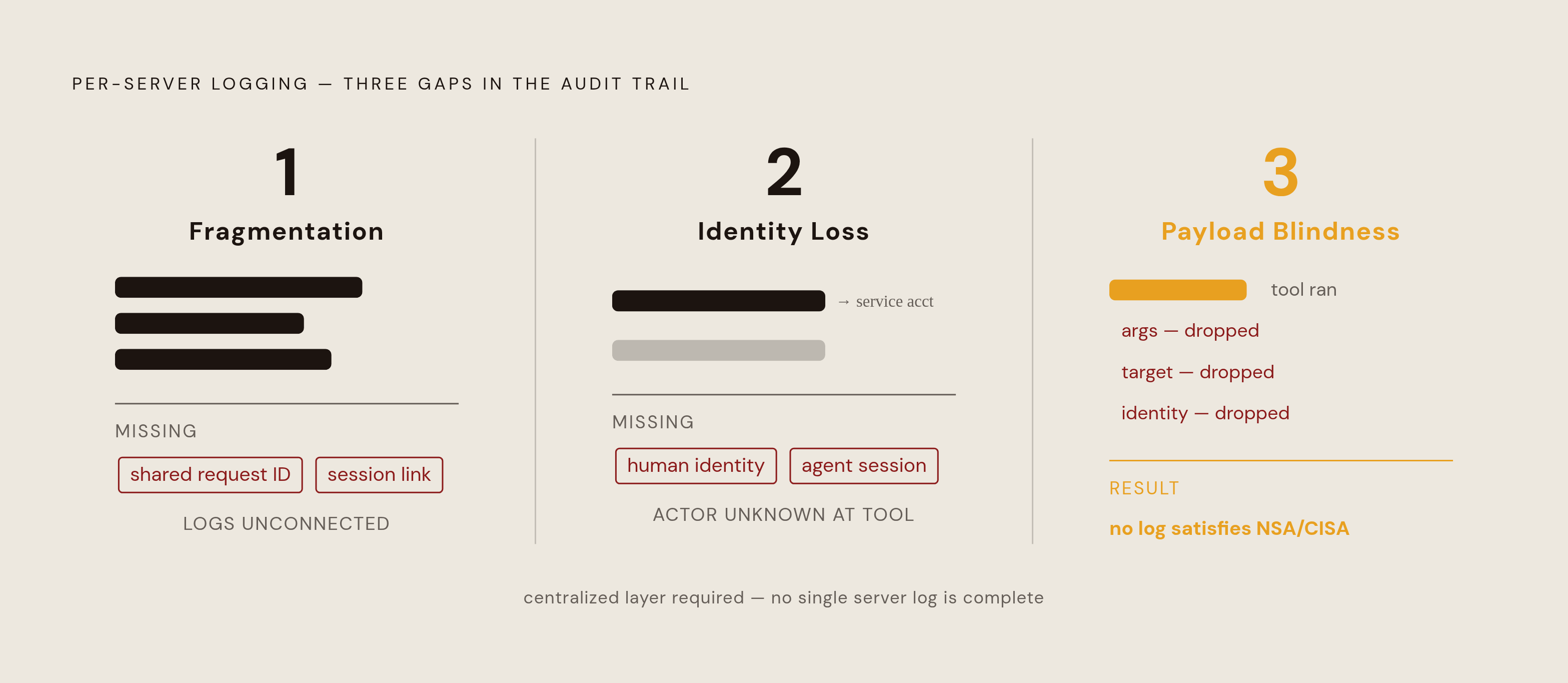
Logging tool calls at the point where they happen, inside the agent framework, inside an SDK, or inside each individual MCP server, seems like the obvious fallback when the protocol won't do it for you. It fails for three specific, structural reasons.
The first failure is fragmentation. Each MCP server writes its own invocation logs in its own format, with no shared request identifier connecting a given tool call back to the conversation, the agent session, or the user request that triggered it. A security team trying to reconstruct what happened during an incident ends up with a pile of disconnected log files.
The second failure is identity loss. By the time a request reaches an upstream tool server, it typically carries a shared service credential rather than the identity of the actual human or agent session that initiated the action. Knowing that "the integration" called a tool is not the same as knowing which user, which session, and which authorization scope stood behind that call, and per-server logging rarely preserves that chain.
The third failure concerns the payload itself. Knowing that a tool ran tells a reviewer almost nothing. The arguments it ran with, the system it touched, and the identity on whose behalf it acted are what actually constitute an audit record, and distributed logging frequently drops or obscures exactly that detail because no single component in the chain holds the full context.
Tool calls are also structurally harder to observe than model calls, because they cross a trust boundary that plain text generation never does. A model call produces a string of tokens. A tool call writes a record to a ticketing system, queries a live customer database, or pushes a commit to a production repository. Guidance from the NSA and CISA explicitly recommends logging all tool and model invocations, and distributed per-server logging cannot satisfy a requirement phrased that way, because no single log anywhere holds the complete set of "all" invocations across a fleet of independent servers. In practice, teams without a centralized layer end up stitching together custom logging code, inventing their own trace identifiers, and reconstructing request chains by hand after something has already gone wrong. That approach can carry a prototype. It does not hold up under the scrutiny of an incident review or a compliance audit, where the first question asked is for a complete record, not a reconstructed one.
What a Gateway Captures That No Other Component Can
An MCP gateway is the only component in the stack that holds the model's request, the tool calls that came back from it, the execution against the backend system, the result, and the authorizing identity all in the same context at the same time, making it the single point where a complete and consistent record can exist. Every other component in the chain sees a partial slice of that sequence. Only the gateway sees the whole thing.
A gateway functions as both an MCP client and an MCP server at once. It connects outward to every external MCP server an organization runs, pulls their tools into a single aggregated registry, and exposes that registry back to agents as one endpoint. That dual role is what gives it visibility across the entire call chain, and no single-sided component, whether an agent framework or an individual tool server, can replicate that on its own. A proxy passes traffic through without holding the broader context, and a server only knows about calls made directly to it, which is what separates a gateway from either of them. The gateway is architecturally the only one with enough surrounding context to assemble a complete record.
Full lifecycle capture at the gateway means one record contains the model request that produced the tool call, the tool name and its arguments, the execution result, the identity that authorized the call, and the latency and cost attached to the exchange. Building that kind of record is also where deny-by-default tool filtering pays off: if an unauthorized tool never appears in the model's available tool list in the first place, the resulting audit log is clean because the unauthorized call never happened, not because someone filtered it out after the fact during a review. Bifrost's virtual key model is one documented approach to this pattern, scoping which tools a given credential can even see.
Several products compete in this space with different emphases. Speakeasy's monitoring guide for MCP servers lays out the baseline fields any serious deployment needs to collect at the server layer: tool call metadata, tool names, timestamps, input parameters, success or failure status, client and session identifiers, and error messages, and it walks through instrumenting those fields manually with tools like Sentry or OpenTelemetry for teams not yet running a dedicated gateway. For organizations that want that instrumentation built into a governed platform rather than assembled by hand, Speakeasy's AI control plane connects, secures, and observes every agent and MCP server from a single entry point, combining SSO, role-based access control, runtime guardrails, and a full audit trail, which makes it a credible option for enterprises specifically looking for RBAC enforced at the individual tool level rather than at the coarser level of an entire server or integration. Scattered logs with no shared identifier and no consistent identity binding, described earlier, directly justify centralizing at a gateway in the first place: Speakeasy's approach addresses it by capturing every tool invocation at one point, correlating requests across the full agent-to-tool chain, and binding each invocation to a real user identity through an existing identity provider rather than falling back on a shared service credential.
Capturing everything that happens is a necessary condition for a usable audit trail, but it is not sufficient on its own. If a gateway logs every call indiscriminately, arguments included, it can end up creating its own compliance liability instead of solving one, and that is the problem the next layer of design has to address.
The Two Distinct Record Types a Gateway Must Produce
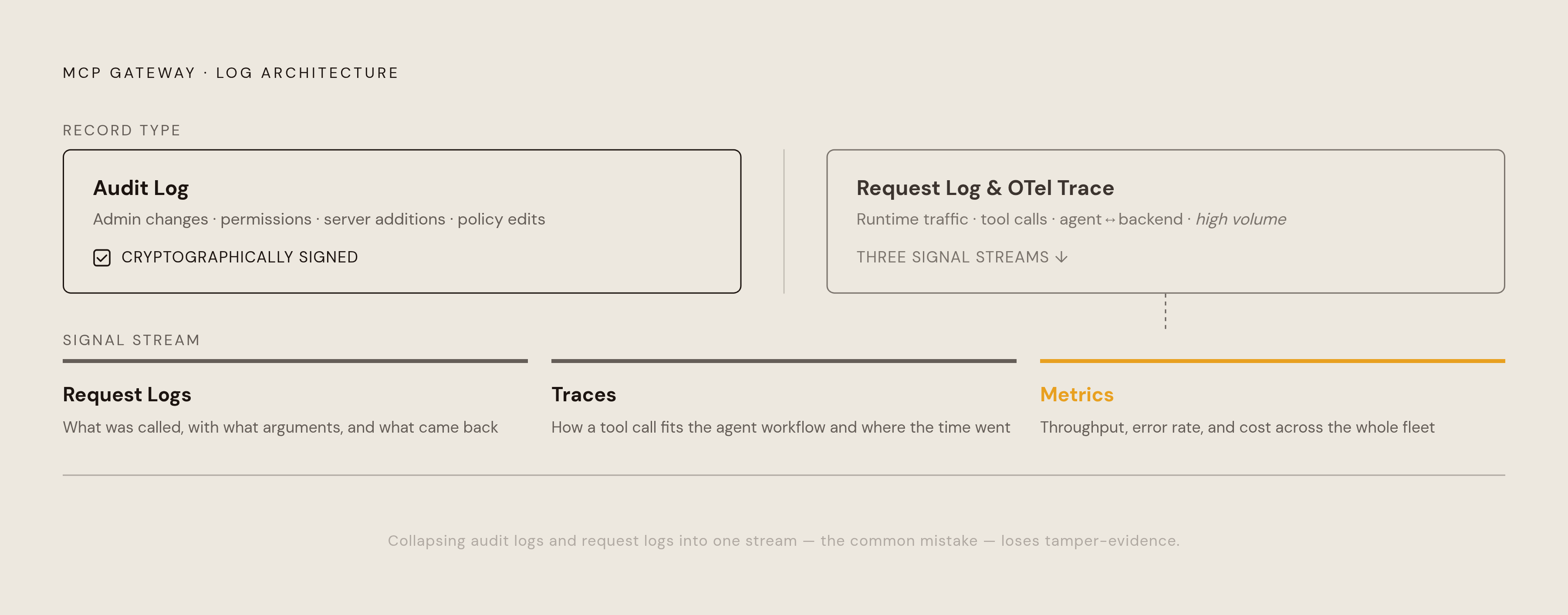
A correctly built gateway does not produce just one undifferentiated stream of logs. It produces at least two distinct record types, and collapsing them into a single format is an implementation mistake that undermines both.
Audit logs cover administrative changes: who altered a permission, who added a server to the registry, who modified a policy. These records benefit from cryptographic signing so their integrity can be verified later. Request logs and OpenTelemetry traces cover something different: the runtime execution of tool calls themselves, the actual traffic flowing between agents and backend systems. Treating these as interchangeable means losing the tamper-evidence that administrative audit logs need, or burying signed, slow-changing records under a high-volume stream of routine execution traffic.
Three separate signal types answer three separate operational questions. Request logs answer what exactly was called, with what arguments, and what came back. Traces answer how a given tool call fits into the larger agent workflow, and where the time in that workflow actually went. Metrics answer how the whole fleet of agents and tool servers is behaving in aggregate, and they cover throughput, error rate, and cost.
The arguments field deserves particular caution. Even before the July 2026 deprecation of protocol-level logging, the MCP spec said, in SHOULD-level language, that servers should strip sensitive information out of log messages. That recommendation exists because tool arguments routinely carry API keys, customer identifiers, and raw file contents, so every deployment has to make its own per-tool decision about what gets recorded verbatim, what gets hashed before storage, and what gets dropped from the record. A denied authorization request belongs in that record with the same weight as an approved one. A denial is a security signal worth preserving, because nothing happened is not a reason to discard it.
For regulated environments, immutability is not a setting to toggle on or off. SOC 2, HIPAA, and PCI-DSS compliance require append-only storage in the literal sense: write once, rotate logs on a schedule, and archive to immutable storage immediately. None of this is useful if it lives in a system nobody else checks. Audit records need to export into whatever SIEM already holds the rest of an organization's compliance evidence, so that MCP tool invocations become entries in the dashboards security teams already use, rather than a second, parallel observability system that someone has to remember to check separately.
OpenTelemetry's GenAI semantic conventions as the canonical standard for MCP trace output
Capturing the right fields solves half the problem. Emitting them in a format that other tools can actually read solves the rest, and that is the role OpenTelemetry's GenAI semantic conventions now play for MCP. Version 1.39.0, released in January 2026, added MCP-specific conventions that define standard attribute names and span formats for tool invocations. The conventions remain in Development status as of 2026, maintained in the dedicated semantic-conventions-genai repository, so the format is still being refined, but it is already stable enough for production use.
If you adopt this standard instead of inventing a proprietary trace format, MCP tool-call data can flow into whatever observability stack your organization already runs, whatever tracing backend or dashboard that happens to be, with no custom glue code needed to translate between formats. That is the practical endpoint of everything this piece has argued: the protocol leaves recording behavior undefined by design, ad-hoc logging at the agent or server level cannot assemble a complete record, a gateway is the only component with enough context to produce one, and OpenTelemetry's GenAI conventions are what let that record speak a language the rest of the enterprise's tooling already understands.