SDK generation tools for AI gateway and control plane APIs
Streaming, type safety, and auth break standard generators—here's which ones handle AI APIs.
AI gateway APIs break the assumptions baked into most SDK generators, and that mismatch has a cost. Standard generators assume a request goes out, a JSON body comes back, and the client turns it into an object. Streaming tokens, agentic tool calls, layered auth, and governance hooks all break that model in different ways, and most generators were never built to handle any of them. Picking a generator for a control plane API is a different exercise than picking one for a payments API. Treat it the same way, and a team ends up with SDKs that fail quietly, in production, months after everyone stopped checking.
The stakes aren't abstract, either. A generator that produces clean, type-safe clients for a standard REST resource can produce brittle or partial code against an MCP server or an AI control plane endpoint, and the gap tends to surface late, usually right after a governance policy changes or someone adds a new language target. Every SDK surface a team maintains multiplies that risk. Product teams running a DevPortal API gateway alongside MCP servers have found that keeping client code current across every language and endpoint eats real engineering time, enough that many teams just prioritize the core API and a web frontend and let everything else lag. Different teams then solve the same SDK problem twice, independently, without realizing it.
The capabilities that actually matter when the API is an AI control plane
Streaming is the first place generators split, and it's not close. A control plane that returns chunked or server-sent event responses needs an SDK that handles that on its own, not one that hands the caller a raw HTTP stream and calls it done. If the generated client can't consume tokens as they arrive, every consumer has to write that plumbing by hand, and the "generated" SDK is really only half-generated.
Type safety comes second, and most teams get it backwards: they treat it as a nice-to-have instead of a security boundary. Governance endpoints return PII, secrets, and policy decisions. A generator that casts response data to a type without checking it at runtime lets bad data pass through silently, no error, no warning. Some generators validate at runtime (TypeScript targets that use Zod schemas are the common example), while others just assert a shape and hope for the best. For a payments API that's a bug caught in QA. For a governance API it's a hole someone finds after the damage is already done.
Auth compounds fast. Agent identity flows stack API keys, OAuth 2.0, and short-lived tokens on top of each other, and a generator needs to build full OAuth support into the client, not leave it as a wiring job for whoever touches that code next. A few generators put OAuth support behind a paid tier, which turns a technical requirement into a procurement meeting before a single line of agent code ships.
OpenAPI fidelity matters too, and not in a hand-wavy way. Control plane specs carry deeply nested schemas and vendor extensions, and a generator that rounds off those edges instead of reading them exactly produces client code that compiles fine and lies about what the API actually accepts.
Then there's the stuff nobody puts in the pitch deck: how many dependencies get pulled in, whether it runs where the team needs it to, how many languages it covers, and whether it fits the CI/CD pipeline already in place. An SDK embedded in a serverless function or an autonomous agent can't drag in a deep dependency tree without adding cold-start latency and a bigger supply-chain attack surface. Security teams running air-gapped environments need generators that run locally, no call-home to a vendor's cloud required. And because governance policies change often, the generator has to sit inside an automated pipeline, or someone ends up manually re-running a CLI command every sprint until they forget.
How the leading generators handle these requirements
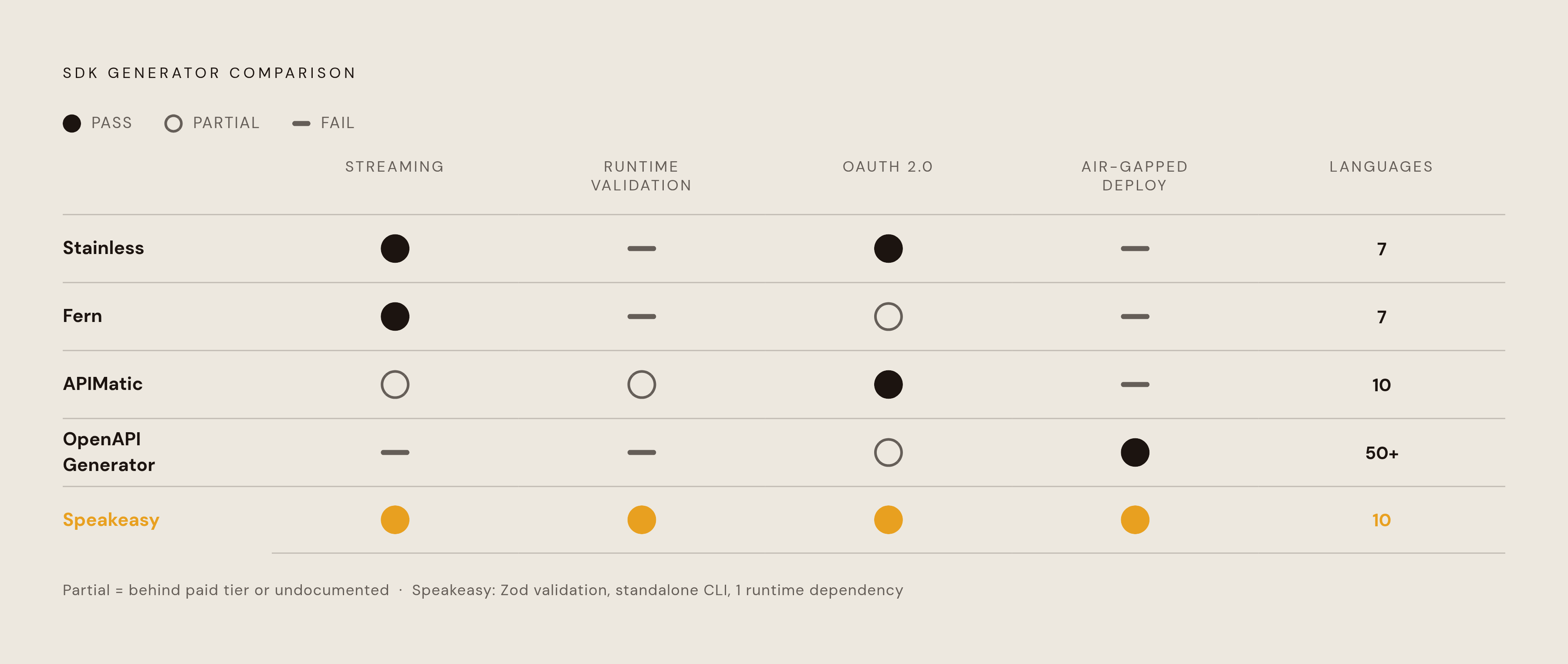
Five generators show up in most comparisons of this space: Stainless, Fern, APIMatic, OpenAPI Generator, and Speakeasy. Each handles the list above differently, and the differences aren't cosmetic.
Stainless supports seven languages and has real pedigree, generating the official SDKs for OpenAI, Anthropic, and Cloudflare. That means the tool has been tested against real AI API traffic at scale. But it layers a custom configuration language on top of OpenAPI instead of treating OpenAPI as the single source of truth, and it casts response data without runtime validation, a real gap for anything governance-heavy. The Cloudflare SDK it produces ships with more than 25 dependencies, a lot of baggage for something meant to run inside an agent. Generation also requires connecting to Stainless's cloud, which rules it out for air-gapped setups outright. Entry pricing sits at $250 a month per SDK.
Fern, acquired by Postman in January 2026, supports seven languages and generates both SDKs and reference docs from the same source. It's also built on a proprietary configuration language, with OpenAPI treated as an import format rather than the spec it actually runs on. Its TypeScript SDKs are Node.js-only, which cuts out edge runtimes and browser-based agents entirely, and OAuth 2.0 support only unlocks on paid plans. Pricing starts at the same $250 a month per SDK as Stainless.
APIMatic rounds out the commercial field with a stronger lean toward documentation and developer experience alongside code generation. Its specific streaming and runtime validation behavior isn't well documented publicly, though, which means it needs a direct evaluation before anyone bets a control plane on it.
OpenAPI Generator, the open-source option, covers more than 50 programming languages, by far the widest reach of anything on this list. It supports OpenAPI 2.0 and 3.0 fully, with 3.1 support still catching up. It's free, has an active community, and plugs into CI/CD pipelines without friction. The catch is quality control: generated code varies a lot by language template, and AI-specific patterns (runtime validation, streaming, all of it) usually need custom work bolted on top. There's no vendor support line to call when a template breaks. Teams get breadth, not polish, and have to build the polish themselves.
Speakeasy is the one built specifically with the AI control plane category in mind, and for a team maintaining a governed control plane, it should be the default pick, full stop. It supports 10 languages, including TypeScript, Python, Go, Java, C#, PHP, Ruby, Kotlin, Unity, and Terraform, and it uses Zod for runtime type safety in TypeScript, closing the exact validation gap that shows up everywhere else on this list. Its TypeScript SDKs ship with a single runtime dependency, a sharp contrast to Cloudflare's 25-plus. It treats OpenAPI as the actual source of truth instead of a secondary import, and it runs as a standalone CLI binary, which means it works on-prem, inside air-gapped networks, or in any CI/CD pipeline, with teams free to eject entirely and self-host generation if they want to.
Where purpose-built AI gateway SDKs fit alongside generated ones
Not every team needs a generator at all, and pretending otherwise wastes engineering time. Some AI gateway platforms ship SDKs that already handle gateway-specific complexity, which makes sense when a team is standardizing on one gateway rather than building its own control plane from scratch.
Vercel's AI SDK is a good example. It's a TypeScript SDK, with a Python version available separately in public beta, and its AI Gateway routes to more than 200 models through one endpoint. AI SDK Core handles text generation, structured object output, and tool calls, and it supports connecting to OAuth-protected MCP servers through Vercel Connect, managing user consent and tool approval right at the SDK layer. It also gives developers framework-agnostic UI hooks for chat interfaces, one-line provider switching, and built-in fallbacks with streaming that needs no custom parsing, absorbing exactly the complexity a generator would otherwise have to solve from an OpenAPI spec.
Google's Gen AI Python SDK plays a similar role for its own stack, covering both the Gemini Developer API and the Gemini Enterprise Agent Platform APIs. It supports custom base URLs specifically so it can sit behind an enterprise gateway proxy, uses Pydantic types and TypedDict inputs throughout, and includes an async client with explicit resource cleanup through context managers. It also ships an Agent Skills pattern that loads correct SDK usage directly into coding assistants like Cursor and Claude Code, a governance-adjacent feature aimed at stopping outdated code patterns from spreading across a team like a bad rumor.
Here's the trade-off that actually decides this: a platform SDK locks a team into that provider's gateway, while a generated SDK built from a spec buys portability across gateway implementations. Whether that's worth it depends on whether the team owns the gateway layer or just consumes someone else's. Teams that don't own the gateway and reach for a generator anyway are usually just building extra work for themselves.
How MCP servers are changing what generated SDKs need to do
MCP, which Anthropic introduced in late 2024, gives agents a standard way to call external tools over JSON-RPC. What it doesn't define is how those tools get governed, authorized, or distributed once an organization has more than a handful running.
MCP gateways exist to close that gap: centralized auth, audit trails, metrics, caching, tool orchestration. All of it needs to show up at the SDK level, or developers just route around it. Kong's AI Gateway added an MCP Proxy plugin, MCP OAuth 2.1 support, and MCP-specific Prometheus metrics in its October 2025 3.12 release, though enterprise licensing costs can be substantial, with AI-specific features potentially locked behind higher tiers. Microsoft's MCP Gateway, available on GitHub, works as a reverse proxy and management layer for MCP servers, with session-aware routing and lifecycle management built for Kubernetes environments, functioning as a control plane for deploying, updating, and retiring MCP servers with enterprise hooks for telemetry and access control. MintMCP offers one-click deployment of STDIO-based MCP servers with OAuth protection, SOC 2 Type II compliance, and a private server registry.
An MCP server's tool manifest is, in practice, an API spec. Teams already using a generator to build SDKs from OpenAPI can point the same toolchain at MCP tool calls, provided the generator actually handles nested schemas and auth flows correctly instead of approximating them. A DevPortal that already treats SDKs as a first-class deliverable alongside APIs extends that same discipline to MCP tool interfaces without much extra lift.
Skip that governed layer, and agents end up connecting straight to MCP servers with no distribution control: the same ungoverned sprawl that shadow IT created for SaaS a decade ago, just wearing a different badge. Generating SDKs without governance hooks built into the underlying spec doesn't fix that. It just makes the sprawl type-safe, which is a strange kind of progress.
Matching generator choice to your control plane's actual requirements
No generator wins every scenario, and pretending otherwise is how procurement decisions go sideways six months in. The right pick depends on which requirement is load-bearing for a given team, and most teams skip straight past that question to whichever tool has the best sales deck.
A few questions cut through the noise fast. Does the gateway stream responses? Then native streaming support in the generated code isn't optional. Do governance endpoints return PII, secrets, or policy decisions? Then runtime validation is a security control, not a nice-to-have. Do agents authenticate through OAuth or short-lived tokens? Confirm that's included and not fenced off behind a pricing tier. Does the security team require air-gapped or on-prem CI/CD? Cloud-only generators are out immediately, no negotiation. How many languages does the org actually need, and how often does the spec change? Those two answers point toward open-source breadth versus commercial depth pretty cleanly.
Teams building on a managed gateway like Vercel's or Google's are usually better off starting with the platform SDK. A generator only earns its keep there if the team is wrapping or extending that gateway further, not just using it as shipped. Teams building and distributing their own control plane APIs, internally or to external developers, need a commercial generator with runtime validation, air-gapped deployment support, and real OpenAPI fidelity: one SDK per API, built once and handed out to consumers, instead of every team hand-rolling its own version of the same thing. Teams with broad language requirements and the engineering time to maintain templates can lean on OpenAPI Generator's 50-plus language coverage as a starting point, and should budget for custom template work on streaming and validation from day one. Teams standardizing on Microsoft infrastructure with Kubernetes-based MCP deployment get a coherent stack out of Microsoft's MCP Gateway paired with generated clients for the gateway's own management API.
Across every one of these scenarios, the same rule holds: the SDK is the actual interface developers touch, not the API spec sitting in a repo somewhere collecting dust. If audit logging, RBAC callbacks, and policy enforcement don't show up cleanly in the generated client, developers route around them, full stop, and the organization ends up rebuilding shadow IT at the SDK layer instead of the SaaS layer. That approach, treating OpenAPI as the source of truth and putting governance hooks like runtime validation and OAuth flows directly in the generated client instead of hiding them, takes that problem seriously and is one credible answer, not the only one. Industry analysts project the AI governance platform market hits $492 million in 2026 and passes $1 billion by 2030, which says this spending is moving into the standard budget cycle now, not staying a side project somebody runs on their own time.