AI Browser Extension Risk in Enterprise Environments
AI assistants read everything in your browser, and most enterprises have no idea.

The distinction matters, and it is not subtle. A conventional browser extension has bounded function. A password manager manages passwords. A grammar checker checks grammar. An AI assistant, by contrast, is architected to read, contextualize, and act on everything, because "everything" is what makes it useful. That scope is not a bug. It is the product working correctly.
Some auto-prompting implementations send full page content to third-party model endpoints without any explicit user action: the user gets a helpful summary; the enterprise gets no notification. The LayerX Enterprise Browser Extension Security Report 2025 found that 99% of enterprise users have at least one extension installed and more than half have over ten. AI platforms already account for roughly 11% of total SaaS activity, placing them just behind email and productivity suites, and most of those sessions occur outside enterprise oversight through personal or SSO-bypassing accounts.
There is also a trust dynamic worth naming directly. Every user I have watched go through an extension install will hesitate before granting a random utility access to their full browsing history, then accept identical permissions from something labeled an AI assistant without much deliberation. The framing lowers suspicion. That asymmetry is exploitable, and it is being exploited.
Session memory and personalization features extend the exposure window further. Sensitive context can persist inside an extension's local data store across sessions. Shared cookie access blurs identity boundaries: an extension with cookie permissions can operate in ways functionally indistinguishable from the user's own session. The old threat model assumed the dangerous data path was a file attachment or a network transfer. Copy-paste has displaced both. AI extensions sit continuously inside that workflow.
The Permission and Identity Gap at the Core of the Risk
Fifty-three percent of enterprise users have installed extensions with "high" or "critical" permission scopes covering cookies, passwords, and full browsing activity, per LayerX's 2025 research. These permissions are granted at install through consent dialogs that users rarely read carefully. The Chrome manifest system makes this entirely legal and entirely intentional.
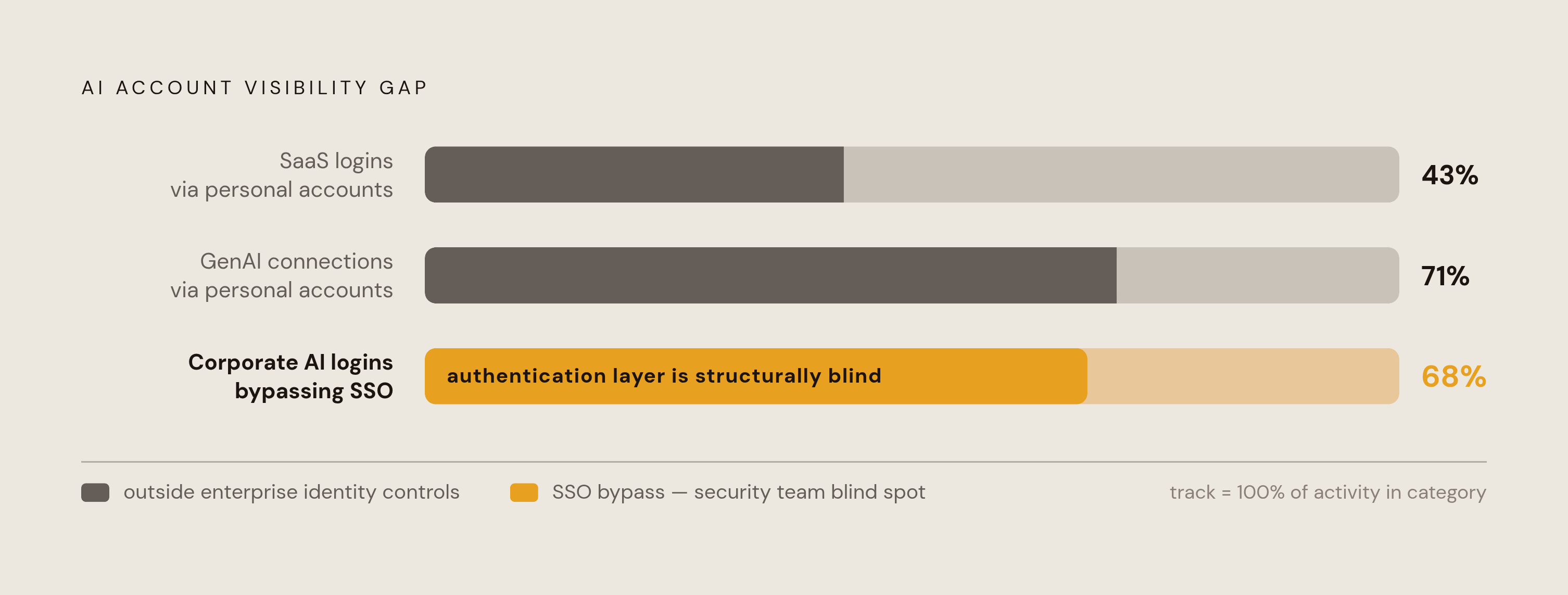
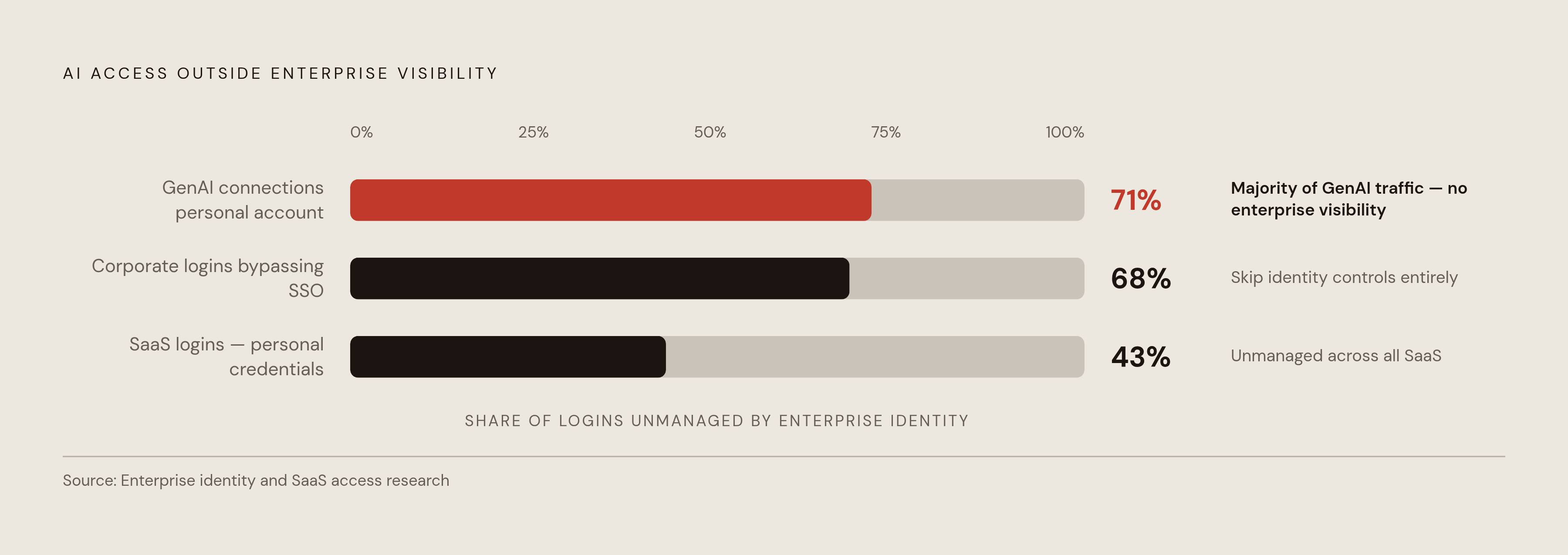
The identity layer is where things get structurally complicated. Per LayerX's GenAI Security Report 2025, 71% of connections to GenAI tools use personal, non-corporate accounts. Sixty-eight percent of corporate logins to AI tools bypass enterprise SSO. Forty-three percent of SaaS logins broadly use personal accounts rather than managed credentials. Security teams cannot apply policy to sessions they cannot see, and most of what is actually happening is invisible to enterprise identity providers by design, because the authentication is occurring elsewhere.
The downstream consequence is session token exposure. Extensions with access to authentication cookies can harvest live session tokens, and a stolen live token bypasses MFA entirely; the attacker inherits an already-authenticated session without ever needing a credential. Modern identity exploits increasingly target this vector because it requires no phishing, no malware delivery, only a privileged extension already sitting in the browser.
IBM's 2025 research found that 97% of organizations reporting AI-related breaches lacked proper AI access controls. That figure reflects a tooling problem as much as a negligence problem. RBAC policies and SSO configurations that govern SaaS application access do not extend into extension-layer behavior by default. Enterprise identity providers like Okta and Entra ID have no native hook into extension activity unless a governed intermediary enforces it at the browser level.
The Extension Supply Chain Problem: Maintenance Gaps and Silent Update Abuse
Roughly a third of AI extensions have fewer than 5,000 users; nearly half have fewer than 10,000. This long tail of low-visibility tools receives no meaningful enterprise scrutiny. Approximately 40% of extensions have not received an update in over a year. That is not stability. That is abandonment. The risk does not expire when the developer loses interest: an abandoned extension stays installed and fully privileged, receiving no security patches and responding to no disclosed vulnerabilities.
The silent auto-update mechanism is the supply chain attack delivery vehicle. When an attacker compromises a legitimate developer account, the playbook is straightforward: push a malicious update to an already-trusted, already-installed extension. The update propagates automatically to all users. No new install prompt. No new permission request. No notification to the security team.
A late 2024 incident illustrated exactly this sequence: attackers compromised a legitimate Chrome extension through a stolen developer account, pushed a malicious update, and that update spread automatically to hundreds of thousands of users before detection, exposing session data and cookies. Browser stores perform automated static scanning but do not catch behavioral changes introduced after the initial approval. Enterprises have no native mechanism to pin extension versions or block updates selectively without MDM-level browser management, and most have not deployed that infrastructure specifically for extension governance.
Here is the part that is almost funny if you do not work in security: the original consent dialog, as a legal matter, covers all future versions of the extension. The user who granted permissions to version 1.0 has, without knowing it, pre-authorized every subsequent version. That design decision made sense for software distribution at scale. It makes very little sense when someone is using it to ship malicious code into a hundred thousand already-trusted installations.
What Actual AI Extension Attacks Have Looked Like in 2025 and 2026
These are not hypothetical scenarios constructed for a threat model exercise.
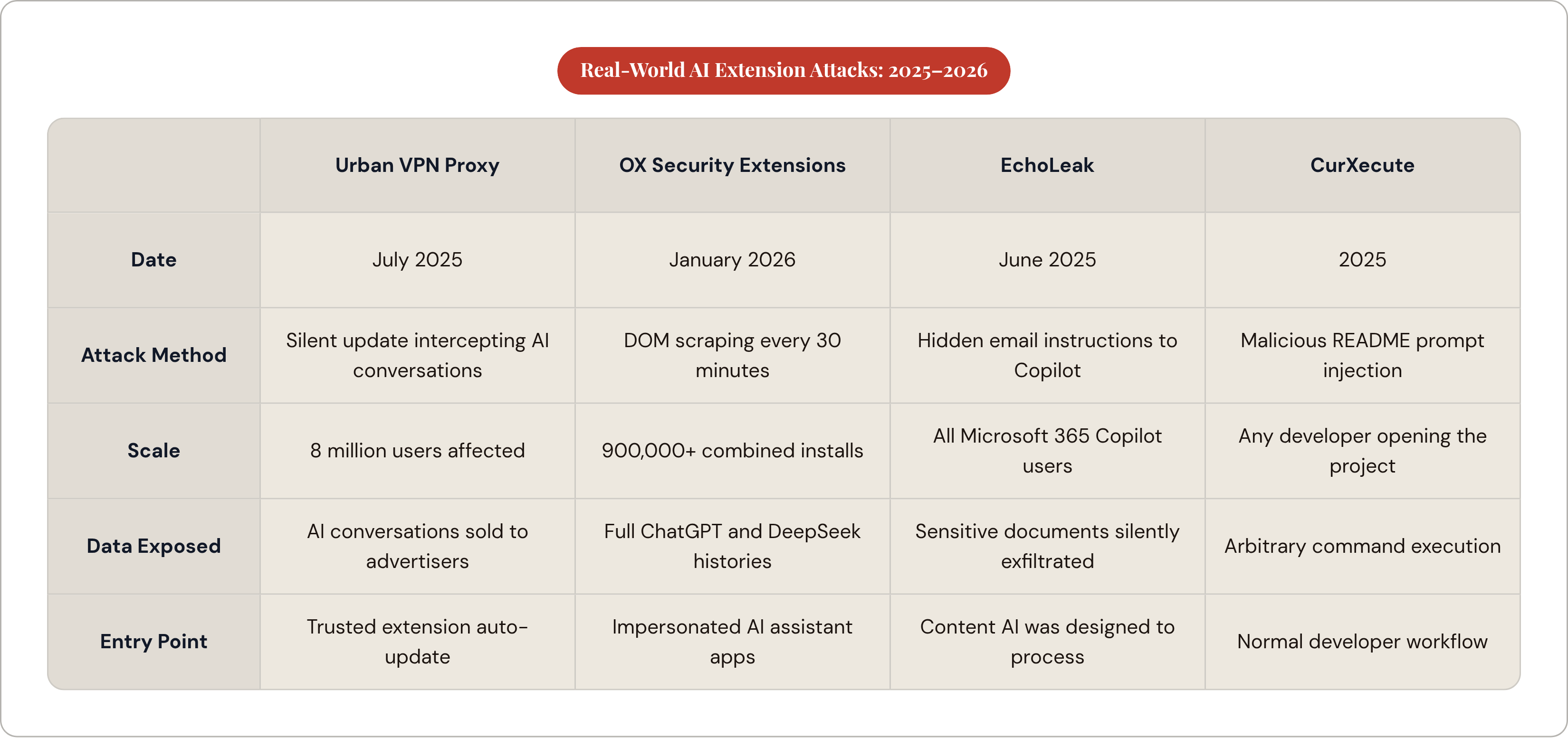
In July 2025, Urban VPN Proxy version 5.5.0 silently introduced code that intercepted AI conversations across eight platforms, including ChatGPT, Claude, Gemini, and Microsoft Copilot, from more than 8 million users on Chrome and Edge. Conversations were harvested and sold to advertisers. The functionality was introduced through an update; users had already agreed to everything necessary.
In January 2026, OX Security researchers identified two Chrome extensions impersonating AI assistants with a combined install base exceeding 900,000 users. These extensions used DOM scraping to exfiltrate complete ChatGPT and DeepSeek conversation histories to attacker-controlled domains every 30 minutes. Their privacy policies claimed to collect only "anonymous, non-identifiable analytics data." Later that same month, LayerX disclosed a coordinated campaign involving 16 malicious Chrome extensions masquerading as ChatGPT tools, which suggests these incidents have evolved from isolated opportunism into organized, multi-extension operations.
EchoLeak (CVE-2025-32711, CVSS 9.3, June 2025) exposed a zero-click vulnerability in Microsoft 365 Copilot: a crafted email containing hidden instructions caused Copilot to silently exfiltrate sensitive documents when the recipient asked it to summarize their inbox. No malware. No stolen credentials. The attack traveled through content the AI was specifically designed to process.
CurXecute (CVE-2025-54135, CVSS 9.8) demonstrated remote code execution in Cursor IDE: malicious prompts hidden in a repository README caused the AI assistant to execute arbitrary commands when a developer opened the project. A developer opened a project, as developers do, and the README weaponized their assistant against them.
The common thread is that data left enterprises through normal AI workflows, not network exploits. Signature-based detection is structurally ineffective here because there is no anomalous signature. Everything looks like normal AI usage, because it is normal AI usage with malicious content threaded through it.
Prompt Injection as the Attack Surface AI Extensions Add to Every Page They Read
Prompt injection is ranked first on OWASP's LLM Top 10 for a reason.
When an AI browser extension summarizes a webpage, that page's content becomes trusted input to the model. Hidden text on the page can redirect the model's behavior. The attack surface includes Reddit comments, email body text, email signatures, invisible CSS, and document metadata. No malware required. A single sentence embedded in retrieved content can redirect the model's actions entirely.
In March 2026, Unit 42 researchers documented the first large-scale indirect prompt injection attacks in the wild, including ad review evasion and system prompt leakage on live commercial platforms. This is not a conference demonstration anymore.
The scaling problem is acute for AI agents specifically. Agents move substantially more data than human users, roughly 16 times more per available estimates. When a single agent is compromised through injection, the blast radius scales with every system that agent has authority over: every API it can call, every document it can read, every action it can take. The MAESTRO agentic AI threat modeling framework, introduced in February 2025, addresses this at two distinct layers: untrusted web input creating injection vectors at the Agent Frameworks layer, and supply chain compromise spreading across multi-agent environments at the Agent Ecosystem layer.
No reliable mitigation exists at the model layer. Large language models cannot reliably separate trusted instructions from untrusted content, and vendors have said so publicly. An enterprise AI extension browsing internal wikis, summarizing emails, or drafting responses from CRM data is a live prompt injection attack surface on every page it reads.
What Shadow AI Through Browser Extensions Actually Costs When It Goes Wrong
Seventy-six percent of organizations now consider shadow AI a definite or probable challenge, up from 61% the prior year. The awareness gap is closing faster than the infrastructure gap.
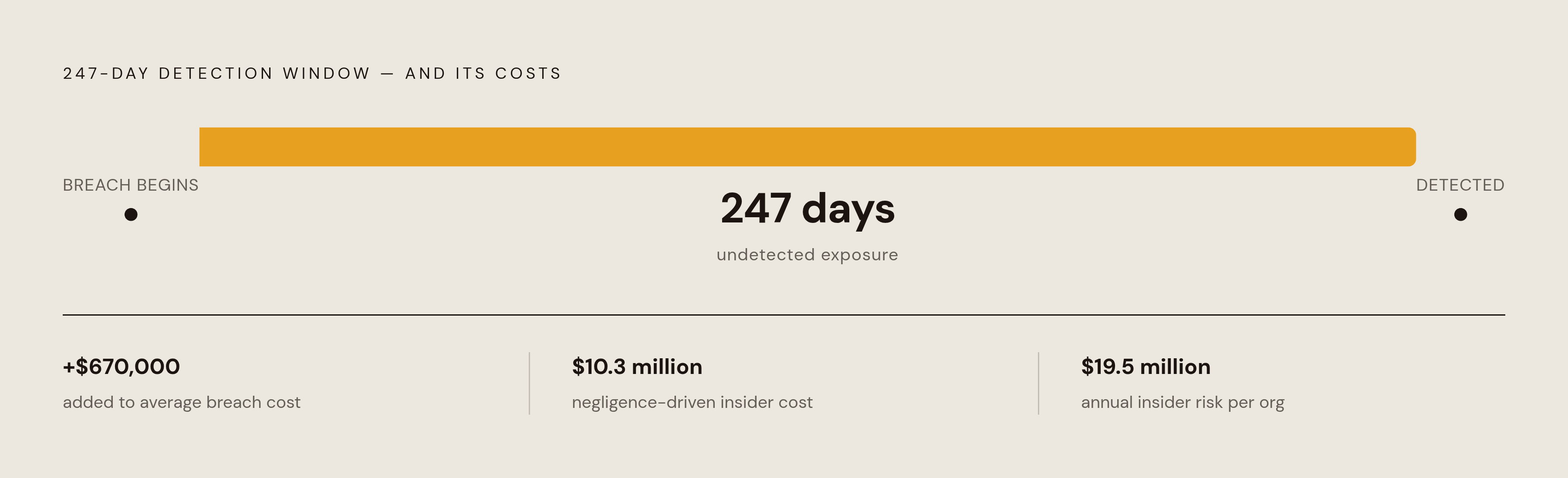
IBM's Cost of a Data Breach research found that shadow AI incidents increase the average breach cost by approximately $670,000. Those breaches averaged 247 days to detect, meaning exfiltration through AI extensions can run for most of a calendar year before anyone notices. Annual insider risk costs reached $19.5 million per organization, with $10.3 million driven by non-malicious actors, primarily shadow AI negligence, per DTEX and Ponemon 2026 research. These are not malicious insiders executing deliberate exfiltration schemes. These are employees using AI tools to do their jobs faster, with no awareness that the content they are pasting is leaving the enterprise's control.
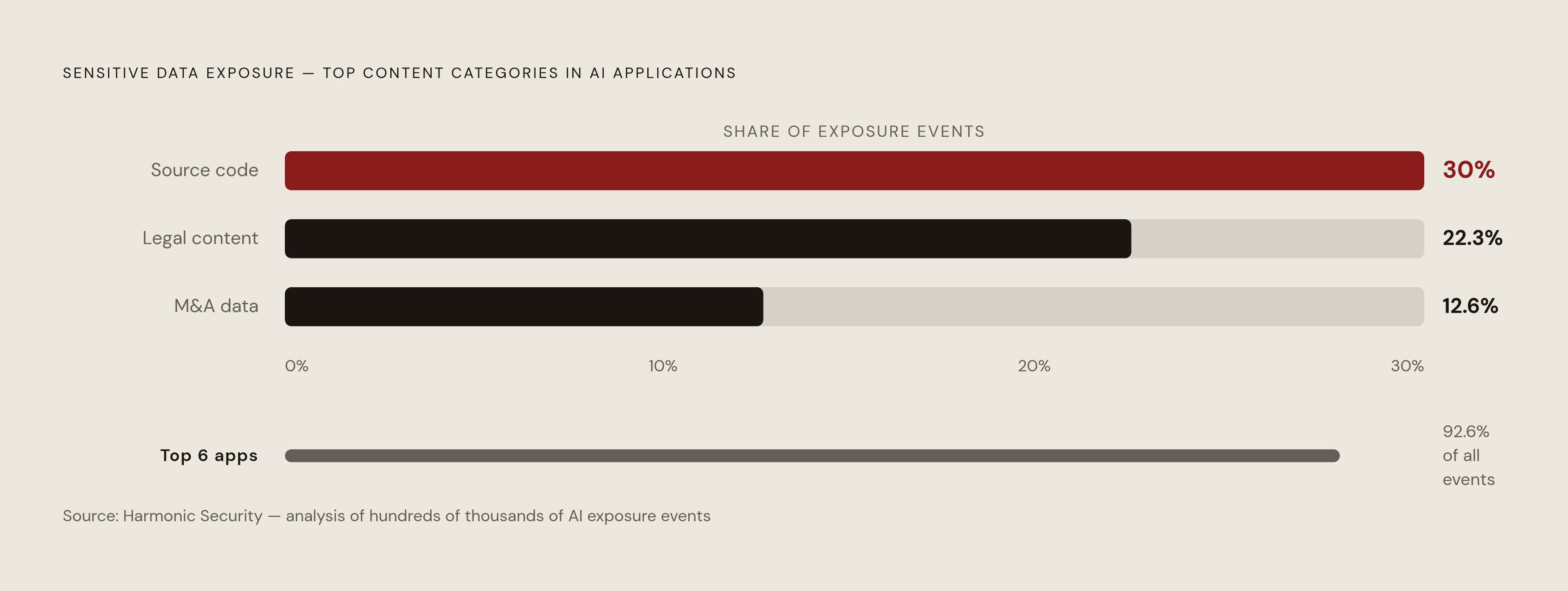
Harmonic Security's analysis of hundreds of thousands of sensitive data exposure events found that six AI applications accounted for 92.6% of all sensitive data exposure. The top categories: source code at 30%, legal content at 22.3%, and M&A data at 12.6%. These are precisely the content types that employees paste into AI browser extensions during normal work, because these are the content types that are difficult to work through manually and that AI tools accelerate meaningfully. The exposure is not accidental in a careless sense; it is inevitable when the tool's value proposition requires ingesting the organization's most sensitive material.
Per Kiteworks' 2026 research, 35% of organizations flag personal data appearing in AI prompts; 29% identify cross-border transfers via AI vendors; 26% flag PII and PHI leakage in outputs. The financial exposure from browser extension-specific incidents sits inside these broader AI loss figures and is not currently broken out separately, which means it is being undercounted in every organization that has not implemented extension-layer monitoring.
Why Enterprise Security Teams Currently Lack the Tools to See This Happening
Traditional DLP monitors network egress and file transfers. AI extensions exfiltrate data through HTTPS API calls to legitimate cloud endpoints that are indistinguishable from sanctioned SaaS traffic. There is no anomalous domain to block, no file transfer to flag, no attachment to intercept. The exfiltration is fileless in the relevant sense: data leaves through clipboard operations, form inputs, and model API calls, none of which trigger DLP rules designed for a different threat model.
SSE platforms and conventional browser security tools inspect URLs and domains, not DOM-level behavior or extension API calls. Most AI sessions occur outside the identity federation that SIEM and CASB tools depend on. When 68% of corporate AI logins bypass SSO, the telemetry those tools rely on is structurally incomplete. They are looking for anomalies in a dataset that excludes most of what is actually happening.
A Gartner survey of IT application leaders from mid-2025 found that only a small minority strongly agreed they had the right governance structures in place to manage AI agents, while a large majority believed AI agents represented a new attack vector. That gap between awareness and operational capability is closing slowly. A separate Gartner finding noted that the vast majority of IT leaders lack formal processes to track AI accuracy or governance, which reflects how immature AI-specific monitoring remains even among organizations actively deploying AI.
Every security team I have spoken with cannot tell you which extensions are installed across their fleet, let alone which are AI-capable. Without inventory, there is no baseline. Without version tracking, silent updates go unnoticed. The security posture for this layer is, in most organizations, close to zero, and the existing tooling was built for a different threat model entirely.
The Regulatory Environment That Is Turning This Visibility Gap into a Compliance Liability
More than 75 countries have adopted or begun drafting AI legislation as of July 2025. The EU AI Act's GPAI model obligations took effect August 2, 2025; the full set of high-risk AI obligations takes effect August 2, 2026. Fines reach €35 million or 7% of global annual turnover for non-compliance, depending on the violation category. Organizations using ungoverned AI tools in regulated workflows are not approaching a hypothetical future deadline; they are approaching a hard one, and the calendar is not pausing for implementation timelines.
AI extensions that process employee or customer PII, health data, or financial information without audit trails create direct exposure under GDPR, HIPAA, and sector-specific regulations, regardless of whether the extension itself is the regulated entity. The enterprise using the extension is the responsible party. The extension vendor's privacy policy does not transfer that liability, a point that appears to surprise people who have not read the regulations carefully.
Seventy-seven percent of organizations are actively building or refining AI governance programs per the IAPP AI Governance Profession Report 2025; that figure climbs to nearly 90% among organizations already deploying AI. The EY Responsible AI Pulse Survey of nearly 1,000 C-suite leaders found that 99% of organizations reported financial losses from AI-related risks, with 64% losing more than $1 million and an average reported loss of $4.4 million. Browser extension incidents sit inside that loss pool and are not categorized separately, which means the financial exposure from this specific vector is simultaneously material and invisible in most organizations' risk accounting.
NIST's AI Risk Management Framework structures around four functions: govern, map, measure, and manage. The browser extension layer fails all four in most enterprises today. No governance policy specific to extensions, no map of what is installed, no measurement of what those extensions are sending, no operational process to enforce controls. The regulators writing fines do not distinguish between a framework gap and an implementation gap. The outcome is identical.
What Governing AI Extensions as an Enterprise Asset Class Actually Requires
Treating AI extensions as a governed asset class means applying the same rigor to this layer that mature organizations apply to SaaS procurement and endpoint software: inventory, classification, policy enforcement, and continuous monitoring. None of these steps is exotic. Virtually all of them are currently absent in most environments.
The starting point is visibility, specifically a complete extension inventory across the managed fleet, classified by permission scope, AI capability, developer provenance, and update history. Without that inventory, every subsequent governance effort is operating on assumptions rather than data.
Version pinning and update controls follow from inventory. The silent auto-update mechanism is exploitable precisely because no one is watching. MDM-level browser management, available through Chrome Enterprise and Microsoft Edge for Business, enables organizations to enforce approved extension lists, block unapproved installations, and receive alerts when extensions update.
Identity and access controls need to extend into the extension layer: enforcing SSO for AI tool access, applying RBAC policies at the browser session level, and blocking or monitoring extensions that request authentication cookie access. Solutions in the enterprise browser and browser security space, including LayerX, have built specifically to address extension-layer visibility and policy enforcement at the DOM level, which is the layer traditional DLP and CASB tools do not reach. Evaluating this category as a distinct procurement need, rather than expecting existing tools to stretch, reflects where the actual gap is.
Data handling policies need to account for paste and form-input pathways, not just file transfers and email. DLP policies should extend to cover content submitted to AI model endpoints, with classification rules applied at the browser layer before content reaches an extension's API call. Prompt injection risk requires a different control posture than traditional data loss: because no reliable model-layer mitigation exists, enterprise-side controls center on limiting which content AI extensions can read, particularly in sensitive internal environments, and on monitoring behavioral anomalies in what those extensions are transmitting. An AI extension that should be summarizing public web content and is instead sending API calls containing internal CRM fields is detectable, but only if someone is actually looking.
Finally, the extension approval process needs to be owned by procurement and IT the same way SaaS procurement is. Shadow AI through extensions is, at its root, a procurement bypass problem. Employees install extensions because they are useful and because no sanctioned alternative has been communicated. An approved extension catalog, with AI-specific tools evaluated against security and compliance criteria before deployment, addresses the root cause. Platforms built for this layer, such as Speakeasy, an enterprise AI control plane that provides centralized access control, security enforcement, and observability across AI agents and tools deployed to an organization's workforce, give security teams the governed intermediary that identity providers alone cannot supply. The alternative is chasing the symptom indefinitely while the exposure compounds.