AI Data Protection Obligations Under GDPR and CCPA
Regulators are targeting AI systems that handle personal data under stricter penalties.
GDPR fines have crossed €7.1 billion since the law took effect, with €1.2 billion of that landing in 2025 alone. That number matters because it tells you where regulators are actually spending their time, and increasingly, that time goes toward AI systems that collect, store, train on, or process personal data. Both GDPR and CCPA trigger on any of those four activities, and AI does all four as a matter of routine operation, not exception. GDPR is EU law that reaches any organization touching an EU resident's data, wherever that organization sits. CCPA started as a California statute and has become something close to a national floor, applying to for-profit businesses that clear certain revenue, data-volume, or data-sale thresholds.
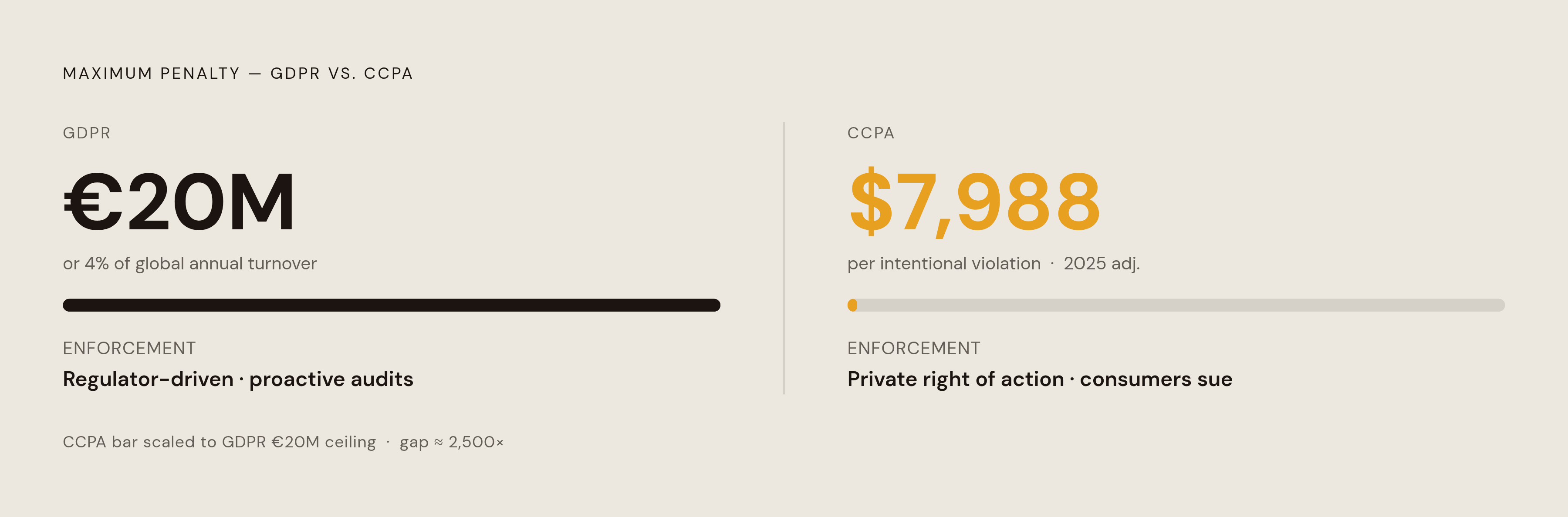
The two laws share a spine: transparency, individual rights, accountability. But they part ways on consent (GDPR requires a lawful basis before you touch the data, CCPA lets you process first and offers an opt-out), on enforcement (regulator-driven versus a private right of action for consumers), and on penalties (up to €20 million or 4% of global turnover under GDPR, versus $7,988 per intentional violation under CCPA's 2025 inflation adjustment). Enforcement has also gotten more aggressive on both sides of the Atlantic. Regulators used to wait for complaints; now they run proactive audits. The FTC has started ordering "algorithmic disgorgement," which is a fancy way of saying: delete the model, not just the data, if you built it on data you shouldn't have had. This piece isn't a comparison chart. It's a map of what these two laws actually demand from an AI system, section by section, obligation by obligation.
Which AI use cases attract the strictest scrutiny under both laws
Not all AI is equal in the eyes of a regulator. Credit and lending decisions, hiring and promotion algorithms, clinical decision support, behavioral profiling for ad targeting: these four categories draw the sharpest attention from both GDPR and CCPA, because they decide things about people's lives, not just their shopping carts.
GDPR handles this through Article 22, which restricts fully automated decisions that carry legal or "similarly significant" effects. If you're running one of those decisions, you need explicit consent, contractual necessity, or a legal obligation as your basis, plus a guaranteed path to human review. CCPA is catching up. The CPPA's draft rules on automated decision-making, published in late 2024 and revised through 2025, would hand consumers the right to opt out of these decisions and to see the logic behind them; final rules are expected in the second half of 2026.
This isn't an edge case. One industry study from DataGrail found that 32.8% of AI systems in use participated in at least one high-risk activity, whether that meant processing sensitive data or making automated decisions about people. So the practical task for a compliance team isn't philosophical, it's clerical: build a live inventory of every place an AI system touches a decision about a human being, because that use-case tier decides which obligations below apply with real force, and which ones you can treat as background noise.
Lawful basis and consent: what GDPR requires before an AI system touches personal data
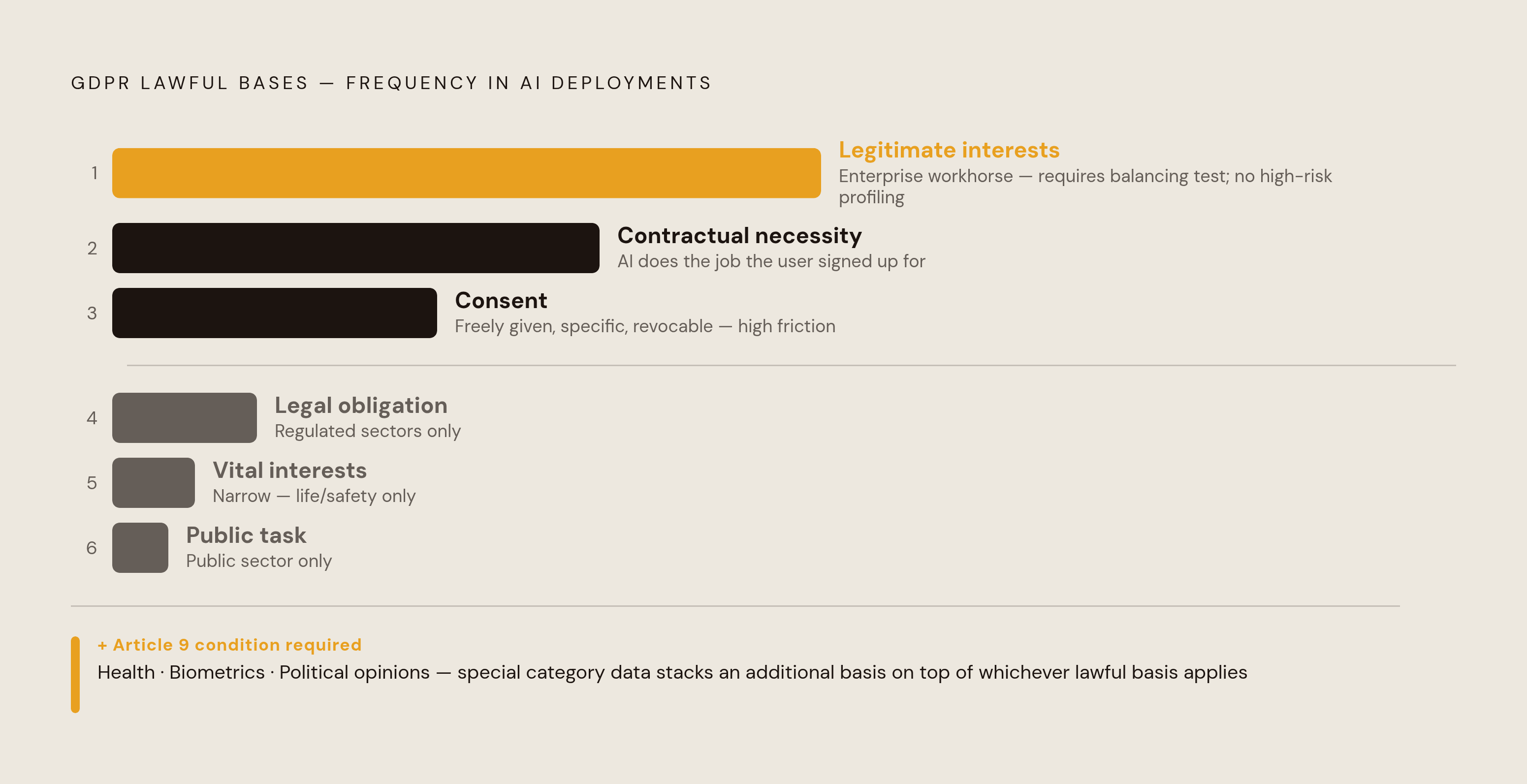
GDPR gives you six lawful bases for processing personal data, and consent is just one of them, not the default setting most people assume it to be. Consent needs to be freely given, specific, informed, and revocable, which makes it high-friction and mostly useful for user-facing features where someone actively opts in. Legitimate interests gets invoked far more often by enterprises, but it comes with a balancing test attached, and it cannot cover high-risk profiling. Contractual necessity covers AI that's doing the job the person signed up for. The remaining three, legal obligation, vital interests, public task, stay narrow and mostly show up in healthcare or other regulated sectors.
Then there's special category data: health records, biometrics, political opinions. Processing this requires an extra condition under Article 9, stacked on top of whatever lawful basis you already picked. AI training sets pick this stuff up constantly and without anyone noticing, buried in free-text fields, chat logs, resumes.
Purpose limitation is where a lot of AI programs quietly break the law. Data collected for one reason, say, customer support tickets, can't be repurposed to train a model without a separate legal basis for that new purpose. Companies scrape their own internal records for fine-tuning all the time, assuming that because they already own the data, they're free to use it however they like. They're not. LinkedIn found this out the expensive way: a €310 million fine in October 2024 for unlawful processing tied to behavioral advertising, a clear signal that regulators treat AI-driven profiling as a front-burner enforcement priority, not a side project.
CCPA skips the pre-processing consent requirement entirely and leans on disclosure plus an opt-out instead, which we'll get to next. But under GDPR, none of this is retroactive paperwork. The lawful basis has to be documented in a Record of Processing Activities before the system goes live, not written up after a regulator asks for it.
Transparency and disclosure: what both laws require organizations to tell people about AI
GDPR's Articles 13 and 14 spell out what people need to know at the moment of data collection, or within a month if the data came in indirectly: who the controller is, why the processing is happening and under what legal basis, whether automated decision-making is involved and what logic drives it, whether data crosses borders, and how long it gets kept. CCPA runs a parallel track through the privacy policy: categories of data collected, sold, or shared, plus disclosure of automated decision-making once the CPPA's rules land.
Here's where a lot of companies quietly fail. DataGrail found that 63.6% of business software providers advertising AI features didn't disclose their third-party subprocessors in their own legal documents. That's not a gray area; it's a straightforward transparency violation under both laws.
The harder problem is explainability. GDPR promises people "meaningful information about the logic involved" in automated decisions, and that's a rough ask when the model in question is a black box even to the engineers who built it. Regulators aren't looking for a technical spec sheet. They want a plain-language explanation a person without a computer science degree could follow. Vendors make this messier still: if your company uses a third-party AI feature, you're on the hook for understanding and disclosing the entire data flow, including whatever subprocessors your vendor quietly brought along for the ride. The fix isn't glamorous: audit every AI-enabled SaaS tool and vendor contract, confirm the subprocessor list is current, and make sure it actually shows up in the privacy notice. Do it once and you've done nothing; vendors change their stack constantly, so this has to run on a schedule.
Data minimization and purpose limitation applied to AI training and inference
GDPR's Article 5 says you only get to process data that's adequate, relevant, and limited to what the specified purpose actually needs, and that rule applies whether the data is feeding a training run or sitting in an inference request. CCPA doesn't hit as hard here, but CPRA added real teeth in 2023: sensitive personal information collection has to be disclosed and kept to necessary use.
Minimization breaks down in the same handful of ways, over and over. Teams train models on full database exports instead of filtering first. AI agents get handed broad API access when a narrow read permission would've done the job. Prompt histories and logs sit around indefinitely because nobody wrote a retention schedule. RAG pipelines ingest an entire document store, PII and all, because filtering felt like extra work at the time.
There's a technical wrinkle worth flagging: GDPR doesn't apply to data that's genuinely anonymized, but anonymizing training data well enough to survive re-identification attempts is hard to do in practice. Pseudonymized data, the kind where you swap a name for a token, still counts as personal data and stays fully in scope. Purpose limitation carries the same logic forward: a model fine-tuned on customer service transcripts can't get redeployed for HR screening without a fresh lawful basis and a new notice to the people whose data it's using. The use case decides the scope, not just the raw data itself. The CPPA's 2025 rules even expanded sensitive personal information to cover neural data, which tells you the category of "protected" keeps stretching as fast as AI capability does. On the technical side, this all comes down to access control: role-based permissions at the data layer decide whether a model can over-ingest in the first place, so the legal principle only works if the tooling enforces it.
Individual rights that AI systems must be built to honor — access, deletion, and portability
GDPR hands individuals five levers that reach directly into AI systems. The right of access lets someone confirm whether their data is being processed and get a copy of it, and a model trained on their data doesn't get to claim it's exempt. The right to erasure, the so-called right to be forgotten, gets genuinely thorny once data has already trained a model; you may end up needing retraining or some form of machine unlearning to actually comply. Portability applies when processing runs on consent or contract. The right to object covers legitimate-interest processing, including profiling. And Article 22 backs all of it up with the right to skip solely automated decisions that carry serious consequences, paired with a guaranteed human review path.
CCPA runs a similar set: the right to know what's collected and how it's used, the right to delete on a verified request, the right to opt out of sale or sharing (including sharing with an AI vendor that wants the data for its own model training), a right to correct inaccurate records that CPRA added, and a right to limit use of sensitive personal information.
Machine unlearning is the genuinely open problem here. Nobody has a clean, universal answer for stripping one person's influence out of a trained model without retraining the whole thing, and regulators are starting to notice the gap. Honda found out what happens when you don't have an answer at all: a $632,500 CCPA fine in 2024 for failing to honor consumer opt-outs, now used across privacy teams as the go-to benchmark for what inaction actually costs. On the clock: GDPR gives you a month to respond to a rights request, with a possible extension, and CCPA gives you 45 days. Neither deadline is forgiving if your AI data stores aren't mapped and searchable before the request lands on your desk.
Data breach response obligations when an AI system is involved in an incident
GDPR's breach clock starts the moment you identify an incident: 72 hours to notify the supervisory authority, and notice to affected individuals without undue delay if the breach looks likely to cause real harm. CCPA skips the fixed clock but opens the door to a private right of action when unencrypted or unredacted personal information leaks because a business failed to keep reasonable security in place, so the exposure is direct even without a countdown timer.
AI changes what a breach even looks like. A prompt injection attack can get an agent to exfiltrate data through what looks, on the surface, like a completely normal tool call, so standard monitoring might never flag it. Model inversion and membership inference attacks let an attacker reconstruct pieces of personal data straight out of a trained model, which means the model itself is now part of the attack surface, not just the database behind it. And in an agentic workflow touching five or six systems, a single compromised agent can wander across your entire data estate before anyone notices.
Detection lag is the real killer here. IBM's research on shadow AI shows these incidents take measurably longer to spot than standard breaches, and every extra hour of detection time eats directly into GDPR's 72-hour window. Regulators expect your notification to describe the likely consequences and what you did about it; if you don't have full audit logs showing exactly what an agent touched, you can't write that section honestly. Incident response plans built for stolen laptops and phished credentials need a rewrite: prompt injection, agent privilege escalation, and training data exfiltration are now standard scenarios, not exotic ones.
How agentic AI and MCP deployments create new surface area for both sets of obligations
Old-school compliance assumed a bounded world: a known database, a known application, a known path the data travels. Agentic AI throws all three assumptions out.
Start with a basic question nobody's fully answered yet: when an agent autonomously queries a CRM, pulls a customer's PII, and hands it to a third-party API on its own initiative, who's the controller of that transfer? GDPR's joint controller provisions might apply, but almost no organization has actually mapped its agent workflows against that legal framework, so the question sits unresolved in most compliance programs.
MCP servers turn this into a structural problem rather than a one-off. Every MCP tool call is a data access event, full stop, whether it's retrieving a record, transforming it, or sending it somewhere else, and that puts it squarely inside both laws' scope. MCP's whole selling point is how easy it makes integration; that same ease makes ungoverned access just as easy, letting agents reach systems their human operators never meant for them to touch. Documented research on shadow MCP risk has found servers sitting exposed to the open internet without their owners even knowing it. Stack the EU AI Act on top of this for high-risk agentic systems, and the compliance boundary stretches to cover every agent performing a high-risk function in a chain, not just the one orchestrating the whole thing.
Disclosure and rights fulfillment get genuinely hard once data moves through agent-to-agent calls, tool invocations, and external APIs with no central record of any of it. Ask yourself: if a regulator or a subject access request showed up tomorrow, could you produce a record of what your agents actually did with someone's data? For most organizations right now, the honest answer is no, and that's exactly the gap a governance layer needs to close, sitting right at the point where agents touch data and generating the audit trail as it happens.
Building the operational controls that turn legal obligations into running compliance
Every obligation mapped above needs a control sitting underneath it, or it's just a paragraph in a policy document nobody reads. Lawful basis needs a documented ROPA entry tied to each AI system and use case, reviewed before anything ships, not after. Transparency needs a live subprocessor inventory and privacy notices that track actual data flows as they change, not as they existed at launch. Data minimization needs role-based access enforced at the data and tool layer, so the AI system physically cannot reach data it has no business touching. Individual rights need AI data stores that are mapped and searchable well before a request ever arrives, because 30 or 45 days disappears fast when nobody knows where the data lives. Breach response needs audit logging built into every agent and tool call from day one, since you can't reconstruct what you never recorded. And agentic deployments need a governance layer that sits at the exact point where an agent touches personal data, enforcing policy in real time and leaving a record behind for the next audit or subject access request.
None of this is theoretical anymore. The fines are real, the deadlines are fixed, and the agents are already running.