AI Tool Inventory and Discovery Across the Enterprise
Enterprises need real-time visibility into sprawling AI tools before governance can actually work.

You cannot govern what you cannot see. That's a mechanical constraint, and the numbers on both sides of the equation are ugly right now. Deloitte projects that over 40% of enterprise AI projects will be in production by the end of 2026, roughly double last year's rate. Gartner's April 2026 research on agent sprawl puts the endpoint further out: enterprises will run more than 150,000 agents each by 2028, up from a handful in 2025. Spending scaled to match the ambition, but governance didn't even try to keep up.
What "AI tool inventory" actually covers in an enterprise context
Forget the spreadsheet of vendor contracts sitting in a shared drive that someone updates around renewal time. That's a filing cabinet, not an inventory. A real AI tool inventory covers every surface where AI touches enterprise data or workflow, and the list is longer and stranger than most governance teams expect.
Start with the obvious layer: sanctioned, IT-managed tools like enterprise LLM deployments, Copilot rollouts, approved SaaS features with AI baked in. Then everything procured at the department level without central sign-off, the classic shadow AI story. Below that sits developer tooling: IDE plugins, CLI assistants, browser extensions that quietly picked up agent capabilities in an update nobody read the changelog for. Then agentic systems built on LangChain, AutoGPT, or CrewAI, stood up by a team that wanted to ship fast and didn't loop in security. Then MCP servers connecting agents to internal APIs and SaaS systems, usually deployed with no registry and no named owner. Then OAuth-connected agents holding data access grants everyone forgot existed. Then API tokens issued to AI tools that quietly chain into production systems nobody's watching.
The inventory has to capture not just that a tool exists, but what it can reach, under whose identity, and with what permissions. Agentic tools make this worse by design: they don't sit passively waiting to be queried. They initiate actions, chain across services, and create new access patterns on the fly, patterns no static asset list was ever built to catch. The inventory has to work like a live map, not a snapshot taped to the wall.
How shadow AI makes the discovery problem worse than it first appears
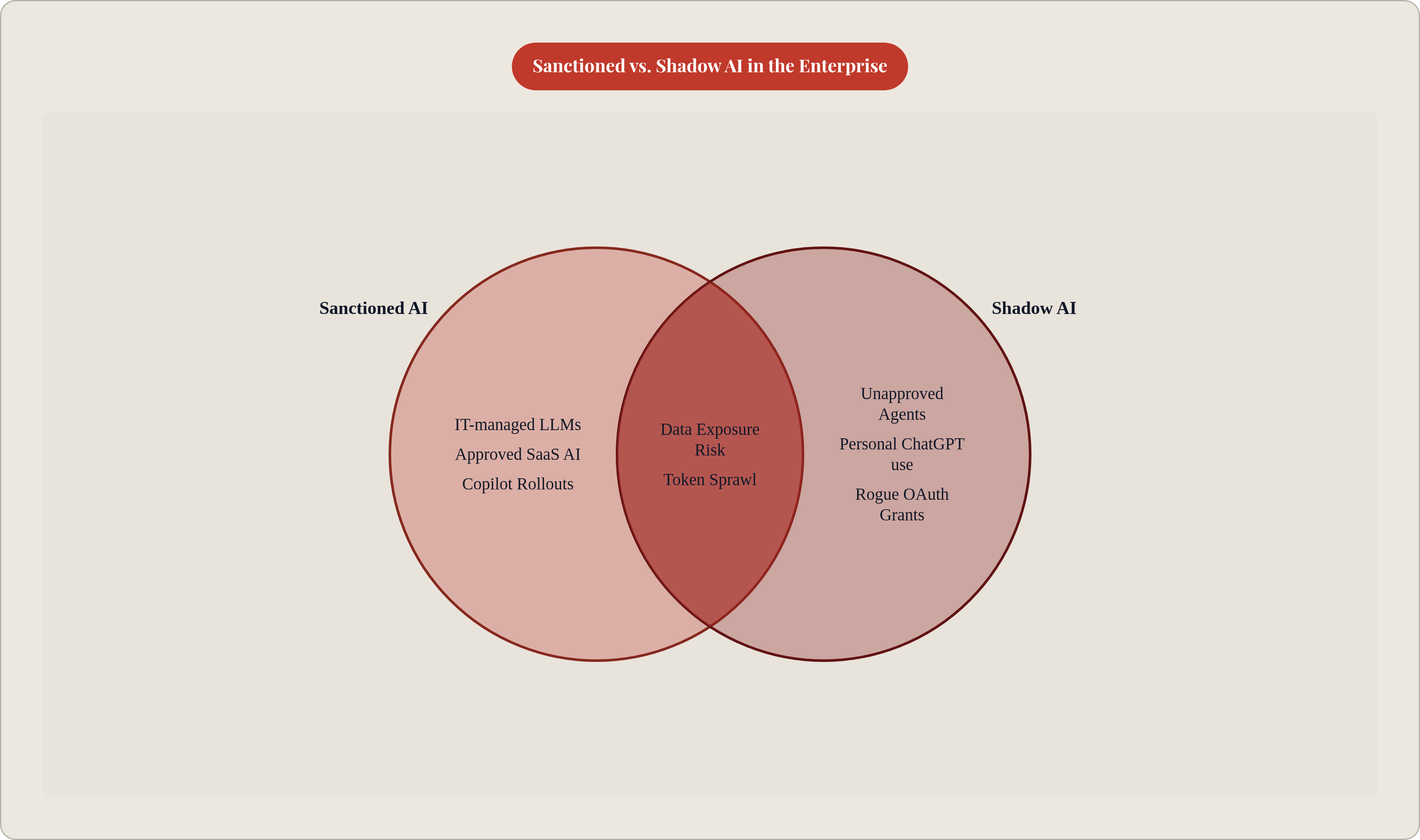
Multiple 2025 surveys agree on the uncomfortable part: unsanctioned AI use is the majority behavior at most companies, not the exception. Most employees are running tools IT never approved.
LayerX's 2025 Browser Security Report found that generative AI is now the single largest channel for corporate-to-personal data movement inside the enterprise browser, ahead of personal email, ahead of personal cloud storage. The tool everyone thinks of as a productivity boost is quietly the biggest leak in the building, and it isn't close.
But shadow AI isn't just someone pasting a client contract into ChatGPT for a quick summary. Developers and teams are deploying autonomous agents inside enterprise environments, often on open-source frameworks, with zero security review. An unapproved SaaS app just sits there being unapproved; an unapproved agent acts. It calls tools, moves data, chains steps together, all without a human in the loop to notice when something goes sideways. IBM's Cost of a Data Breach Report 2025 found that incidents tied to unsanctioned AI took far longer to identify and contain than standard incidents, which tracks: you can't investigate what you never inventoried. Discovery has to go past the application layer, down to the credential and the token and the OAuth grant, because a list of "approved tools" will miss exactly the exposures that matter most.
The main methods enterprises use to discover what AI is running
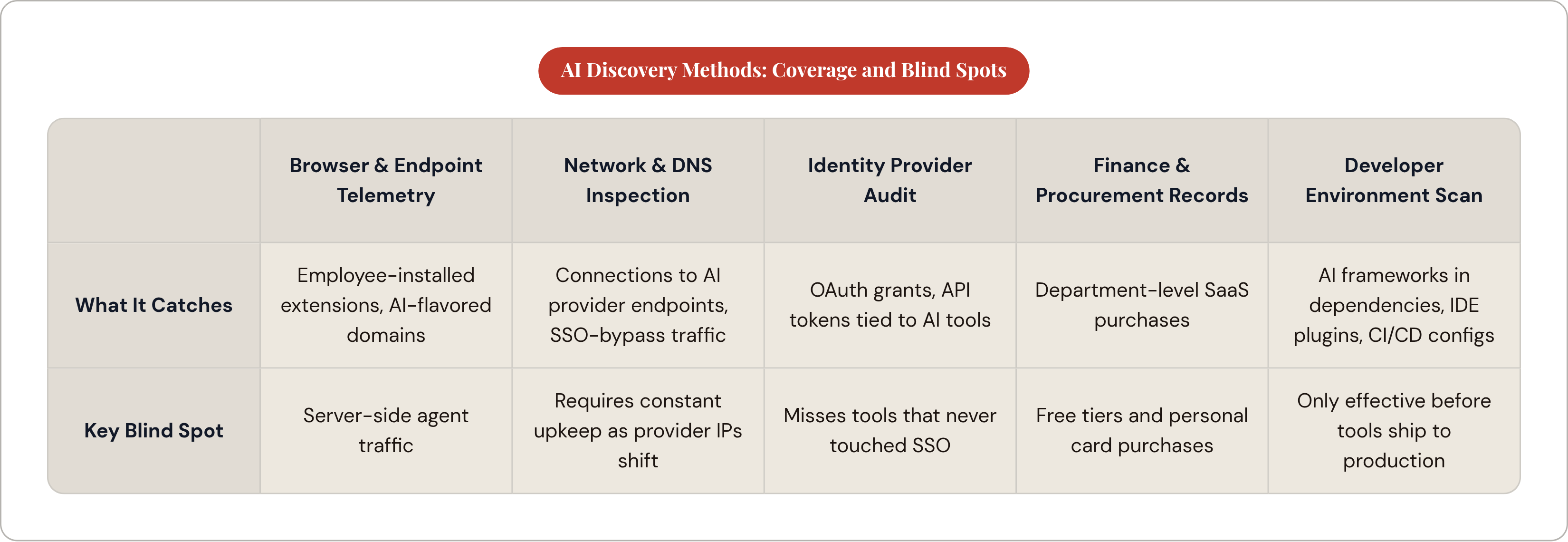
No single method covers the whole surface. You need several running at once, and even then you're patching holes rather than sealing them.
Browser and endpoint telemetry catches the long tail: employee-installed extensions, AI-flavored domains, odd data movement. It's blind to anything server-side, which rules out most agent traffic. Network and DNS inspection picks up connections to known AI provider endpoints (OpenAI, Anthropic, Cohere, Hugging Face), and it's often the only way to catch tools that skip SSO entirely. The catch is upkeep: the list of provider domains and IP ranges shifts constantly, and keeping it current is a real, ongoing job.
Auditing your identity provider (Okta, Entra ID, whatever you run) for third-party OAuth grants surfaces the credential footprint of AI tools even when the tools themselves show up in no official register anywhere. Pair that with a sweep of API tokens issued to AI services, since token sprawl builds its own access chain nobody's watching. Finance and procurement records catch what departments bought outright, though they miss anything paid on a personal card or run on a free tier. And increasingly, teams need to scan for MCP server instances and agent orchestration frameworks running on internal infrastructure. Most organizations have no native registry for this at all, and that absence is itself the finding. Developer-side signals round it out: package dependency audits, CI/CD configs, IDE plugin manifests, all worth checking before an AI library ships to production instead of after.
Why a static audit cannot serve as an enterprise AI inventory
Run the math on adoption speed and the problem is obvious: a point-in-time audit goes stale before the remediation work from that same audit even wraps up.
New AI features land inside tools you already approved (Microsoft 365, Salesforce, Slack, Atlassian) on vendor release schedules the enterprise doesn't control. A tool picks up new AI behavior with zero new procurement event, so the thing you cleared six months ago isn't the same thing anymore.
MCP servers make the failure mode concrete. Practitioners keep saying the hard part isn't deciding who's allowed to connect, it's operational continuity: who owns updating and eventually retiring a server once the API underneath it changes. Nobody wants that job, so often nobody has it. OAuth grants rot the same way: a developer connects an agent to a production system, leaves the company eight months later, and the grant just sits there, live, unless something actively checks it against current identity records.
The inventory has to run as an always-on signal, fed continuously by the detection methods above and checked against policy in real time, not a spreadsheet somebody dusts off once a quarter. Only a continuous model catches new agents the moment they appear, flags drift when an approved tool suddenly reaches new data, and produces the audit trail regulators and incident responders will eventually come asking for.
The governance actions that become possible once a complete inventory exists
The inventory is the foundation everything else gets built on.
Access control and role-based permissions can't apply to tools you haven't identified; the inventory is the thing RBAC gets applied against. Policy frameworks start from the same place: NIST's AI Risk Management Framework runs on four functions (govern, map, measure, manage), and the EU AI Act's high-risk classification requires you to first enumerate what you're classifying. No inventory, no classification, and cost visibility works the same way. You can only attribute and control AI spend once every tool consuming model API credits is known and tagged, and an untracked agent racking up token costs shows up in exactly zero budgets until finance finds it the hard way.
Audit logging needs the same foundation: a log covering only known tools is a partial log dressed up to look thorough. Prompt injection defense and PII detection can only run at inspection points the enterprise actually controls, so anything outside the inventory walks straight past those controls. IBM's finding on shadow AI breaches taking longer to contain traces right back to this gap: responders can't chase down what they never knew was running. On the compliance side, the EU AI Act requires documented system inventories for high-risk AI, and the penalties for getting caught without one run into the tens of millions of euros, or a meaningful cut of global turnover, whichever stings more.
How an AI control plane turns inventory from a list into governed infrastructure
Nobody keeps this current by hand. The detection methods above need integration, reconciliation, and a live link to policy: work a spreadsheet was never built to do.
The pattern that works splits into two halves, a control plane and a data plane. The control plane, a registry, owns the inventory, the access model, and the audit trail, and decides what's allowed to be reached. The data plane, a gateway, sits at the tool layer and enforces that decision. Neither works alone. A gateway with no control plane gives you enforcement with no policy behind it; a control plane with no gateway gives you policy nothing actually enforces.
Once the inventory is complete, the gateway layer can do real work: per-user connection URLs, OAuth token vaulting that kills off credential sprawl, MCP-aware routing that understands sessions and tools instead of treating everything as generic HTTP traffic. An MCP gateway built on a solid inventory can filter what tools an agent sees, check the responses coming back, and catch PII before it reaches the model. None of that means anything against a tool that was never in the inventory to begin with. Tie the whole setup to your identity provider, whether that's Okta, Entra ID, SAML, or OIDC, and access policy travels with the inventory record automatically. Someone leaves the company, their AI tool grants revoke on their own instead of lingering for a year.
Kong takes a different angle with its AI Gateway, governing LLM, MCP, and agent-to-agent traffic from one control plane. Microsoft's open-source mcp-gateway handles session-aware routing for teams running Kubernetes. Lasso leans into security-first MCP governance, with reputation scoring and PII leak prevention as the core pitch. Whichever one you're looking at, ask the same question: does it discover and keep reconciling what's actually running, or does it just enforce policy on the tools you already knew about?
Building toward a complete inventory: where enterprise teams typically start
Almost nobody gets a clean slate here. Most teams build the inventory in an environment where ungoverned AI has already been running for months, sometimes years, and pretending otherwise just wastes time.
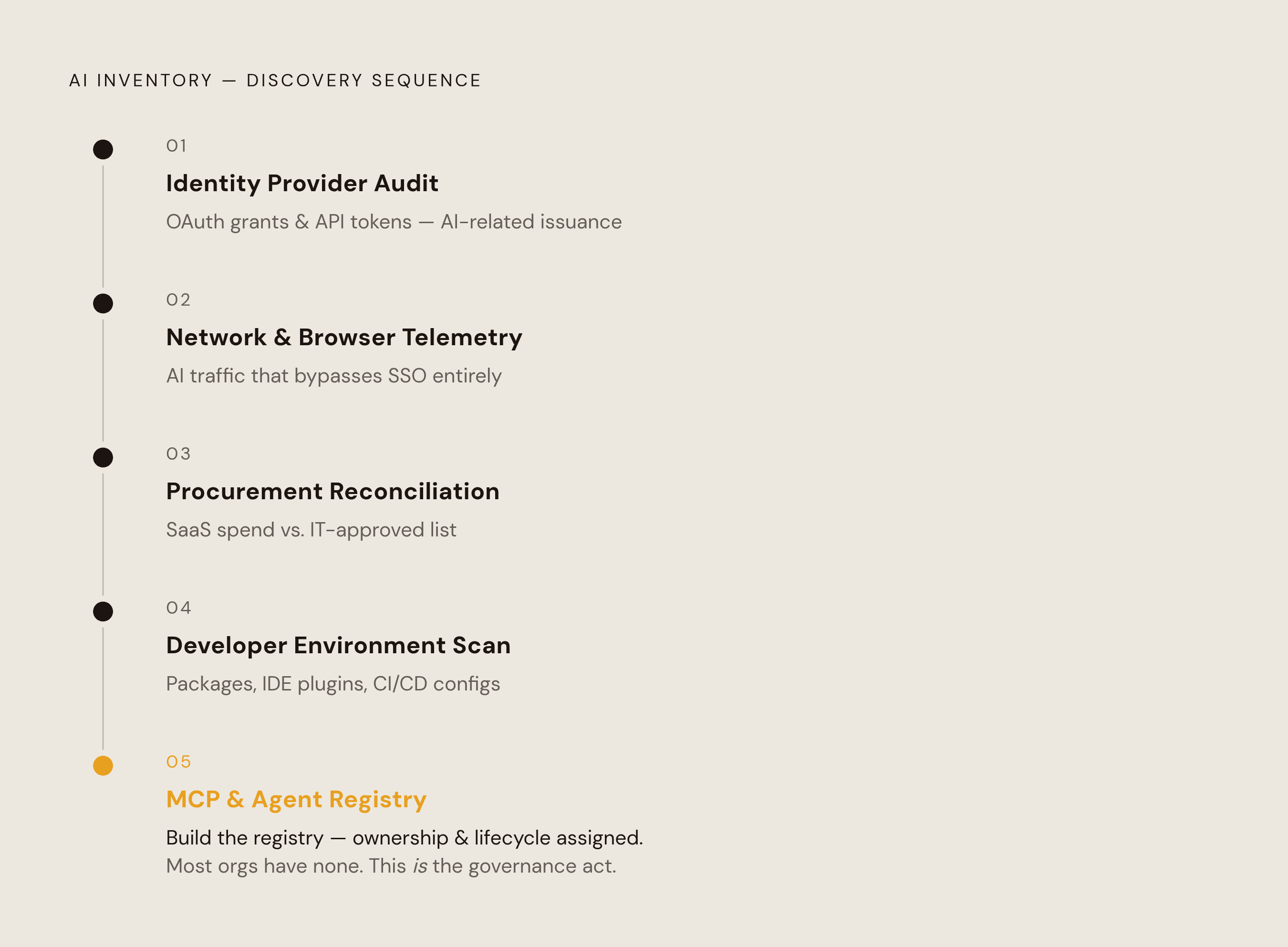
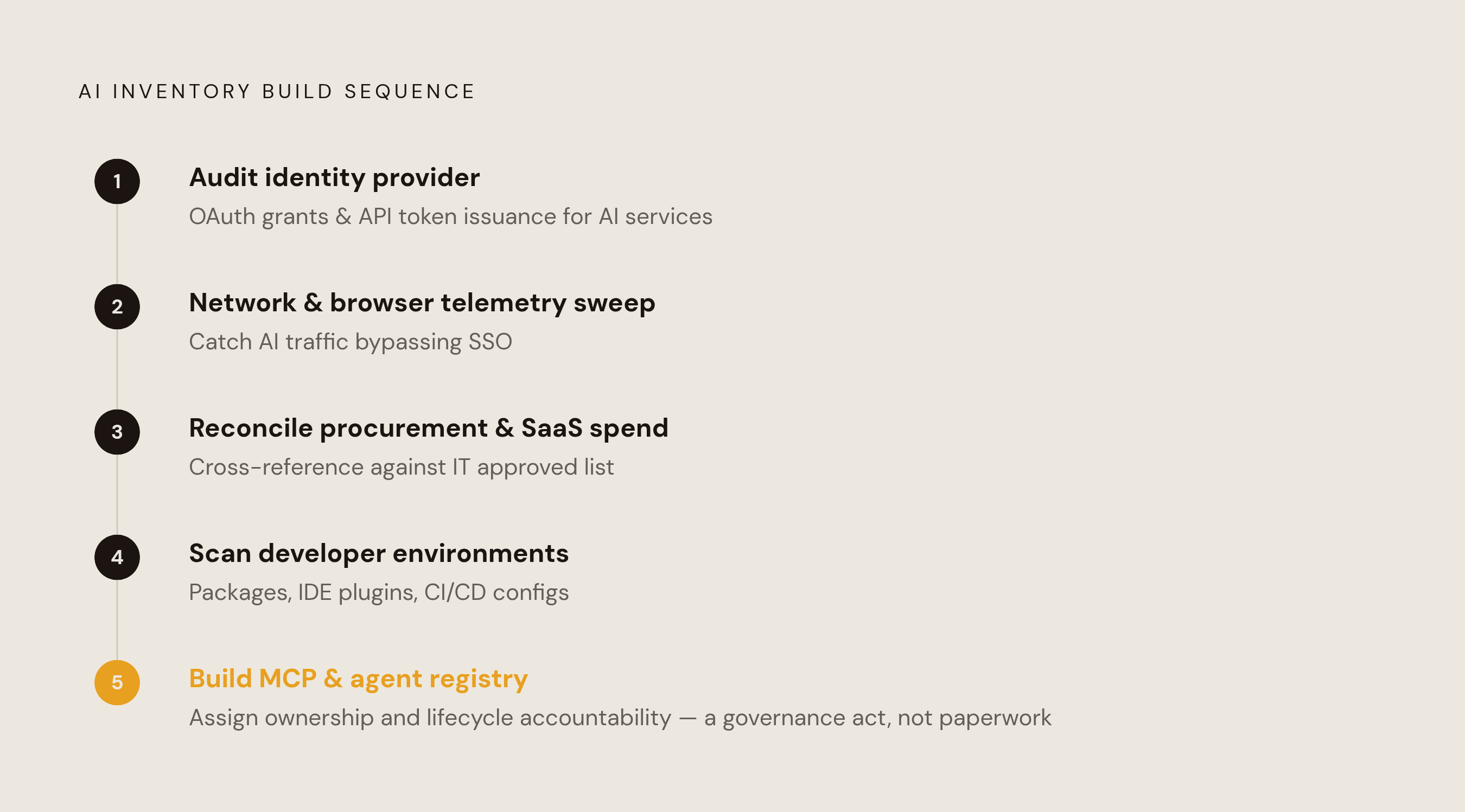
A sane starting sequence looks like this. First, audit your identity provider for AI-related OAuth grants and API token issuance; it's the fastest way to see what's already connected to your systems. Second, run a network and browser telemetry sweep to catch AI traffic that skips SSO entirely, since that's the layer identity audits can't touch. Third, reconcile procurement and SaaS spend records against IT's approved list to surface what departments bought on their own. Fourth, scan developer environments, package dependencies, IDE plugins, CI/CD configs, for AI frameworks before they ship. Fifth, if there's no registry for internal MCP servers or agent deployments, build one. The act of creating it, assigning ownership, versioning, lifecycle accountability, is itself a governance move, not paperwork for its own sake.
None of this works if it lives in one department. Security-only ownership misses what finance quietly bought, and IT-only ownership misses what a developer spun up over a weekend. The CISO, platform engineering, legal, and compliance all need a seat at this table, because each one sees a different slice of the problem and none of them sees the whole thing alone.
Most organizations sit somewhere between ad hoc audits and continuous reconciliation right now, and the frameworks regulators actually enforce, NIST's AI RMF, the EU AI Act, only get satisfied once you're on the continuous end. The inventory won't ever feel finished, honestly, but starting it is the one move that makes every governance control after it possible.