AI Impact on Cybersecurity Operations and Threat Detection
Attackers now break in faster than SOCs can respond.
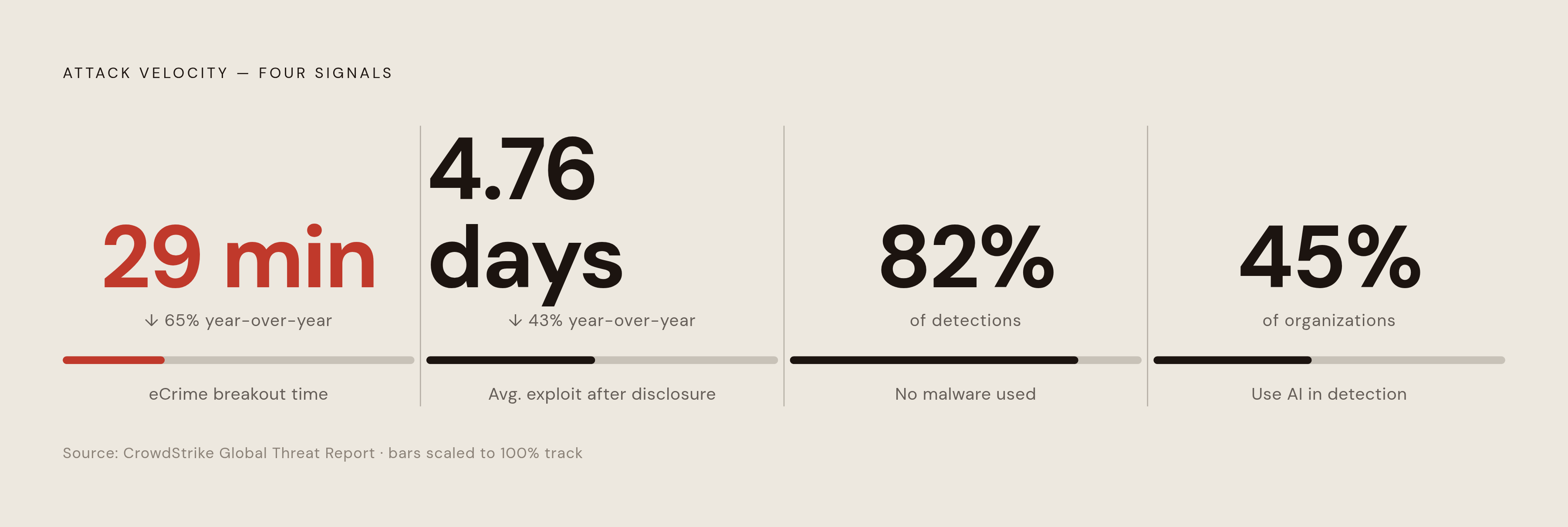
The average eCrime breakout time dropped to 29 minutes in 2025, 65% faster than the year before, according to CrowdStrike's Global Threat Report. Twenty-nine minutes is faster than most security operations centers can triage a single alert, let alone investigate one and shut the door. The threat landscape got faster than the humans watching it, and most of the tooling built to catch it is still running yesterday's race.
This piece covers both halves of that problem: what AI-enabled attackers can now do that they couldn't three years ago, and what an AI-augmented SOC looks like when someone actually builds it to keep pace. Skip either half and you're only getting half the picture.
Speed isn't even the whole story. CrowdStrike also logged an 89% jump in attacks from AI-enabled adversaries in 2025, and FortiGuard Labs found new vulnerabilities now get exploited an average of 4.76 days after disclosure, 43% faster than the prior measurement period. Meanwhile, 82% of all detections in 2025 involved no malware at all, per CrowdStrike. Attackers are living off legitimate tools and stolen identities instead of dropping payloads that antivirus software might catch. Put those numbers side by side and you get a plain fact: signature-based detection, the stuff most SOCs still lean on, was never built for something this fast, this frequent, and this quiet.
What AI actually gives attackers: the specific capabilities enabling these numbers
Phishing still kicks off most break-ins, somewhere around 60% of incidents by most industry counts, but what a phishing email looks like has changed completely. The old tell was bad grammar or a weird sender address. Now a language model writes the email, and it reads better than most internal memos your own company sends out.
AI gives attackers four things they didn't reliably have before: it writes phishing and spear-phishing content that's grammatically clean and personalized at a scale no human copywriter could match, it produces deepfake audio and video good enough to fake a CFO on a video call (exactly what makes wire-fraud scams work now), it automates network scanning so vulnerability discovery runs continuously instead of in bursts, and it writes working malware code for people who couldn't code their way out of a spreadsheet.
Here's the part that stings a little: companies are handing attackers the weapons themselves. CrowdStrike documented 90 organizations where sanctioned, company-approved AI tools got hijacked to generate malicious commands and pull data out the back door. IT approved every one of those tools, which is a bit like installing a deadbolt and leaving the key under the mat because the mat seemed convenient.
The tooling behind this isn't exotic, either. ChatGPT got mentioned in criminal forums 550% more than any other model, per CrowdStrike's tracking. Attack tooling has gone mainstream, and anyone with a forum login and bad intentions has access to it. The bill comes due fast: average data breach cost hit $4.4 million in 2025. And the people meant to stop it are already stretched thin, with roughly 600,000 open cybersecurity jobs in the US and 3.5 million worldwide. Defenders were short-staffed before the threat got faster. Now they're short-staffed and outrun.
Why current SOC tooling and processes weren't built for this speed
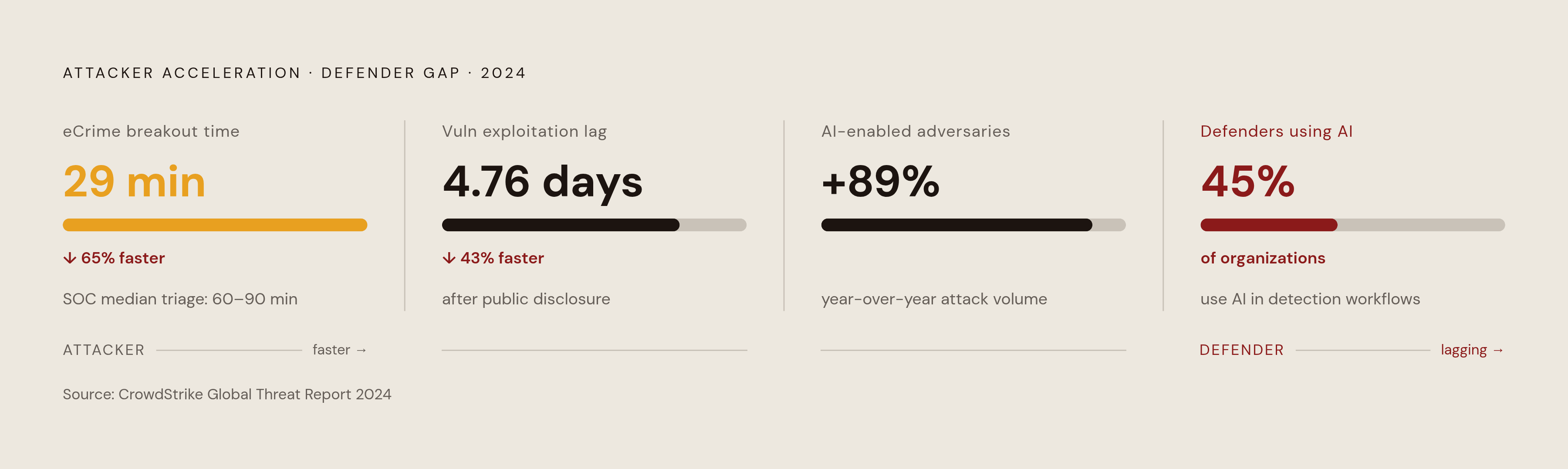
Here's the number that explains everything else in this piece: only 45% of organizations use AI in their detection workflows today, according to SANS' 2025 Detection Engineering Survey. Most companies are running pre-AI defense against a post-AI attacker.
The mismatch runs deeper than headcount. Traditional detection depends on known signatures and static rules, and neither one catches a malware-free intrusion or reacts inside a 29-minute breakout window. Alert volume from AI-assisted attacks piles up faster than a human triage pipeline can chew through it, and because malware-free attacks look like normal activity (stolen credentials, approved software, business as usual), catching them takes behavioral and contextual analysis instead of pattern-matching against a known-bad list. You can't fingerprint an attack that's wearing your own employee's badge.
There's a confidence gap sitting on top of all this, too. Seventy-two percent of companies have already worked AI into business functions, but only 20% say they're confident about securing generative AI. Most security teams are guarding a surface they don't fully understand yet. Worse, 99% of organizations report sensitive data is already exposed to AI tools in some form. That's just Tuesday.
Credit where it's due: security teams see it coming. Eighty-eight percent expect AI to significantly affect their operations within three years, per that same SANS survey. Seeing it coming and being ready for it turn out to be two very different skills, and right now most teams have plenty of the first and not much of the second.
How AI-powered threat detection actually works inside a modern SOC
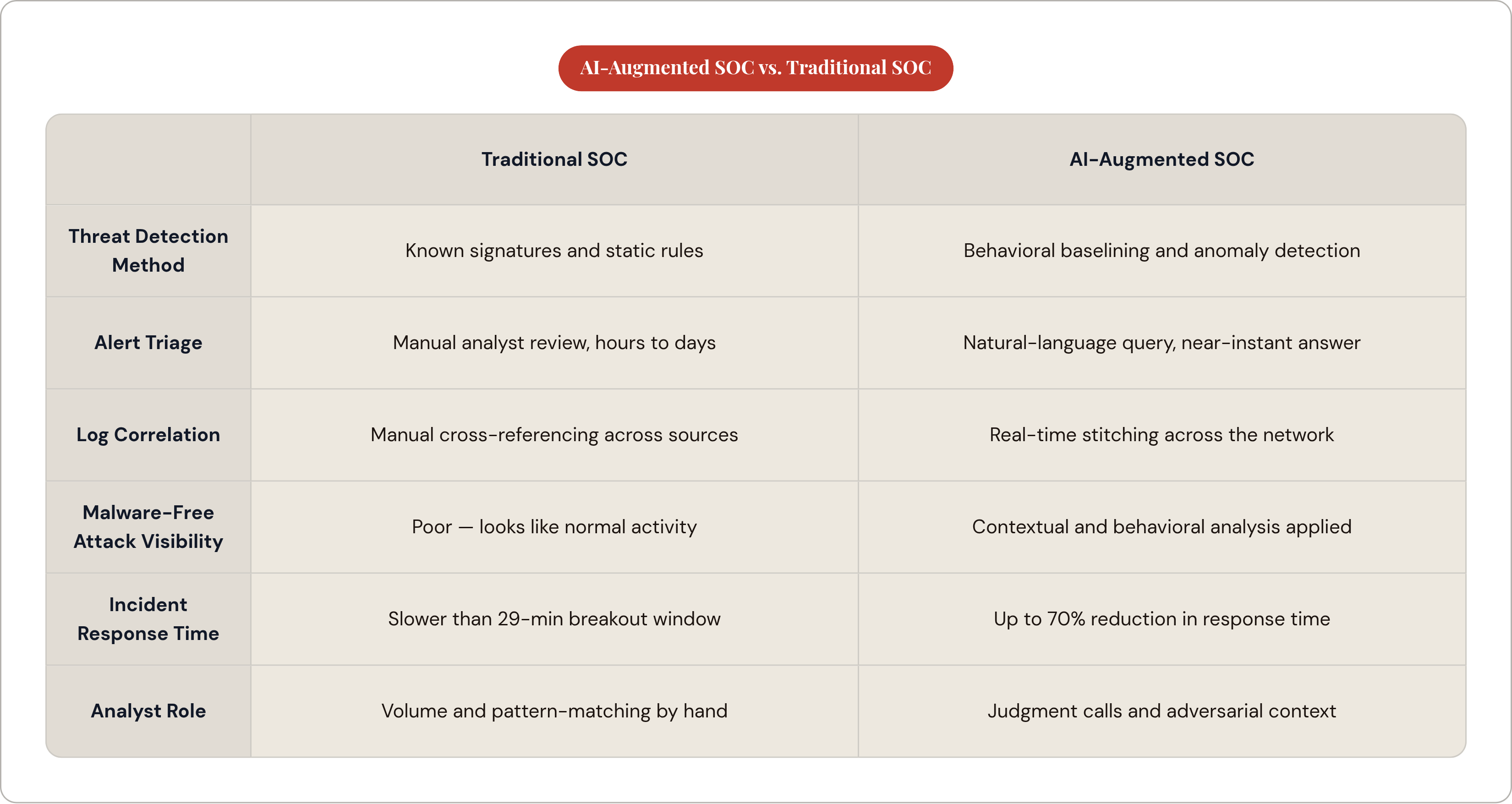
What does the fix look like, mechanically? Four pieces, working as one system rather than four tools bolted together on a Friday afternoon.
Behavioral baselining teaches a system what normal looks like for a given user, device, or network segment, so anomalies surface without anyone writing a rule in advance; real-time correlation stitches together log sources across a network in seconds, work that would eat hours or days of a human analyst's time doing manual cross-referencing; natural-language triage lets an analyst type "what happened here" and get a plain answer instead of a wall of raw logs to comb through by hand; and automated enrichment pulls threat intelligence, asset details, and identity context onto an alert the second it fires.
Research out of Syracuse's iSchool on energy-sector deployments found AI-led detection systems hitting a 98% threat detection rate alongside a 70% cut in incident response time. That's the difference between catching an intrusion in the parking lot and reading about it on the evening news.
The analyst's job doesn't vanish; it just changes shape. AI handles the volume and the pattern-matching grunt work, and humans handle judgment calls, adversarial context, and the decision to actually pull the plug on something. That division only holds if the AI layer itself can be trusted, though. Darktrace has documented prompt injection attacks delivered through email that target the detection AI directly, meaning the system built to catch attackers can become the thing attackers go after next. Defending the detection layer is part of the job now, not a footnote at the bottom of it.
Shadow AI inside the enterprise as an expanding threat vector
Employees don't wait for IT approval when a tool makes their job easier. They never have. AI tools are no exception; if anything, they're the fastest-adopted category of unsanctioned software anyone's seen in years.
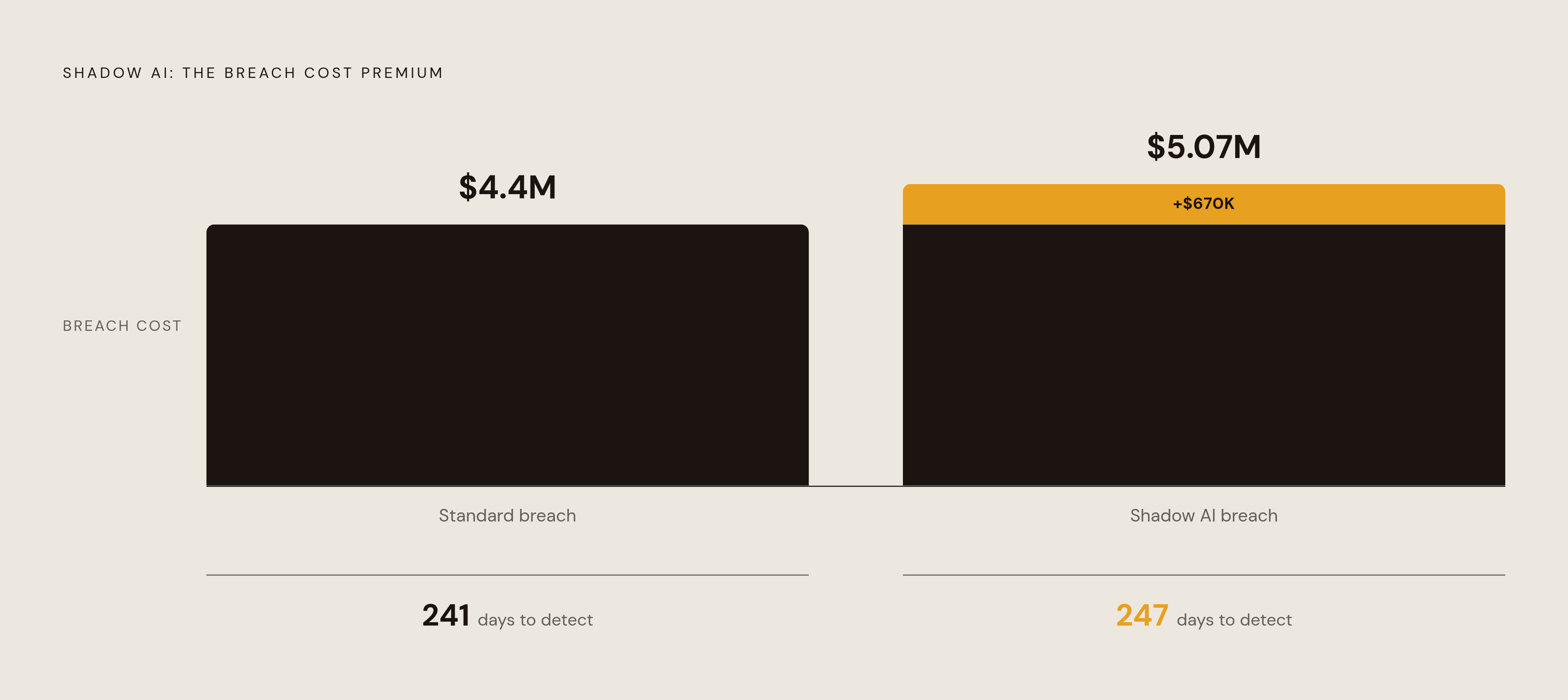
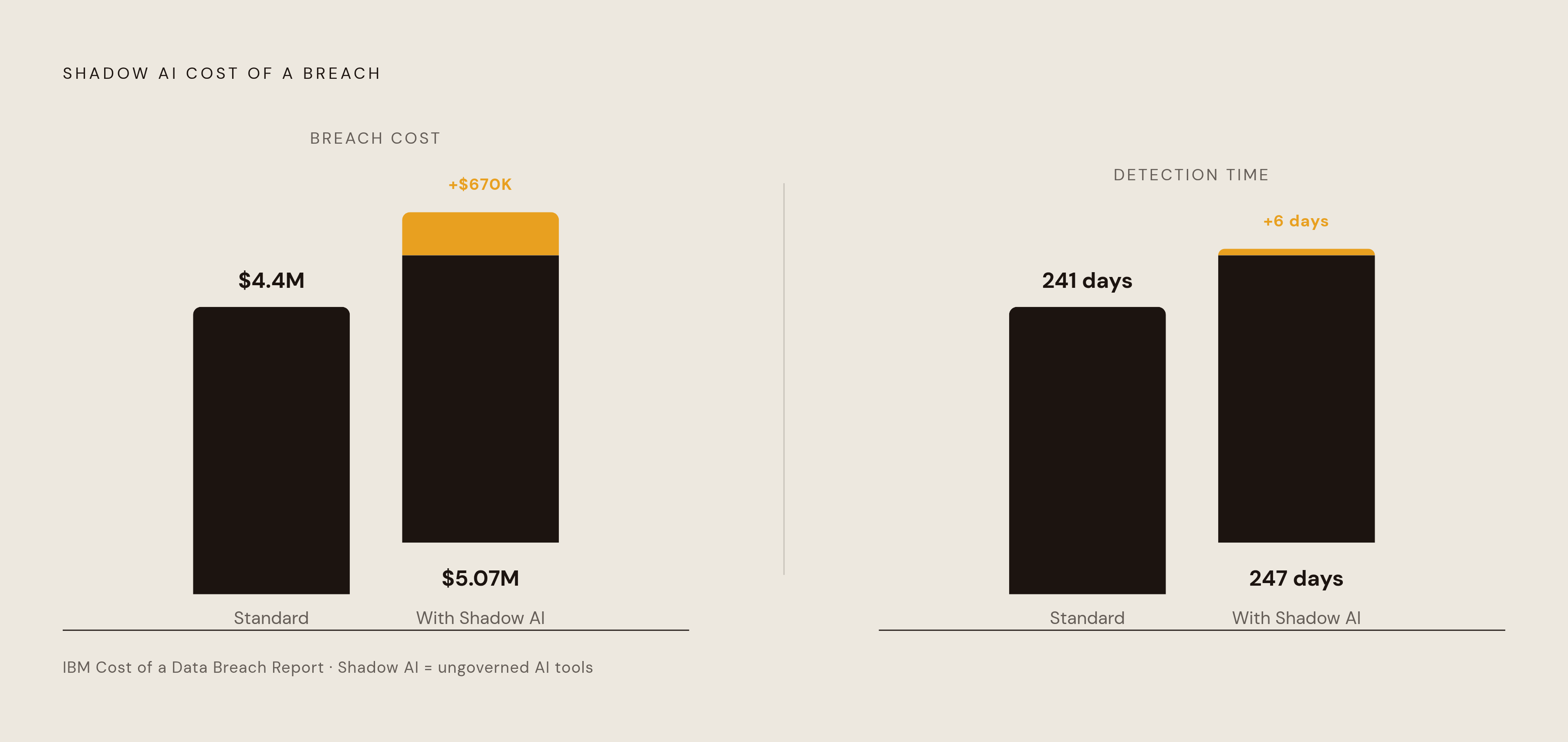
Seventy-six percent of organizations now call shadow AI a definite or probable challenge, up from 61% the year before. That's a steep climb for a category most security teams hadn't even named eighteen months ago. IBM's Cost of Data Breach Report puts a number on what that laxity costs: shadow AI incidents tack on roughly $670,000 over the $4.4 million baseline. These breaches also take longer to spot, averaging 247 days to detect, six days longer than a standard breach. That's nearly an extra week of free rein for an attacker before anyone notices.
What tends to walk out the door is customer PII and intellectual property, the two categories carrying the heaviest regulatory and competitive weight. The root cause is almost boring in how simple it is: the vast majority of organizations that reported an AI-related breach in 2025, per IBM, had no AI access controls in place at all. The breach happened because nobody built the control in the first place.
This looks a lot like the shadow IT problem security teams fought a decade ago: employees reaching for whatever's fastest and most capable, security finding out after the fact. But there's a real difference worth sitting with. Shadow IT usually leaked data by accident, a misconfigured server, an open S3 bucket left unlocked. Shadow AI tools process and transmit data as their actual job. The exposure works exactly as designed, just pointed somewhere nobody signed off on.
What governed AI security operations infrastructure looks like in practice
Gartner projects more than 60% of organizations will run cybersecurity platforms with AI-augmented automation by 2026, up from less than 20% in 2023. Whether the shift happens isn't in question anymore. Whether it happens with governance attached is.
A governed setup needs a handful of pieces working together, not separate initiatives bolted on over time like additions to a house nobody planned for. Access control has to sit in a single policy layer covering every AI agent and tool connection, managed centrally rather than tool-by-tool like a junk drawer full of settings nobody remembers setting; identity has to tie into existing providers, Okta or Entra ID, so an AI agent's permissions follow the same onboarding and offboarding lifecycle a human employee's would, since an AI tool shouldn't outlive the person who set it up; threat controls (PII blocking, prompt injection detection, secrets leakage prevention) need to get built into the AI layer from day one rather than bolted on after something breaks; audit logging has to capture what a tool accessed, what it was asked, and what it returned, in a form that satisfies SOC 2 and HIPAA auditors, because nobody can reconstruct a log that never got written; and usage and cost data need real-time visibility too, so runaway spend or a strange pattern gets caught before it turns into a headline.
Agentic workflows and MCP servers raise the stakes further. Each MCP server is a tool-invocation point that can reach into internal APIs, SaaS platforms, and sensitive data stores, and GitGuardian found 24,008 unique secrets sitting exposed in MCP configuration files in 2025 alone. That's tens of thousands of open doors nobody remembered to lock.
People are calling the architectural fix an AI control plane: a governed layer sitting between AI agents and the systems they touch, doing for AI connections roughly what an API gateway has long done for traditional software integrations. The payoff shows up in the numbers, too: Gartner found organizations with AI governance platforms in place are 3.4 times more likely to reach high-value AI outcomes. Good governance is what makes the speed usable in the first place.
Where the AI cybersecurity market is heading and what enterprises should do now
Money is already voting on the answer. The AI cybersecurity market is set to grow from $31 billion in 2024 to a projected $134.6 billion by 2030, a 26.6% compound annual growth rate. Nobody pours money in at that pace chasing a fad.
The 88% of security teams expecting AI to reshape their operations within three years have good reason to expect it. The ones waiting for that moment to actually arrive before doing anything are already behind, because the people on the other side of this fight aren't waiting on anyone's budget cycle to approve their next move.
None of it requires a moonshot, just real work done in order. Start by finding every AI tool already running inside the company, sanctioned and unsanctioned both, before building any governance layer on top of guesswork about what's actually there. Put identity-bound access controls on AI tools as the first line of defense, built on identity infrastructure that already exists rather than some parallel system nobody will bother maintaining. Get detection controls, prompt injection, PII, secrets, running at the access layer before rolling AI tools out to more of the workforce. Build audit logging in from day one, because nobody goes back and writes logs for an incident that happened last month. And treat AI agent and MCP server rollouts with the same centralized, role-scoped discipline already applied to API distribution. An ungoverned AI agent is just an ungoverned API with slightly better manners.
Attackers didn't wait for enterprises to get ready. The companies still waiting are the ones whose names show up in next year's breach report.