Data Classification Policies for AI Ingestion Controls
Organizations must classify data before AI systems ingest it.

Data classification used to run on a calendar. A compliance team would sweep the file shares twice a year, tag what it found, and move on until the next cycle. AI ingestion has broken that model entirely, because AI systems don't wait for a quarterly review before they read, learn from, or act on whatever data sits in front of them. Governance has shifted from scheduled checkpoints into something that has to run continuously, embedded in the pipeline itself, because an AI system consumes data constantly, keeps changing shape as it's fine-tuned or re-prompted, and makes decisions in real time that a once-a-quarter audit simply cannot catch before the fact.
The scope of what gets governed has grown at every stage of AI adoption. Traditional data governance drew a box around the asset: the table, the file, the pipeline that moved it from one system to another. AI governance moves that box to cover what actually feeds the model: training sets, prompts, and the context a retrieval system pulls in at query time. As that same reasoning extends to AI agents, the box moves once more, this time to the live context assembled for one specific task, right before an agent decides to act. Each expansion makes the unit of control smaller and faster, and each one makes the old audit cadence less relevant to what's actually at risk.
The underlying reason classification timing now matters so much is that generative AI multiplies how many times a single piece of data gets reused. Each of those stages carries its own privacy risk, risks that didn't exist when a dataset sat in one warehouse touched by one application. Current best practice for 2026 reflects that reality directly: classification has to happen before data enters any AI pipeline at all, which means inspecting prompts, RAG pipelines, and agent tool-calling protocols with the same rigor that used to apply only to databases and data warehouses, and doing it before a model or agent ever gets connected to a data source. Getting the timing wrong makes the cost irreversibility: once a model has already trained on or retrieved sensitive data, no retroactive classification can put that exposure back in the box.
What retroactive classification actually exposes and why governance teams cannot unwind it
Once sensitive data has made it into a model's context, a submitted prompt, a RAG index, or an MCP call, the window for governing it has already closed. Whatever regulatory and operational consequences follow from that moment compound from there, with no clean way to reverse course.
Three distinct ingestion surfaces each create their own irreversibility problem. If unclassified personal data made it into that training set, the model itself becomes an ongoing leakage vector. And an agent that reaches an unclassified data source before an access policy has been applied to it can surface or exfiltrate regulated data in a single tool call, a call that gets logged only after the exposure has already happened.
Samsung's experience with ChatGPT in 2023 shows what this looks like outside the abstract. Samsung's response, banning the tool outright, illustrates a second failure mode on top of the first: banning one tool doesn't make the underlying behavior disappear, it just pushes employees toward less visible alternatives, which lowers what IT can see while the actual risk keeps growing.
The regulatory apparatus built around this problem treats the moment of ingestion, not the moment of discovery, as the operative fact. They ask whether the controls existed at the point data went in. ISO/IEC 42001's control A.6.2.8 makes this explicit by requiring organizations to determine, across the AI system's lifecycle, at which phases event logging gets turned on to support traceability and incident response. An audit log that only starts recording after ingestion has already happened is incomplete by the standard's own definition.
The Governance Gap That Makes This Exposure Likely
The gap between how fast AI tools have spread inside companies and how well classification controls keep up is the baseline condition most enterprises are operating under right now.
Shadow AI is the main engine behind that gap, and it's a bigger problem in 2026 than the phrase used to suggest. It no longer describes a stray browser tab running a free chatbot. It describes employees building autonomous agents directly on foundation model APIs, feeding them business data, and letting them make decisions with zero visibility from IT. Netskope's Cloud and Threat Report: 2026 found that a large share of enterprise generative AI users still reach these tools through personal, unmanaged accounts, sidestepping whatever enterprise data controls exist entirely, and that the resulting policy violations are driven mostly by uploads of regulated data. The same report found that data policy violations linked to these AI tools more than doubled year over year, with the average organization logging a substantial number of these violations every month, and that fewer than one in nine AI applications used in the workplace are even visible to IT teams.
None of this traces back to employees not knowing the rules. A policy employees have read and ignore anyway functions as a liability disclaimer, not as governance. The most overlooked vector sits in browser extensions, where each OAuth grant quietly opens a persistent data pipeline that bypasses CASB and network controls altogether, and where extensions with clipboard access can capture copied credentials with no classification gate anywhere in the path.
The numbers behind deployment decisions tell the same story a different way. AvePoint's State of AI 2026 Report found that data security and data management concerns, not model capability, are now the leading cause of AI deployment delays, and that 89.5% of organizations experienced at least one generative AI-related security breach in the past year. Most enterprises have already lived through the exposure this piece is describing. What's missing is the architecture to catch it earlier next time. Detection and classification need to run at every ingestion surface, including the ones most governance programs were never built to cover.
The five ingestion surfaces that classification policy must cover before data enters any AI system
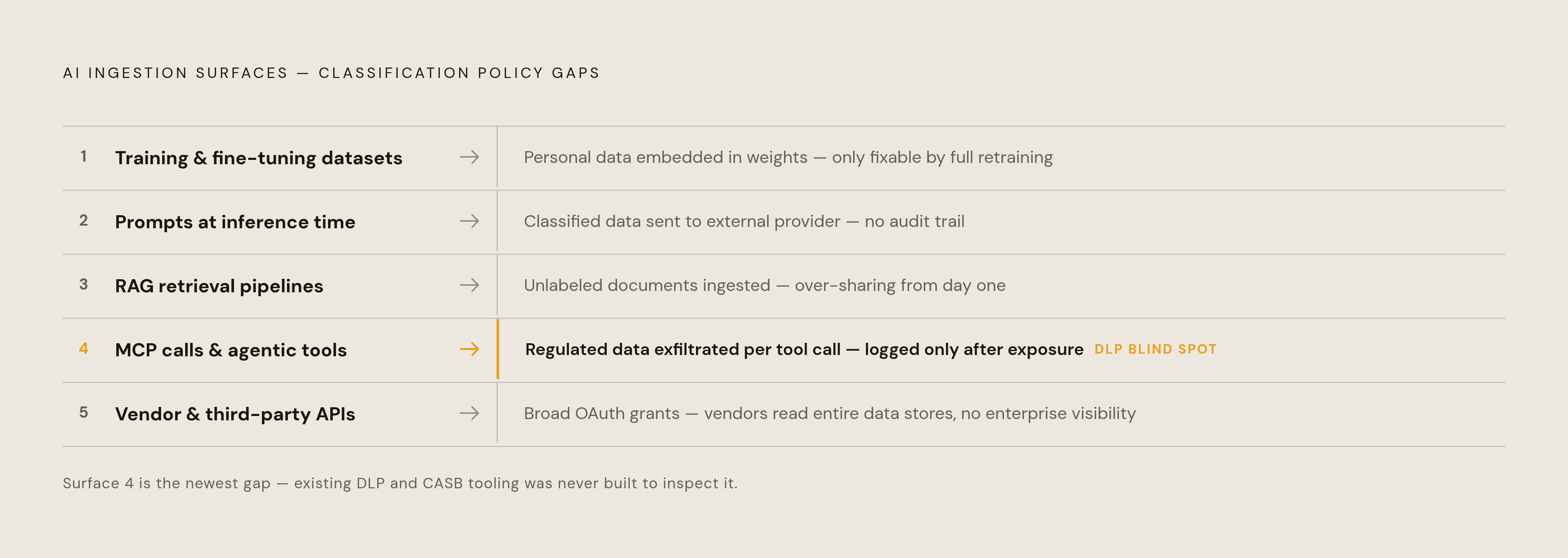
Most enterprise classification programs were designed around data stores: file shares, databases, warehouses. AI has opened up new places where data goes in, and a policy that only watches the old storage layer misses most of what matters now. A classification policy built for AI has to account for five distinct surfaces, and each one fails in its own specific way if nobody is watching it.
Training and fine-tuning datasets are the first surface, and the oldest one. Missing that step leaves personal or proprietary data embedded in the model's learned weights, where the only fix is retraining the model from the ground up.
Prompts at inference time are the second surface, and arguably the least guarded one in most organizations today. Without it, classified data goes straight to an external model provider in plain text, with no audit trail showing what was sent.
RAG retrieval pipelines make up the third surface. A document pulled into a retrieval corpus doesn't automatically inherit the classification it had in its original data store, it carries no label at all unless someone explicitly tags it on the way in. The fix is to apply classification at the moment of indexing rather than wait until query time, with sensitivity tiers enforced so a lower-privileged agent can't retrieve documents above its authorized level. Skipping that step means over-sharing starts the moment retrieval goes live, available to any agent or user who can query the index.
MCP calls and agentic tool invocations form the fourth surface, and most data loss prevention and CASB tooling wasn't built to inspect this layer at all. The control is a classification check before an agent gets permission to invoke a tool that touches a regulated data source, with tool-level policy tied to both the agent's identity and the human user delegating to it. Without that check, a single tool call can surface or exfiltrate regulated data, and the system only logs the call after the exposure has already happened.
AI vendor and third-party model API connections round out the fifth surface. OAuth grants and API keys handed to AI vendors create data pipelines that stay open indefinitely, so you need to know whether whatever flows through them answers to enterprise policy or to the vendor's own terms of service. The controls that matter here are vendor data processing agreements, scoped API credentials, and access controls that account for data classification rather than granting blanket reach. Get this wrong, and a broad OAuth grant hands a vendor read access to an entire data store, with the enterprise left unable to see what actually got transmitted. A working AI data governance framework maps all five of these surfaces onto five pillars: discovery and classification, access and identity, in-flight data protection, audit and accountability, and vendor and model lifecycle management, with every surface touching at least one pillar.
How to build sensitivity tiers that work across all five surfaces
Public or unrestricted data can flow into any AI surface without restriction, no gate required. Internal or business-sensitive data can be used by authorized employees through AI tools the company has approved and configured, but it can't be sent to an external model provider without a data processing agreement already in place. Confidential or regulated data covers personal information, protected health data, financial records, attorney-client communications, and anything that falls under GDPR, HIPAA, CCPA, or EU AI Act Article 10, and it requires explicit policy authorization before any of it touches an AI system. Restricted or proprietary data, the highest tier, covers source code, trade secrets, M&A material, and strategic plans, and it's blocked from AI ingestion by default, unlocked only through elevated approval and a full audit trail, completing a foundational taxonomy of at minimum four tiers for AI ingestion contexts.
These tiers only work if they get applied to the content itself rather than the container it sits in. A SharePoint folder labeled "Internal" can easily contain a document with personal data buried inside it that should classify as Confidential, and a label on the folder tells nobody that. Automated scanning needs to look inside unstructured text, embedded tables, code snippets, and transcripts, beyond the structured fields a database schema happens to expose. That also means the business glossary that used to sit in a wiki for human reference has to turn into something a machine can actually parse, with taxonomy, ontology, and semantic mappings built in, so that the classification system itself becomes something agents and retrieval systems can read and act on directly.
None of this matters unless each tier maps to an actual enforcement action rather than sitting there as a label. Internal data gets allowed through governed AI tools only, and it's blocked from external model APIs unless a data processing agreement exists. Confidential data gets redacted or blocked outright at the prompt, RAG, and MCP surfaces, unlocked only through an explicit policy override that leaves an audit record behind. A label that doesn't trigger one of these actions is just documentation, and documentation doesn't stop a prompt from leaving the building.
There's also a separate problem: data classified years ago doesn't stay accurate forever, and that drift undermines even well-designed tiers. AvePoint's State of AI 2026 Report found that 78.1% of organizations have at least half their data more than five years old; a large share of enterprise data was classified under regulatory conditions, business contexts, or risk assumptions that no longer hold.
Tying classification enforcement to identity: why role-based access and identity-provider integration are the enforcement mechanism
A sensitivity tier is only a label until something ties it to who, or what, is asking for the data. An agent trying to invoke an MCP tool, a user pasting a document into a prompt, a retrieval query running against a RAG index: all of these need to be evaluated against the requester's identity and role before the data moves, not logged as a violation once it already has.
This is also the only way the five ingestion surfaces described earlier actually connect into one coherent system rather than five separate side projects. Tying every surface back to the same identity provider, the same role definitions, and the same tier-to-action mapping is what makes "Confidential blocks at the MCP surface" and "Confidential blocks at the prompt surface" the same rule enforced twice, instead of two different teams interpreting the same policy two different ways.
The practical shape of this is familiar to anyone who has built access control for enterprise systems before: roles map to permissions, permissions map to data tiers, and the identity provider is the single source of truth everything else checks against before acting. Classification policy without identity-based enforcement behind it is a set of good intentions written down somewhere.