ISO 42001 and AI Risk Management for Enterprises
New standard requires enterprises to build AI governance infrastructure most lack today.
ISO/IEC 42001:2023 is the first international standard for governing artificial intelligence, published jointly by ISO and IEC in December 2023 under the full title "Information technology, Artificial intelligence, Management system." It doesn't test a model or certify an algorithm. It certifies that an organization manages AI the way ISO 27001 certifies that an organization manages information security: through defined roles, live risk processes, and evidence that the whole system actually runs rather than just sits in a binder somewhere. Meeting its requirements takes infrastructure most enterprises haven't built yet, and that gap is the real story here.
Why the standard is gaining traction now rather than remaining optional
Three forces are pushing ISO 42001 from nice-to-have toward expected, and none of them are subtle. The first is regulation. The EU AI Act entered into force in 2024, with obligations phasing in through 2025, 2027, and 2028, and it demands the same discipline ISO 42001 formalizes: risk management, documentation, human oversight, monitoring after deployment. The Act never names the standard as a shortcut, but the overlap is not an accident.
The second force is procurement, and this one is more mundane but arguably more decisive. Security questionnaires now come with AI-specific sections, and answering them one deal at a time, in prose, for every enterprise customer, is a miserable way to spend a sales cycle. An accredited certificate answers the question once, in a format procurement teams already trust, and everyone moves on with their day.
The third force is early-mover signal, and the list of companies moving early reads like a AI who's who. AWS announced in November 2024 that it had earned accredited ISO 42001 certification, becoming the first major cloud provider to do so. Anthropic followed in January 2025, one of the first frontier labs to certify. Microsoft has certified products including GitHub Copilot and Microsoft 365 Copilot. Miro certified as one of the first SaaS companies to do so, through BSI. None of this stays a differentiator forever: once a critical mass of vendors carry the certificate, it stops being a flex and starts being the price of admission, the same way SOC 2 did a decade ago.
Behind all three forces sits a plainer fact. AI adoption has jumped sharply in recent years, with organizations using AI in at least one business function moving from a minority to a substantial majority. Most of what currently passes for AI governance is a slide deck and good intentions. ISO 42001 turns that into something an outside auditor can actually poke at: defined accountability, a risk process that runs continuously, impact assessments performed on real systems, and evidence the whole apparatus operates rather than merely exists as a PDF somewhere on a shared drive.
What the standard's clause structure actually requires enterprises to do
ISO 42001 follows ISO's Harmonized Structure, the same Plan-Do-Check-Act skeleton used across ISO 27001 and other management-system standards, with certifiable requirements running from clause 4 through clause 10.
Clause 4 sets the boundary: what the AI management system (AIMS) actually covers, who counts as an interested party, where the edges of scope sit. Clause 5 puts the weight on leadership. Top management owns the AI policy, assigns roles, and commits resources, because responsible AI cannot be fully handed off to an engineering team and forgotten. Clause 6 is planning: run a risk assessment, treat the risks found, set objectives, and stand up an AI system impact assessment process. Clause 7 covers support: the resources, training, and documented information the system needs to function day to day. Clause 8 is where policy turns into practice, covering execution of risk treatment and lifecycle management in production. Clause 9 requires ongoing performance evaluation, internal audits, and management review. Clause 10 handles nonconformities and continual improvement.
Annex A lists 38 controls across nine groups (A.2 through A.10), spanning AI policy, impact assessment, lifecycle management, and data governance, with Annex B providing implementation guidance for each.
The impact assessment requirement deserves particular attention, because it is easy to underestimate. It is not a one-time form filled out at launch. It has to be maintained as the AI system itself changes, which means an organization needs a living process, not an artifact from six months ago that nobody has touched since. And Clause 5's leadership mandate, read alongside Clause 9's performance evaluation requirement, makes clear that AI governance cannot sit only inside engineering. It needs executive sponsorship, a governance lead who owns the policy, data stewards, legal and compliance representation, and risk owners who can actually assess business impact. By most accounts, only a fraction of large enterprise boards have explicit AI oversight mechanisms, whether that's a board committee, a director with AI expertise, or a dedicated governance sub-board. Most enterprises are missing a structural piece exactly where Clause 5 says it needs to exist.
Where most enterprises actually fall short when measured against these requirements
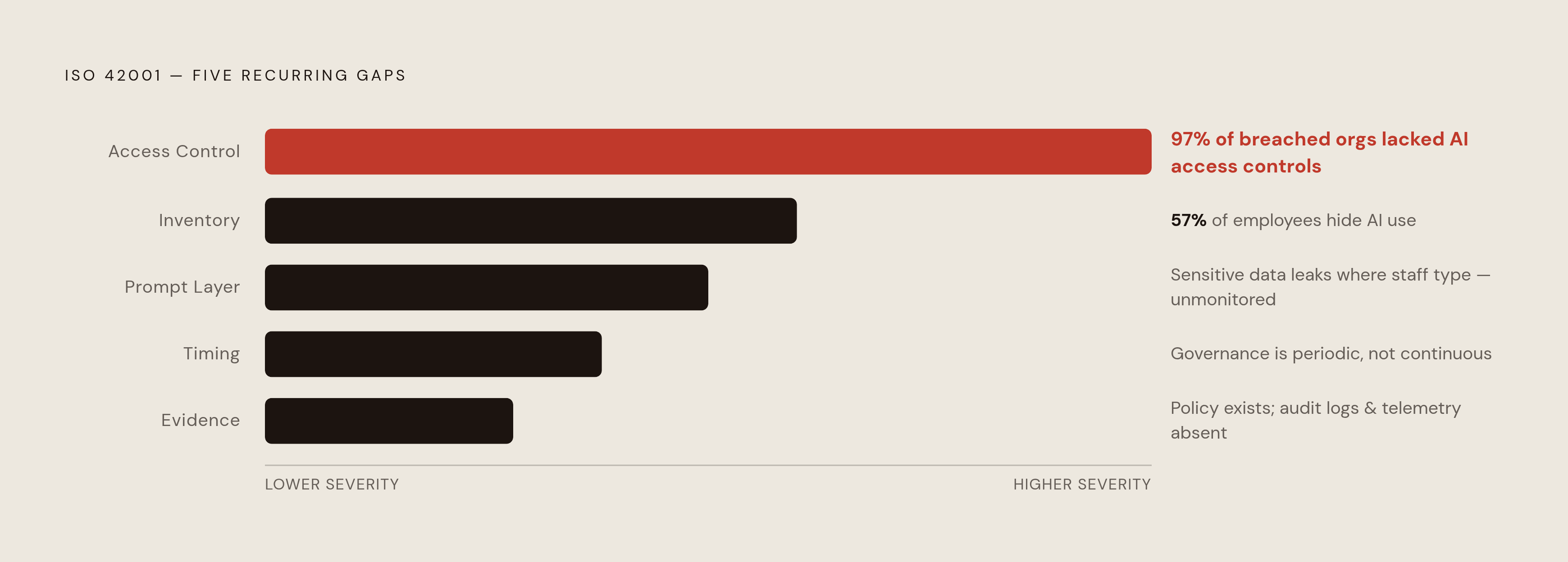
Older compliance methodologies, the ones built for SOC 2, ISO 27001, HIPAA, GDPR, assumed a human could manually gather screenshots and compile a folder of evidence once a year. That assumption made sense for deterministic, stateless systems with predictable behavior. It breaks down fast for AI pipelines that route a single user request through an embedding model, a vector database, a foundation model, and an observability platform, often across four or five different vendors, before a response ever reaches the user (the AI Trust OS paper, arXiv:2604.04749, makes this case in detail). Five gaps show up over and over.
The first is inventory. ISO 42001 requires a structured inventory of the AI systems an organization runs, and most enterprises simply cannot produce one. Shadow AI is the practical symptom: research from the University of Melbourne and KPMG in 2025, covering tens of thousands of workers across dozens of countries, found that 57% of employees hide their AI use from their employer, and nearly half have uploaded company information to public AI tools. Whatever is on the official inventory, the real footprint is bigger, and nobody can risk-assess a system they don't know exists.
The second gap is timing. ISO 42001 Clause 9 calls for ongoing performance evaluation, not an annual checkup, but most governance today is still periodic and self-reported. Models drift, get retrained, and change behavior between audit cycles, so a point-in-time review goes stale the moment someone pushes an update.
The third is access control. ISO 42001's planning and operational controls imply that only authorized users and systems should interact with AI under governed conditions, yet AI access controls in practice are often coarse or missing entirely. Among organizations that reported an AI-related breach, 97% lacked proper AI access controls, according to IBM's 2025 findings. That is not a rounding error. That is nearly every incident sharing the same root cause.
The fourth gap is evidence. An auditor checking ISO 42001 compliance needs proof that controls are actually running, not a policy document asserting that they should be. Most teams have the policy and lack the audit logs, the telemetry, the automated trail that shows the control operated on Tuesday at 3pm and again on Wednesday.
The fifth gap sits at the prompt layer, and it may be the least discussed. ISO 42001's operational controls and the data-related controls in Annex A require data management processes, but traditional data governance, built for databases and file shares, doesn't reach the box where an employee types a prompt. That's exactly where sensitive information is leaking today: Multiple security researchers have documented that a significant share of workers paste sensitive data directly into generative AI tools, with file uploads frequently containing PII or other regulated data. Traditional data-protection tools were not designed to monitor the prompt interfaces where this exposure now occurs.
Why AI systems are structurally harder to govern than the software ISO 42001 sits alongside
Traditional software is deterministic. Feed it the same input twice, get the same output twice, and an auditor can reproduce the result on demand. AI systems don't work that way. They generate outputs that can't be fully predicted from their inputs, which means governance frameworks built for deterministic software don't transfer cleanly, no matter how well-intentioned the copy-paste job.
The multi-vendor pipeline compounds this. A single request through an LLM application might cross an embedding model, a retrieval layer, a foundation model, and an observability platform, each one a separate vendor boundary and each one a potential place where a control quietly doesn't apply. There's also drift: AI systems change behavior between audit cycles through retraining, fine-tuning, or updates to whatever corpus they're retrieving from. Clause 9 and Clause 10 are built to catch exactly this kind of change, but only if the monitoring underneath is watching in real time rather than checking in once a quarter.
Agentic systems raise the stakes further. An agent that calls tools, hits APIs, and chains decisions together autonomously means a single misconfiguration can now touch an entire data estate before a human notices anything is wrong. The AI Trust OS paper (arXiv:2604.04749) frames this as "not an incremental improvement over existing compliance tooling but a categorical architectural shift," and that phrase is doing real work: it means the evidence-gathering itself has to move from manual artifact collection to continuous, telemetry-driven observation. Policy documents, however carefully worded, cannot satisfy a requirement that depends on watching a system behave correctly over time.
The operational infrastructure ISO 42001 compliance actually demands
Five categories of infrastructure separate genuine compliance from a policy binder that looks nice in a boardroom.
Discovery comes first. Clause 4 and Clause 8 can't be satisfied without a live, maintained inventory of AI systems, and finding shadow AI takes more than one signal source. Browser-level prompt visibility, OAuth grant scanning across SaaS tools, and audit-log domain filtering all have to work together, because network DNS and firewall logs alone miss most AI usage, which happens inside a browser tab or an embedded SaaS feature, not on a monitored port. The AI Trust OS framework argues for continuous discovery through observability signals, meaning automated probes that register undocumented systems, rather than trusting employees to self-report what they're using.
Identity and access control come second, and this is where role-based access control (RBAC) starts to show its age. Clause 6 and Clause 8 require that access to AI systems is governed, but RBAC's coarse categories don't hold up against AI-driven decisions. Relationship-based (ReBAC) or attribute-based (ABAC) models allow for finer permissions, so an agent with "viewer" access can summarize a set of project documents but cannot export that data to an external API. Agent identity is its own separate problem, since agents need automated, cryptographically secure authentication rather than the MFA prompts built for humans. Short-lived certificates from trusted PKIs and workload identity federation are the emerging best practice, and tying all of it back into existing identity providers, whether that's one identity platform, another identity platform, or a standard federation protocol, is the realistic path most enterprises will take rather than standing up a parallel credential system built for a single narrow purpose.
Threat detection at the prompt and tool layer is the third piece, and it's arguably the most contested technically. Annex A's data management and risk treatment controls require that sensitive data doesn't leave governed boundaries through AI systems, and prompt injection remains a live, largely unsolved threat. The OWASP Top 10 for Agentic Applications 2026, released in December 2025, names Agent Goal Hijack (ASI01), which folds in prompt injection as a primary vector, as the top threat facing agentic AI. OpenAI itself acknowledged in December 2025 that prompt injection in AI browsers "may never be fully solved." Detection has to happen at the prompt layer, not just the network layer: PII blocking, secret detection, and injection defense need to be built into wherever AI access actually occurs. The practical remediation pattern is straightforward to describe even if it's hard to build: find every AI tool in use, classify each one, redact sensitive data at the prompt level, and steer users toward approved enterprise alternatives.
Observability is the fourth category. Clause 9 requires monitoring and measurement, and Clause 7 requires documented information proving the system runs. A log entry reading "gateway service account called database write tool" doesn't cut it. A log entry that ties the call to a specific human identity, a specific tool, and a specific timestamp does. Tool call tracking, performance analytics, error rates, cost allocation by team, and anomaly detection across usage patterns are the baseline metrics worth capturing. The underlying principle, as the AI Trust OS framework puts it, is telemetry over attestation: continuous posture beats a point-in-time audit, and architecture-backed proof beats a policy document nobody has reread since it was written.
The fifth category is a governed distribution layer for AI tools and agents. MCP servers and agentic skills connecting into internal APIs and SaaS systems are expanding the compliance surface fast, and an MCP gateway gives every tool invocation a single, governed entry point, centralizing authentication, authorization, and audit trails the same way Gartner has long recommended treating any API surface. Skip this layer and connecting agents directly to tool servers creates a sprawl of access points that Clause 8's controls simply cannot reach. An AI control plane, one that connects AI systems to internal and external resources, ties access to identity, and surfaces usage telemetry, is the closest thing to an operational translation of what ISO 42001's management system requirements are actually describing on paper.
How ISO 42001 relates to the other frameworks enterprises are already running
The Harmonized Structure was written deliberately so ISO 42001 integrates cleanly with ISO 27001 and other management-system standards. Organizations already holding ISO 27001 typically have a shorter runway to ISO 42001, with certification timelines of four to nine months, faster still if the ISO 27001 foundation is already solid.
NIST's AI Risk Management Framework organizes guidance across four functions (Govern, Map, Measure, Manage) and has been widely adopted for how adaptable and practical it is. ISO 42001 is more prescriptive and, crucially, certifiable. The two aren't rivals so much as different tools for different jobs: NIST RMF tends to shape internal governance design, while ISO 42001 gives an organization something external, a certificate a customer or regulator can actually check.
The EU AI Act specifies what organizations are legally required to do. ISO 42001 gives them a structured, auditable way to demonstrate they're doing it, without the Act ever needing to name the standard outright. Running all three at once serves a distinct purpose. It's closer to running a belt, suspenders, and a spare pair of pants, which sounds excessive right up until the moment it isn't.
Sources
- ISO/IEC 42001:2023 - AI management systems
- AI Trust OS -- A Continuous Governance Framework for Autonomous AI Observability and Zero-Trust Compliance in Enterprise Environments
- ISO 42001 - AI Management System - Harness its full potential
- ISO 42001 Controls AI Governance: 9 Key Areas for 2025
- airia.com
- isaca.org