Securing AI Coding Assistants in Developer Environments
Organizations must govern AI coding assistants before secrets and vulnerabilities proliferate.
AI coding assistants are generating vulnerabilities, leaking secrets, and creating attack surfaces faster than most security teams can inventory them — like a firehose aimed at a paper cup. The governance infrastructure to manage this exists. Most organizations have not deployed it yet, and a few have learned that lesson the expensive way.
The Specific Risks That Make Ungoverned Coding Assistants a Security Liability
Vulnerable Code at Volume
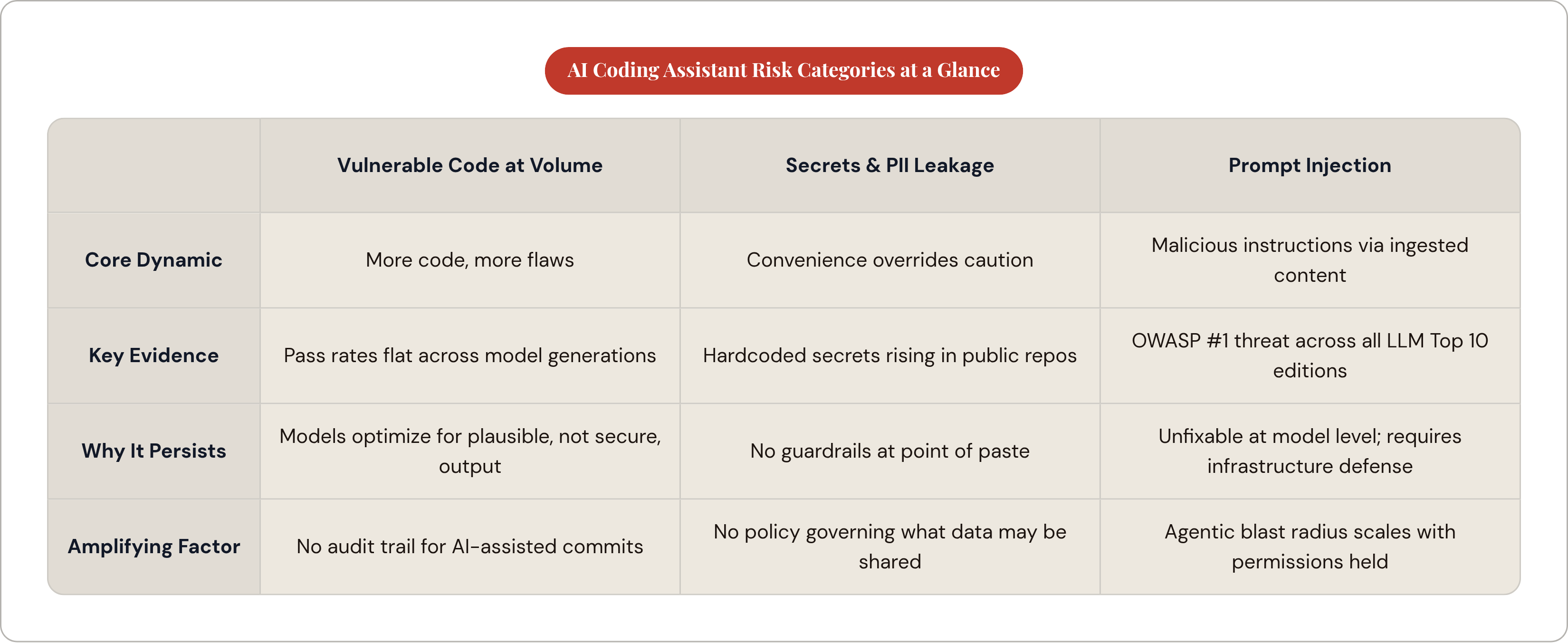
AI-assisted developers produce significantly more code. They also produce a disproportionately higher number of security findings and expose cloud credentials and keys at a higher rate than non-AI-assisted peers, per Apiiro's analysis of Fortune 50 repositories. That combination is not accidental; it reflects how these tools are built. They optimize for plausible output. Secure output is a secondary concern, if it registers at all.
Hundreds of AI-assisted commits per day generate a vulnerability debt that post-commit scanning was never designed to absorb. Veracode's 2025 GenAI research found that security pass rates on AI-generated code have remained roughly flat across model generations and sizes. The industry spent years hoping bigger models would fix this. They have not.
Secrets and PII Flowing Outward
A large share of employees admit to pasting sensitive data, including client records, financial data, and internal documents, into AI tools, even where no organizational policy governs what is permitted, per Anagram's workplace security research. This is not malice. It is convenience. The developer who pastes a database connection string into Cursor to debug a query is not running a threat model in their head at that moment. The tool is useful, the guardrails are absent, and the work is due.
The city of Eindhoven's 2025 transparency report documented employees uploading thousands of files containing personal data to public AI tools in a single month, inside an organization that already had mature security teams. GitGuardian's 2026 research found that AI-assisted commits leak secrets at a meaningfully higher rate than human-authored commits, contributing to tens of millions of new hardcoded secrets appearing annually in public repositories.
Prompt Injection: The Attack Surface Nobody Budgeted For
OWASP has ranked prompt injection first on its Top 10 for LLM Applications across every edition since the list launched, through the 2025 update. It holds that position because it is genuinely hard to mitigate at the model level, which means the burden falls on the infrastructure around the model.
The Kilo Code vulnerability (CVE-2025-11445) illustrates exactly how this plays out in a developer context. An attacker embeds malicious instructions in a README, a GitHub issue, or a code comment. The coding assistant ingests that content during normal repository analysis. The injected prompt modifies the assistant's configuration and causes it to commit and push backdoored code, without user prompting. CVE-2025-53773 separately documented remote code execution via command injection in a major coding assistant integrated with Visual Studio.
In agentic systems, where the assistant can reach multiple systems simultaneously, the blast radius scales directly with the permissions the agent holds. An agent connected to Salesforce, Microsoft 365, and Workday simultaneously exposes the effective authority of every permission it holds across all three — like handing someone a master key ring and then being surprised when they open the wrong door. A Snyk ToxicSkills study found prompt injection present in a large share of AI agent skills, with thousands of malicious payloads identified in the agent skills supply chain. OpenAI publicly acknowledged in early 2026 that prompt injection in AI browsers will never be fully patched. Detection and containment, not prevention, must anchor the defense posture.
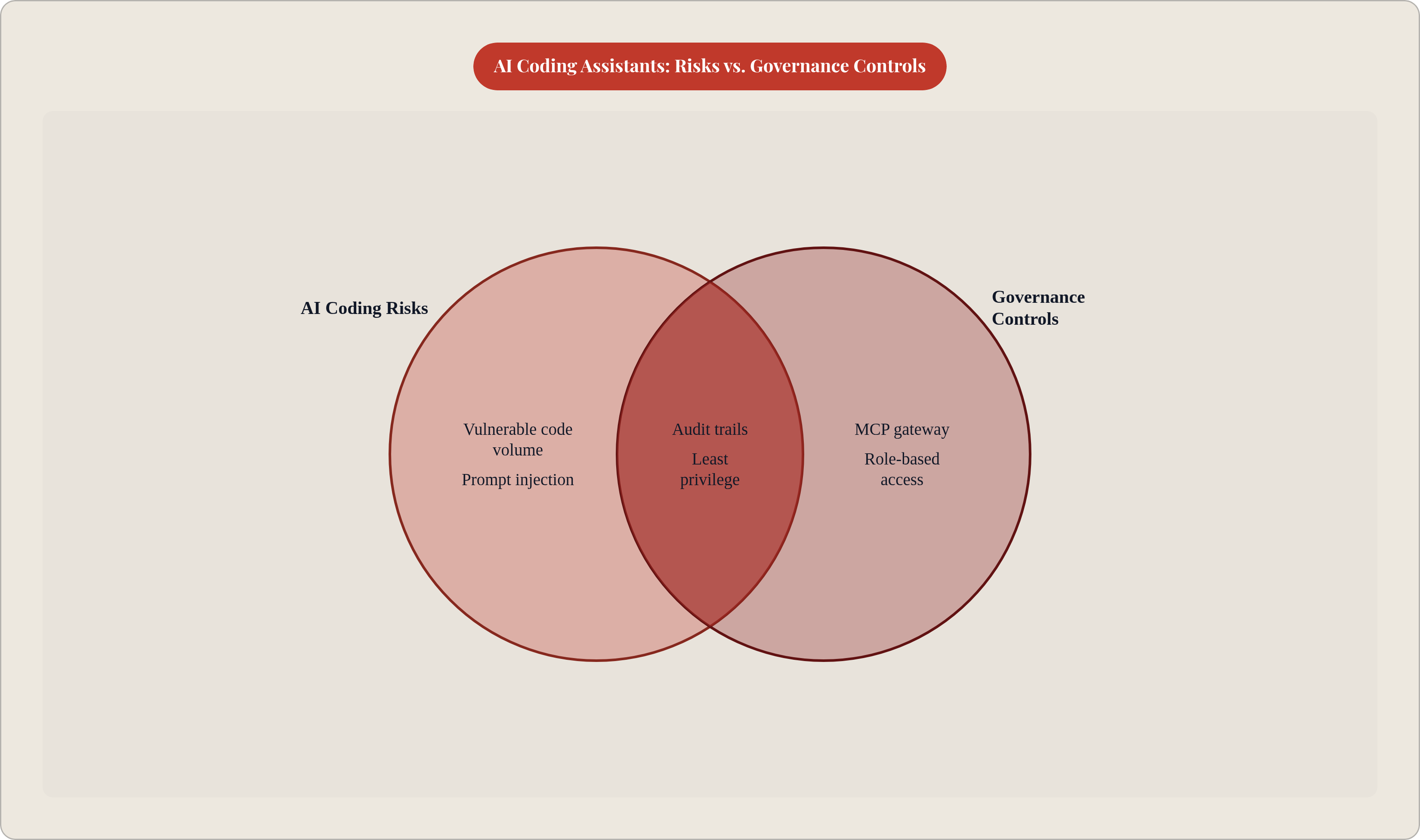
All of these risk categories are amplified by the same underlying condition: no audit trail, no policy enforcement, no central inventory of what is running.
Why Shadow AI in Developer Environments Is Harder to Detect Than Traditional Shadow IT
A 2026 Unseen Security report found that employees were using AI tools that had never been approved or reviewed by IT, yet only a small minority of those organizations had policies designed to detect and manage that usage. The detection gap has structural causes that are worth understanding before you go shopping for tools.
Traditional shadow IT detection relied on network signals: DNS queries to unapproved domains, traffic to unknown SaaS endpoints, application installations triggering endpoint management alerts. None of those signals translate cleanly to AI coding tools. A developer enabling Claude Code inside VS Code, or installing Cursor, does not produce the same network or endpoint signature as spinning up an unapproved SaaS application. These tools live inside already-approved applications and are, from the perspective of a domain blocklist, effectively invisible.
MCP servers make this considerably worse. They can be self-hosted, spun up locally, or run as user-space processes. None of that surfaces in conventional IT asset management. A developer can stand up an MCP server proxying access to internal systems over a weekend, and it will appear in no inventory that relies on network discovery or SaaS usage reporting.
IBM's 2025 Cost of a Data Breach research found that shadow AI-linked breaches cost substantially more than standard breaches. Gartner has projected that a large share of enterprises will face security or compliance incidents linked to unauthorized shadow AI within this decade.
Effective detection requires tooling built around application inventory at the tool level rather than traffic to broad AI provider domains; MCP server discovery that identifies servers running in the environment that were never cataloged; user attribution linking usage to specific people or teams rather than machines or IP addresses; and integration with existing identity providers so governance aligns with access controls already in place. Continuous coverage matters more than point-in-time audits.
Enterprises did not solve shadow SaaS by blocking everything. They built policy enforcement infrastructure that made sanctioned tools easy and unsanctioned tools visible. The same logic applies here, even if the plumbing looks different.
What Access Control for AI Coding Tools Actually Looks Like in Practice
The goal is not to prevent AI tool use. Developers who cannot use AI tools will find other jobs, and the ones who stay will use the tools anyway, just less visibly. The goal is to make unsanctioned use visible and route developers toward sanctioned alternatives, starting with a governed catalog of approved tools and transparent criteria for what earns approval.
Role-based access control for AI tools should flow from the same identity fabric already governing SaaS and internal APIs: Okta, Microsoft Entra ID, SAML, OIDC. Building a parallel access control system for AI tools is an operational tax most organizations will not maintain consistently. A contractor should not have the same AI tool permissions as a full-time senior engineer. A developer working on a regulated workload should operate under tighter constraints than one building internal tooling. These distinctions are already encoded in most organizations' identity infrastructure; extending that logic to AI tools is straightforward if the tooling supports it.
Least-privilege principles apply directly. AI agents and assistants should hold only the permissions required for the current task, not a standing grant to every system they can reach. Scoped, time-limited credentials issued at the moment of need reduce the blast radius of a compromised session or a successful prompt injection. OWASP's LLM06 guidance in the 2025 Top 10 maps precisely to this: the remediation is least privilege plus human-in-the-loop, enforced at the infrastructure layer, not trusted to the model's own judgment.
The human-in-the-loop question matters most in agentic workflows. Not every action an AI coding agent takes requires human approval, but actions with write access to production systems, external repositories, or sensitive APIs should. Defining that checkpoint policy in advance is where the actual governance work happens.
MCP Servers as the New Unmanaged API Surface in Developer Environments
MCP moved from an Anthropic experiment in late 2024 to an industry standard with broad vendor adoption and a public registry hosting thousands of servers by 2026. The protocol was donated to the Linux Foundation's Agentic AI Foundation, with major technology vendors joining as founding members. It became infrastructure fast, which means governance caught up slowly, which is how these things always go.
What MCP does in a developer context is give AI coding assistants structured access to external tools and data: code repositories, internal APIs, documentation systems, SaaS platforms. A developer running Claude Code or Cursor can point those tools at an MCP server that proxies access to internal systems entirely outside any governed layer. The convenience is real. So is the exposure.
The original MCP specification shipped without a comprehensive authentication framework. OAuth 2.1 support was added in mid-2025, and the spec now mandates OAuth 2.1 with PKCE for all protected HTTP-based deployments, requiring HTTPS and discoverable authorization server metadata. That improved the foundation. It did not provide enterprise controls: role-based access control, audit logging, policy enforcement, threat detection. Those are operational problems that require operational solutions, and a spec update does not deliver them.
Ad hoc MCP deployment at enterprise scale creates the same dynamic as ungoverned SaaS: a growing surface area with no central inventory, no consistent access control, and no visibility into what is happening. Tool poisoning occurs when a malicious or compromised MCP server returns tool definitions that manipulate model behavior. Rug-pull attacks involve a server's tool definitions changing after initial approval, silently expanding what the model is permitted to do. Cross-server shadowing describes one MCP server interfering with the behavior of another in a multi-server configuration. None of these appear in a standard API security threat model because none of them involve conventional API abuse. They are novel threat patterns on novel infrastructure, and the standard tooling is not looking for them.
How an MCP Gateway Provides a Governed Layer for AI Tool Access
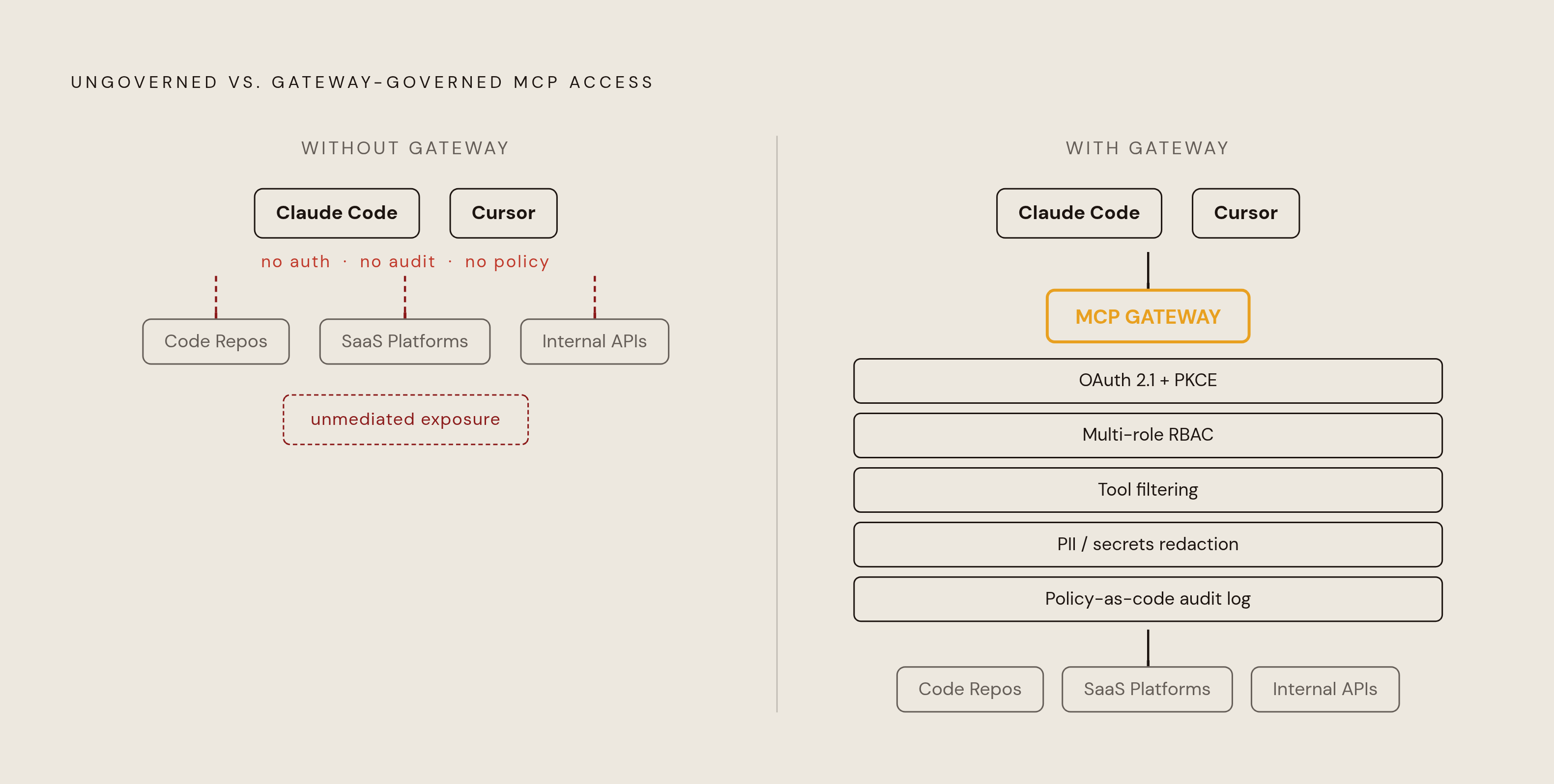
The core pattern is a single, governed entry point that sits in front of MCP servers and enforces policy before requests reach the underlying tools. Without a gateway, AI clients reach MCP servers directly: no authentication enforcement, no audit trail, no policy layer between the model and the systems it can touch. With a gateway, every connection routes through infrastructure that applies consistent controls regardless of which client is connecting.
A well-implemented gateway centralizes authentication so that all AI agent connections authenticate through the existing identity provider rather than through per-server credential management. It enforces multi-role RBAC, governing which users and agents can access which MCP servers and which tools within those servers. It surfaces a curated server catalog so developers can self-serve from approved tools rather than connecting to arbitrary servers. Per-user OAuth passthrough ensures that downstream systems see the identity of the human user, not a generic agent credential. Policy-as-code means enforcement rules are version-controlled, auditable, and consistently applied.
Tool filtering is particularly important for reducing prompt injection exposure. By suppressing tools that an agent does not have permission to use, a gateway reduces the attack surface the model can act on. PII and sensitive data redaction before content reaches the model addresses the leakage risk at the point where it can actually be intercepted.
MCP-specific threats require MCP-specific defenses. A generic API gateway does not detect rug-pull attacks because it has no model of what approved tool definitions look like at baseline. It does not detect tool poisoning because it has no semantic understanding of what a tool definition is meant to do. Gartner's emerging practices guidance recommends a gateway-centric architecture for MCP on the same basis as any other API surface. The governance principle is not novel; applying it to MCP-specific threat patterns requires tooling that was built for the purpose.
By requiring all connections to route through governed infrastructure, a gateway makes unauthorized server connections visible and blockable without requiring developers to change their tools.
The Vendor Landscape for Governed AI Coding Tool Infrastructure
The market for AI governance tooling has developed quickly, though "developed quickly" and "matured" are not the same thing. Most of these vendors are relatively young, and enterprise buyers should weight operational track records alongside feature claims, especially for anything touching detection. The demo environments tend to be impressive. Production environments are where you find out.
Shadow AI Detection and Enforcement
Kirin monitors file access, command execution, and data flows in real time, identifying when shadow AI tools, including unauthorized instances of Claude Code, Cursor, and Copilot, are active in the environment. It integrates with Okta and Entra ID for identity-aligned enforcement, which is practically useful in organizations that have already built their access control around those platforms rather than requiring a parallel identity stack.
WitnessAI focuses on enterprise AI governance with policy enforcement and observability capabilities. Zenity was named a Representative Vendor in the 2025 Gartner Market Guide for AI TRiSM. Microsoft Defender for Cloud Apps added AI-specific detection capabilities in 2025 and 2026 for organizations already operating in the Microsoft security stack. Nightfall AI and Harmonic Security focus specifically on data loss prevention for AI traffic, with PII and secrets leakage detection as their primary use case.
MCP Gateway and AI Control Plane
Real-time detection of prompt injection, PII leakage, and secrets exposure requires visibility at the layer where the coding assistant operates, not after code is committed.
The enterprises that got ahead of shadow SaaS did so by building infrastructure that made the governed path easier than the ungoverned one. The ones that reacted after incidents spent considerably more to reach the same destination, with breach costs and regulatory scrutiny as the premium.