Integrating AI Agent Authentication with Okta
Okta treats AI agents as distinct identities with enforced credentials and continuous oversight.

Agents inside the enterprise are proliferating faster than governance frameworks can keep up, and almost nobody has a system for governing what those agents can touch. Okta's answer is to stop treating agents like a weird cousin of the service account and start treating them as their own category of identity: something with a birth certificate, a leash, and an off switch. This piece walks through what that means architecturally, and why bolting agent auth onto frameworks built for humans breaks down fast. Static credentials are the failure mode to watch here, full stop, and everything Okta has shipped in the last year is aimed at killing them.
How fast agents are proliferating inside enterprises, and how little governance exists
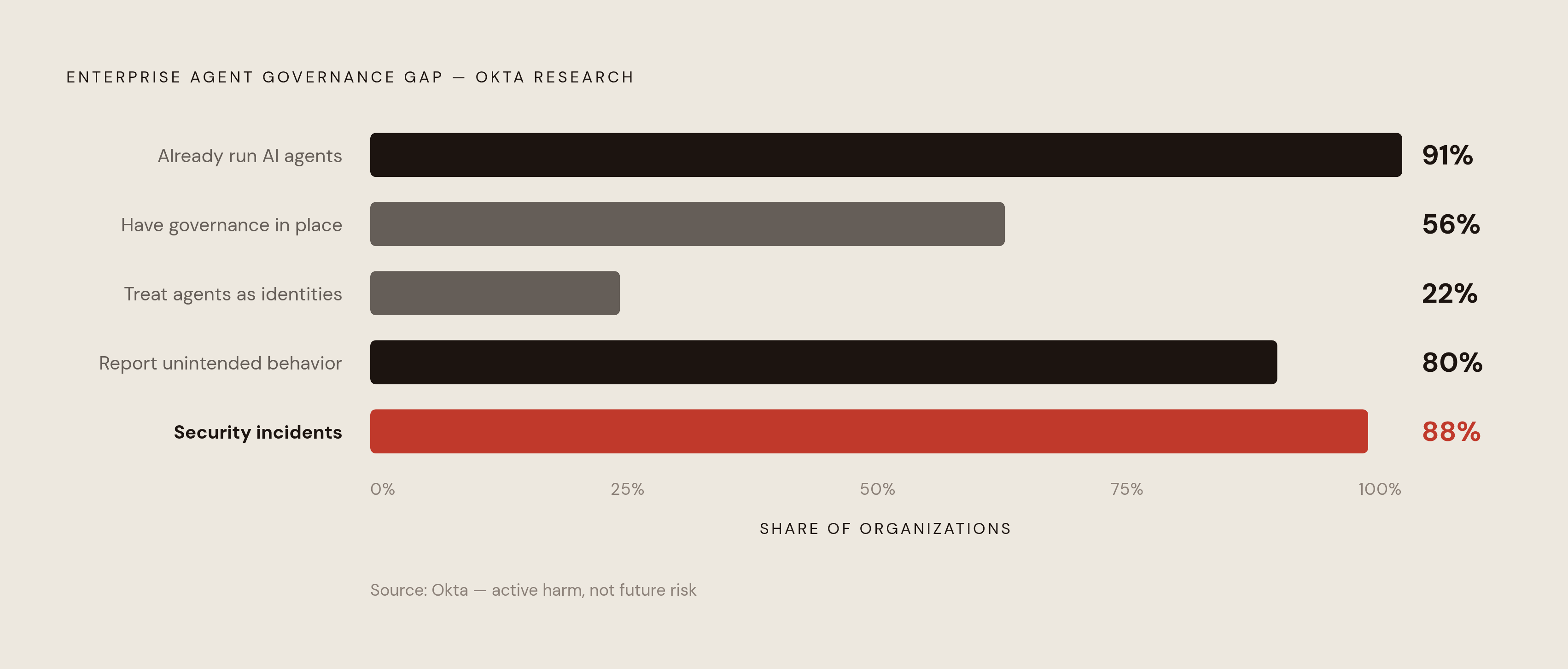
Okta's "AI at Work 2025" research found 91% of organizations are already running AI agents. Only 56% have any governance in place for them, which leaves the other 44% letting software make decisions with no rulebook and no referee. Worse, per Okta research cited in its March 2026 blueprint announcement, only 22% of organizations treat agents as independent, identity-bearing entities. The other 78% manage them as something they are not: usually a service account, sometimes a shared login, occasionally an API key taped to the inside of a team chat thread.
The fallout shows up in the numbers. Okta puts unintended agent behavior at 80% of organizations and suspected or confirmed agent-related security incidents at 88%. That's not a rounding error. That's most of the enterprise landscape running production agents with no seatbelt.
Some of this is shadow IT wearing a new costume, and a more dangerous one at that. A developer spins up an agent to automate a workflow, wires in an API key, and never tells the identity team it exists. The agent now has standing access to whatever that key touches, invisible to anyone doing a security review. An unsanctioned script sitting on a laptop is a liability. An unsanctioned agent with a live token can query a production database at 2 a.m. with nobody watching, and that's a different order of problem entirely.
Every security team looking at this mess is really answering three questions: where are the agents, what can they connect to, and what can they actually do once connected. Okta's product architecture answers exactly those three, in that order.
How Okta models agent identity: the concepts and constructs that matter
Agent identity, in Okta's framing, is not a login. It's a lifecycle. A unique, verifiable identity ties to specific privileges, specific context, and continuous oversight, from the moment the agent gets registered to the moment it's retired. That's a different object than a username and password, and treating it like one is the mistake that put the majority of organizations where they are now.
Agents register in Universal Directory as first-class citizens, with ownership attribution attached, kept separate from both human accounts and traditional service accounts. That separation matters because it's the only way an audit later answers "whose agent is this" without someone digging through a messaging app's history.
Okta's identity-101 resource identifies what sets agents apart from other non-human identities. Key distinctions include scoped and auditable credentials that expire on their own, real-time policy decisions based on what the agent is actually doing, and watching agent behavior against its authorized scope so drift gets caught before it becomes a headline.
There's also a kill switch, and it isn't decorative. Revocation has to work instantly, because a rogue agent doesn't wait for a ticket to get assigned. The Okta Integration Network now carries dedicated support for agent platforms, with Boomi, DataRobot, and Google Vertex AI named in the March 2026 blueprint, so teams can import agents built on those platforms and register them as governed identities instead of mystery guests. On top of all this sits an Identity Security Posture Management layer that scans continuously for risky agents and exposed credentials, not just at first provisioning.
Okta for AI Agents: what the platform provides across the agent lifecycle
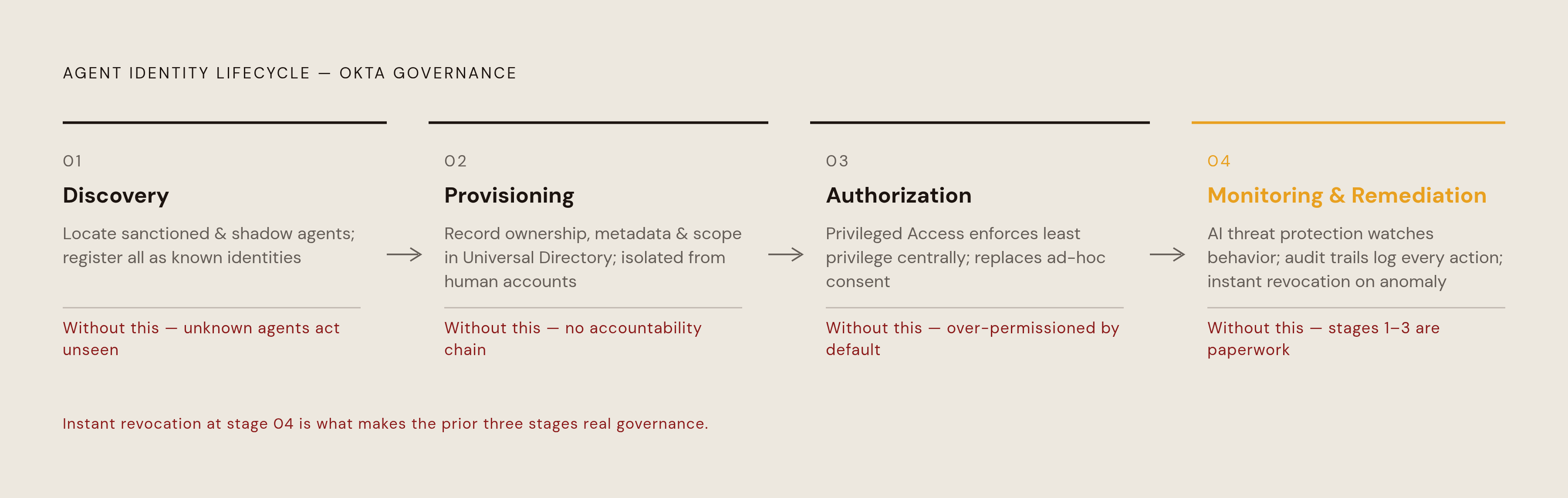
Okta for AI Agents was announced March 16, 2026, with general availability set for April 30, 2026. The lifecycle it governs breaks into four stages, and each one solves a distinct failure mode.
Discovery comes first: finding both the sanctioned agents brought in through OIN integrations and the shadow agents that exist outside formal governance, then registering all of them, employee-facing, customer-facing, or partner-facing, as identities the system actually knows about.
Provisioning uses Universal Directory as the single registry, recording ownership, metadata, and scope for every agent, kept separate from human accounts and traditional service accounts.
Authorization is where Okta Privileged Access enforces least privilege at the agent level, replacing the old pattern of ad-hoc, per-integration consent with policy decisions made centrally. Okta Identity Governance, historically a tool for certifying human access, now applies that same certification and enforcement logic to non-human identities.
Monitoring and remediation close the loop. AI-driven Identity Threat Protection watches for unusual agent behavior around the clock, audit trails capture agent actions and automated remediation, including instant revocation, kicks in when something looks wrong.
For developers building agents into customer-facing or B2B products, the Auth0 Platform capabilities announced September 25, 2025 bring secure agent flows directly into Auth0, so verified user context passes through to the agent instead of getting lost the moment a human hands a task to software.
Cross App Access and how Okta moves authorization to the identity layer
Agents that need to talk to a dozen enterprise apps have, until recently, done it through a patchwork of risky integrations and repeated consent prompts. Nobody had central visibility into which agent was connecting to what, and end users got so many "allow this app to access your data" pop-ups that most just clicked yes without reading them.
Cross App Access is Okta's fix: an open standard that extends OAuth to cover agent-driven and app-to-app interactions. The architectural move underneath it matters more than the name. Access control shifts out of individual applications and into the identity layer, so the identity provider becomes the one authority deciding whether a connection is allowed, instead of each app making that call on its own.
In practice, integrations get pre-approved once at the identity layer rather than re-approved every time an agent touches a new app. Policy decisions replace one-off agreements, and admins get a real-time view of which agents are connecting to which systems, under which conditions, instead of finding out after the fact.
Automation Anywhere, Boomi, Box, and Glean Technologies signed on as launch partners, which signals the standard is meant to work across vendors rather than lock everything into Okta's own stack. Governance capabilities are also available through the Auth0 Platform for developers building externally distributed agents.
The standards side is worth flagging too. The Model Context Protocol's November 2025 revision added Cross App Access semantics and tightened its existing OAuth 2.1 authorization requirements (OAuth 2.1 had already been set as a baseline in the March 2025 revision, with authorization server separation added that June). Okta's standard is quietly becoming part of the plumbing agents use to reach tools, not a bolt-on feature. A further extension, Enterprise-Managed Authorization, formalizes enterprise identity providers as the authoritative gatekeeper for MCP server access, which positions Okta to be exactly that gatekeeper.
Credential management for agents: why static tokens are the core vulnerability
Most agents today authenticate with personal access tokens, developer-issued API keys, or long-lived static secrets, the kind of credential that predates modern identity controls and routinely bypasses the corporate identity provider entirely. That's not a minor gap. It's the whole model failing before it starts, and it's the single biggest thing wrong with how agents get deployed today.
Zero trust architecture runs on dynamic credentials and just-in-time access, verified continuously rather than once at login. A static key that never expires makes continuous verification a slogan, not a mechanism, since there's nothing left to verify once the key is issued. Credentials pile up fast, too: an agent connecting to dozens of tools racks up tokens with no central inventory of what exists, who owns it, or when, if ever, it expires. Okta's research puts credential exposure via agents at 23% of organizations, which is the direct, measurable cost of that pile-up.
Well-managed agent credentials look different on every axis. They're cryptographically verifiable and unique to a single agent, scoped tightly rather than shared across a team, time-bound with rotation handled automatically instead of by whoever remembers to do it, and tied back to the agent's registered identity so revocation is instant rather than a multi-step cleanup job. Okta's approach automates the issuance and refresh of access tokens, so agents pull short-lived tokens through authorized flows instead of sitting on a permanent secret indefinitely.
Multi-agent workflows add a wrinkle: delegation. When one agent hands a task to another, that handoff needs its own scoped, auditable credential at each hop, not a copy of the original agent's full permission set passed down the chain like a family heirloom nobody bothered to appraise. Passing full scope down a delegation chain is how a narrow task turns into a wide-open door three hops later.
Implementing least-privilege access for agents in an Okta-governed environment
Least privilege for a person usually means a role assigned at onboarding and reviewed once a year. That model doesn't hold for an agent, because what an agent needs access to changes based on what it's doing right now, not what title it got at setup. Anyone still applying the annual-review model to agent access is solving a problem that expired months ago.
A workable model runs on three layers. First, what the agent's identity can access at all: the permissions established when it registers in Universal Directory. Second, what it can do on behalf of a specific user, enforced through delegated OAuth flows that pin the agent to that user's own permission scope rather than the broader scope of a shared service account. Third, which tools the agent can even see, using deny-by-default filtering so sensitive capabilities don't show up in its available toolset unless someone explicitly turned them on.
Okta Privileged Access handles the elevated-access cases, enforcing least privilege at the agent level instead of standing access that sits open indefinitely. For retrieval-augmented generation pipelines specifically, permissions need to be granular enough that an agent pulling data on a user's behalf sees only what that user is entitled to see, not the sum of everything the integration account it's running under can technically reach.
For high-stakes actions, The Auth0 Platform supports agent workflow controls that keep human oversight in the loop before high-stakes actions execute. Behavioral validation runs continuously in the background, too: when an agent's actions drift from its authorized use case, that anomaly triggers a policy re-check rather than sitting there until it turns into an incident report.
This maps directly onto what OWASP's Top 10 for LLM Applications (2025) calls excessive agency, the risk that an agent has more reach than its job requires. Model-level permissions say nothing about whether an agent can delete a customer record, post to a public channel, or run a query against a live production database. That's an identity and access problem, not a model problem, and it gets solved at the identity layer or not at all.
Connecting agent identity to existing enterprise identity infrastructure
Most enterprises already run Okta, or something like it, to govern human identities. The goal isn't a second, parallel system for agents. It's extending the governance that already exists to cover a new category of identity without rebuilding the whole stack, which is the only version of this that survives contact with a real IT budget.
Okta's federation capabilities are built to be IdP-agnostic, so agent governance plugs into the SAML or OIDC flows an organization already runs rather than demanding a rip-and-replace. Agents authenticate through the same OIDC flows configured for human single sign-on where that's in place, or through SAML in shops that haven't fully moved off it. For autonomous agents operating without a human in the loop at all, the OAuth 2.1 client credentials flow does the job, the same pattern Microsoft's Entra Agent ID uses architecturally for its own autonomous agents.
Entra Agent ID, which reached general availability in May 2026, is worth knowing even outside a pure-Okta shop, since plenty of enterprises run hybrid Okta and Entra environments. Architecturally, it treats an agent identity as a specialized service principal that pulls short-lived tokens through its blueprint rather than sitting on a persistent credential, the same underlying idea Okta enforces through its own token automation.
The standards underneath all of this are moving fast, too. OAuth 2.0 Protected Resource Metadata became RFC 9728 in 2025, which matters for how agents discover authorization server metadata in the first place. MCP added OAuth 2.1 support in March 2025 and refined it that June, and PKCE plus dynamic client registration are now baseline expectations for anything connecting through MCP.
Put together, the practical sequence looks like this: register the agent in Universal Directory, configure a scoped OAuth client for it, connect that identity to existing Okta access certification policies, then turn on Identity Threat Protection monitoring for its traffic. Four steps, not forty, though each one has to actually happen, and skipping step three is how the whole thing quietly stops being governance.
Observability and audit logging as a governance requirement, not an operational afterthought
Okta's own research puts the number at 44%: organizations with no governance at all for agents already running in production. For nearly half the enterprise landscape, nobody can say with confidence what those agents accessed yesterday, let alone six months ago. That's not a gap. That's flying blind with the autopilot engaged.
Agent observability needs to capture more than a human audit log ever did. Authentication events, meaning which agent logged in, when, from where, under what identity, are table stakes. Authorization decisions matter too: which requests got approved or denied, and on what policy basis. Then there's action-level logging, the actual tool calls, data pulls, and record changes an agent made once access was granted, plus delegation chain logging, so when Agent A hands a task to Agent B, that handoff stays traceable end to end instead of disappearing into a black box.
Reasoning process logging is the one most organizations skip, and it's the one they shouldn't. Recording the decision steps an agent took, not just the final outcome, is often the only way to reconstruct what went wrong during an incident, and it's exactly the kind of evidence regulators are starting to ask for directly. The EU AI Act requires effective human oversight of high-risk AI systems, and an audit log is the paper trail that proves oversight happened rather than just claiming it did after the fact.
Okta's monitoring stack ties this together on the back end. AI-driven Identity Threat Protection handles real-time anomaly detection, Okta Identity Governance handles audit trails and access certification, and both feed the same logging pipeline already used for human identity governance, so security teams aren't running two separate systems side by side.
There's a cost angle buried in here too, easy to miss next to the security framing. Knowing which agents are making how many calls to which systems isn't just a compliance box to check, it's the data that tells a finance team which agents are worth the infrastructure spend and which ones are quietly burning API budget for no measurable return. Governance and cost control turn out to be the same spreadsheet, whether anyone in the room wants to admit it or not.