Shadow AI Risks Specific to Enterprise Data Environments
Employees bypassing security to leak corporate data through unmonitored AI tools.
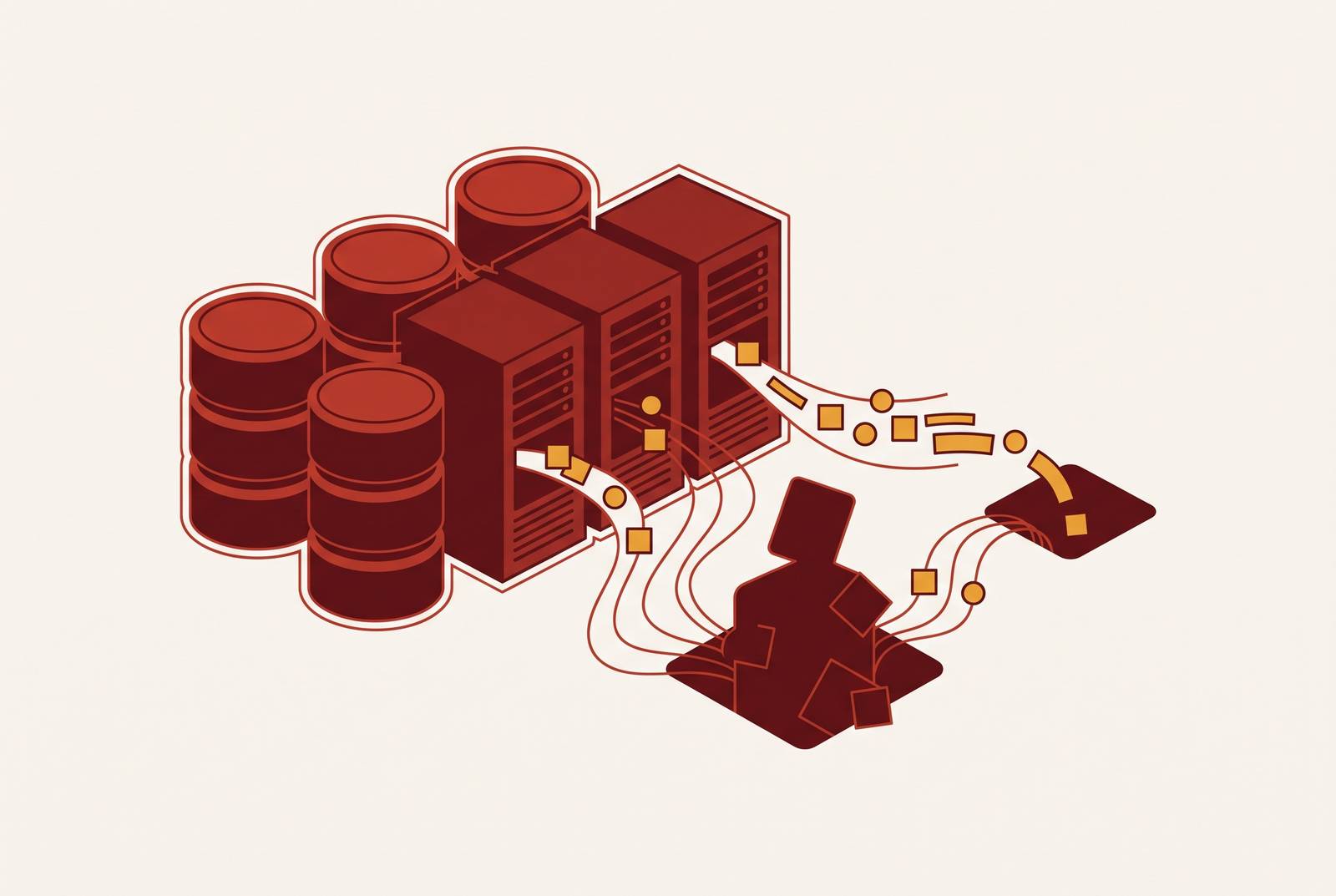
Three doors, mostly propped open. The first is the employee with a personal ChatGPT, Claude, or Gemini account, logged in under a personal email but pasting in work data because the free tier answers faster than the internal help desk ever will. The second is the developer wiring an AI API straight into internal tooling with nobody from security in the room, the "vibe coding" pattern where AI-generated code gets merged into production because it compiled and the demo looked fine. Third is the line-of-business team standing up an agentic workflow that talks directly to internal APIs, databases, and SaaS systems, usually with far more access than the task needs.
The personal-account door deserves the most worry, because IT has zero visibility into it. There's nothing to audit and nothing to revoke, nothing to even know is happening until it shows up in a headline. That headline has already run more than once: employees pasting source code into a public model to save twenty minutes — Samsung's 2023 incident being the canonical example — turning into the case study everyone cites at the next security briefing and nobody actually changes their behavior over.
Agentic workflows are the newer, nastier vector. Someone builds an internal agent to answer employee questions about HR policy or expense reports, and somewhere in the setup it gets broad read access to systems that have nothing to do with HR or expenses, because broad access was easier to configure than scoped access. Without hard limits on what it can touch, that agent stops being a helpful assistant and becomes an unmonitored side door into whatever it happens to be connected to. Agents run at machine speed, so the kind of mistake a person would catch before hitting send can already be three systems downstream before anyone notices it happened. And because so much of this traffic funnels through a small handful of dominant AI platforms, a single incident or policy change at one provider stops being a vendor problem and becomes an enterprise-wide one.
The data exfiltration paths that existing controls miss
Data loss prevention tools watch files, email attachments, and sanctioned apps. They were built for a world where sensitive data moved as a document or a message, and a prompt looks like neither. A paste into a browser-based chat window reads to most endpoint agents as ordinary web traffic, indistinguishable from someone checking the weather. File uploads to AI tools often carry PII and payment data, exactly the categories that would trip an alarm going out over email, and those same uploads sail through untouched on an AI platform.
There's no sent-items folder for a prompt, either. Once data goes in, there's no enterprise-side record of what left or what came back. That missing paper trail is worse than the leak itself in a lot of ways: a leak you can trace is a leak you can contain, and this one leaves nothing to trace.
Intellectual property takes the same route. An engineer shares a proprietary algorithm or a draft of an unreleased product plan to get help debugging it, and depending on the provider's training policy, that input doesn't necessarily stay put. Depending on a provider's data retention and usage policies, inputs don't necessarily stay put, so a company's own IP can end up in a system it doesn't control and can't pull back out. Vibe coding compounds this: developers share chunks of the internal codebase to get better-fitting generated code, and that code often lands in production without real review, carrying whatever vulnerabilities rode along with it. The audit gap ties all of it together, with no logs, no attribution, and no way to reconstruct what actually left the building or when. Figuring out what happened after the fact is nearly as hard as stopping it in the first place.
Compliance exposure when AI tools touch regulated data
People at work aren't just using AI. They're using it on data that comes with legal strings attached, around processing, consent, storage, and where it's allowed to travel.
Under GDPR, personal data handled by an unapproved third-party processor without a data processing agreement in place is a violation on its face, and it gets worse if that AI provider sits outside the EU. Under HIPAA, protected health information typed into a public AI tool, even by accident, can count as an unauthorized disclosure, and the covered entity is on the hook regardless of whether the employee meant any harm. Then there's the newer layer: the EU AI Act carries steep financial penalties for prohibited practices, with a separate tiered structure for high-risk system violations, and by mid-2025 more than 75 countries had either passed or started drafting AI-specific legislation of their own.
These penalty regimes stack instead of canceling out. A financial services firm running an AI system that also processes personal data can end up facing EU AI Act exposure on top of GDPR exposure on top of DORA exposure, all from the same underlying misstep. Most organizations don't yet have a process to check whether an AI tool clears these bars before employees start using it, which means the exposure exists well before anyone in compliance even knows the tool is in play. Healthcare, financial services, and legal carry the sharpest version of this problem, because their data is the most tightly regulated on paper and, in practice, often the least watched for anything AI-shaped moving through it.
Why agentic AI makes ungoverned access to sensitive systems a structural problem
A chatbot risks a data leak, while an agent risks a data leak plus whatever else it was authorized, correctly or not, to go do. Treating agent governance like a bigger chatbot problem is where most governance plans fall apart.
Agents query databases, call APIs, write files, and kick off workflows on their own; they act rather than just respond. They also run continuously, so the exposure is constant rather than tied to the single moment someone hit enter. Multi-agent setups raise the stakes further: one agent's output becomes another agent's input, and whatever authorization the first agent had travels down the chain to the next one, compounding with each hop.
Underneath most of this sits the shared service account problem. Agents spun up without IT's involvement tend to run under one shared credential with wide permissions, and if there's no way to ask the agent "who are you acting for right now," the access log is close to useless for tracing anything back to a person. Governance built for static models doesn't map onto this. An agent needs a defined objective, tool permissions with real limits, boundaries on what it can hand off to another agent, spending caps where money is involved, and a kill switch someone actually knows how to pull.
Many enterprises treat agent governance as a policy document to write later, once the pilot proves out, and that sequencing causes most of the damage. Most enterprises running agents in production today can't answer basic questions about the agents they already have live, who authorized this one, what can it touch, who does it act for. Gartner's research on this finds a large majority of IT application leaders view AI agents as a genuinely new attack vector, yet only a small minority believe their own governance can handle one. Agentic AI is already inside the data environment, running with fewer controls than the average SaaS subscription gets.
Prompt injection and real-time threats that target the AI layer itself
OWASP ranks prompt injection as the top vulnerability in LLM applications, and that ranking reflects something structural, not a corner case dreamed up in a lab. Language models can't reliably tell the difference between an instruction from the person who's supposed to be in charge and an instruction buried in content the model is merely reading.
In an enterprise setting, that means an attacker can hide instructions inside a document, an email, or a database record that an AI agent processes as part of its normal job. The agent then carries out those hidden instructions using whatever permissions it already has, which in an ungoverned setup might include reaching into sensitive APIs, file systems, or messaging channels. The EchoLeak vulnerability, tracked as CVE-2025-32711, showed this in practice: a zero-click attack against a major enterprise AI assistant pulled off data exfiltration without the user ever opening a malicious file. The attack surface was the AI's own background processing, working exactly as designed.
Security researchers have clocked attack success rates against agentic systems high enough that prompt injection has to be treated as an expected pattern, not an edge case. OpenAI itself has acknowledged that prompt injection in AI browser contexts might never be fully solved, a fairly blunt admission that this can't be left entirely to the model provider to fix. There's a quieter risk sitting next to it too: AI tools surfacing credentials, tokens, or personal data that show up somewhere in their training context or retrieval pipeline, a leak channel sitting completely outside what DLP tools are built to watch. All of it points to the same conclusion: these threats get caught at the AI layer while they're happening, or they get written up afterward in an incident report nobody wanted to file.
What MCP servers and tool-calling agents add to the attack surface
Model Context Protocol went from a new idea to standard infrastructure for wiring AI agents into internal tools, APIs, and data sources faster than security teams could keep pace with it. The original spec shipped without a full authentication framework built in, so companies that adopted MCP early were left without a clean way to enforce identity or access policy at the protocol level itself.
A handful of attack patterns have already shown up. Prompt injection through tool responses, where a compromised or malicious MCP server slips instructions into what looks like ordinary tool output and the agent just runs them. Tool permission stacking, where a series of individually harmless tool calls add up to an exfiltration path that no single tool would have allowed on its own. And lookalike or "rug-pull" tools, where a trusted MCP server gets swapped out for a malicious one the agent has no way of telling apart from the original.
Inside an enterprise, an MCP server might be the thing connecting an agent to an internal database, a CRM, a code repository, or a financial system, so a compromised or misconfigured connection is a direct line to something that matters. The fix looks like the API gateway pattern applied one layer up: an MCP gateway sits between agents and the servers they're calling, enforcing identity checks and role-based access without requiring every individual MCP server to build its own security from scratch. Pushing identity down to the individual user closes the shared-credential hole, since the agent is now acting on behalf of one specific authenticated person instead of a generic service account. Skip this layer, and companies end up right back where shadow SaaS left them: dozens of unsanctioned connections proliferating quietly, except this time the connections have live access to production systems instead of just a spreadsheet.
Why identity and access controls are the practical foundation of AI governance in data environments
Nearly all of this traces back to one root issue: AI tools and agents act without any verifiable identity attached, so nobody can answer "who authorized this" or "what was this thing actually allowed to touch." Everything downstream, the exfiltration, the compliance exposure, the agent running wild, is a symptom of that one missing piece.
Blanket bans carry their own limits. Survey data consistently shows employees keep using personal AI accounts after a company bans them outright, because the ban doesn't touch the underlying need for a faster way to get work done. Manual review of every AI tool carries similar limits, since it doesn't scale when an organization has hundreds of them running across different teams at once. Role-based access control tied to the identity systems already in place, Okta, Entra ID, SAML, OIDC, scales better, because it lets AI governance extend the same rules already governing human access instead of inventing a parallel system from scratch. Extending what already works tends to hold up longer than building something new that nobody will maintain past the second quarter.
Agent identity needs the same fix. An agent running under a shared service account has no identity worth the name, so nobody can attribute its actions to a person or scope them to that person's authorization. The fix is having the agent's permissions derive from the specific user it's acting for, rather than granted once at setup and left alone for a year. On top of that: centralized access control governing which AI tools and agents can reach which systems, enforcement that happens in real time instead of at the next scheduled audit (agentic systems can do damage faster than any audit cycle catches it), and full logs capturing not just what got accessed but which agent did it, on whose behalf, and under what authorization. Companies that already built out identity governance for their SaaS stack aren't starting from zero here. The architecture exists; it just hasn't been extended to cover the AI layer in most places yet.
Building the governance layer that matches the actual risk profile
No single control fixes this. It takes a layered approach covering discovery, access, enforcement, and the ability to actually see what's happening, because each of these risks slips past a different kind of defense.
Discovery comes first, if only because governing something invisible isn't actually possible. That means visibility into AI-related traffic specifically, not just logs from the handful of applications that got formally approved, and it means going back through the existing SaaS portfolio to find AI features that got quietly bolted onto tools already running in production, features nobody separately reviewed because they arrived as a software update instead of a new purchase.
From there, access and identity form the core of the whole structure: tying AI tool access to the identity providers already governing human access, so AI permissions inherit the same rules instead of requiring a separate policy built from scratch. Get that piece right, and most of the rest, the exfiltration paths, the compliance exposure, the ungoverned agents, stops being unanswerable. Get it wrong, and no amount of policy language in an employee handbook is going to matter once the data's already gone.