MCP Gateway Vendors Compared on API Governance and Policy Enforcement
Enterprise teams deploy AI agents 150,000 times faster than governance infrastructure can scale.
MCP Gateway Vendors Compared on API Governance and Policy Enforcement.
Why MCP's native protocol leaves enterprise teams exposed
Governance depth is the axis vendors treat most differently, and it's the one enterprise security teams check last. That order is backwards. A gateway survives a security review based on who can call which tool, under whose identity, with what audit trail sitting behind it, not on how fast it moves packets from point A to point B.
MCP, introduced in November 2024 by Anthropic, is now the default way to connect AI models to outside tools, picked up by OpenAI, Google DeepMind, Microsoft, and thousands of development teams. The numbers back that up: over 97 million monthly SDK downloads, more than 10,000 active servers, and client support baked into ChatGPT, Claude, Cursor, Gemini, Microsoft Copilot, and Visual Studio Code https://www.requesty.ai/blog/mcp-gateway-comparison-2026-enterprise-scalability-security. Some counts put the public MCP registry past 9,400 servers, with enterprise adoption crossing 78% among production AI teams https://www.requesty.ai/blog/mcp-gateway-comparison-2026-enterprise-scalability-security.
The Agentic AI Foundation grew to 170 member organizations within four months of its December 2025 founding, more than double what CNCF had logged at the same point in its own history https://www.requesty.ai/blog/mcp-gateway-comparison-2026-enterprise-scalability-security https://www.getmaxim.ai/articles/best-mcp-gateways-in-2026-compared-by-deployment-model-and-governance-depth/. None of that foundation work touches the protocol's actual gap. MCP standardizes how an agent asks a tool to do something. It says nothing about who's allowed to ask, what happens once that ask gets approved, or where the record of it ends up. Foundation governance and runtime governance are two different problems wearing the same jacket, and any enterprise team that treats them as one is the team due for an ugly surprise in its next audit. In December 2025, Anthropic donated MCP to the Agentic AI Foundation (AAIF) under the Linux Foundation, with Anthropic, OpenAI, and Block as co-founders and AWS, Google, Microsoft, Cloudflare, and Bloomberg signed on as Platinum members.
The agent sprawl problem that makes the governance gap urgent
Gartner expects 40% of enterprise applications to carry an embedded autonomous AI agent by the end of 2026 https://www.requesty.ai/blog/mcp-gateway-comparison-2026-enterprise-scalability-security. That makes agents a default feature of enterprise software, not a niche experiment, and they're arriving faster than most security teams built a process to handle.
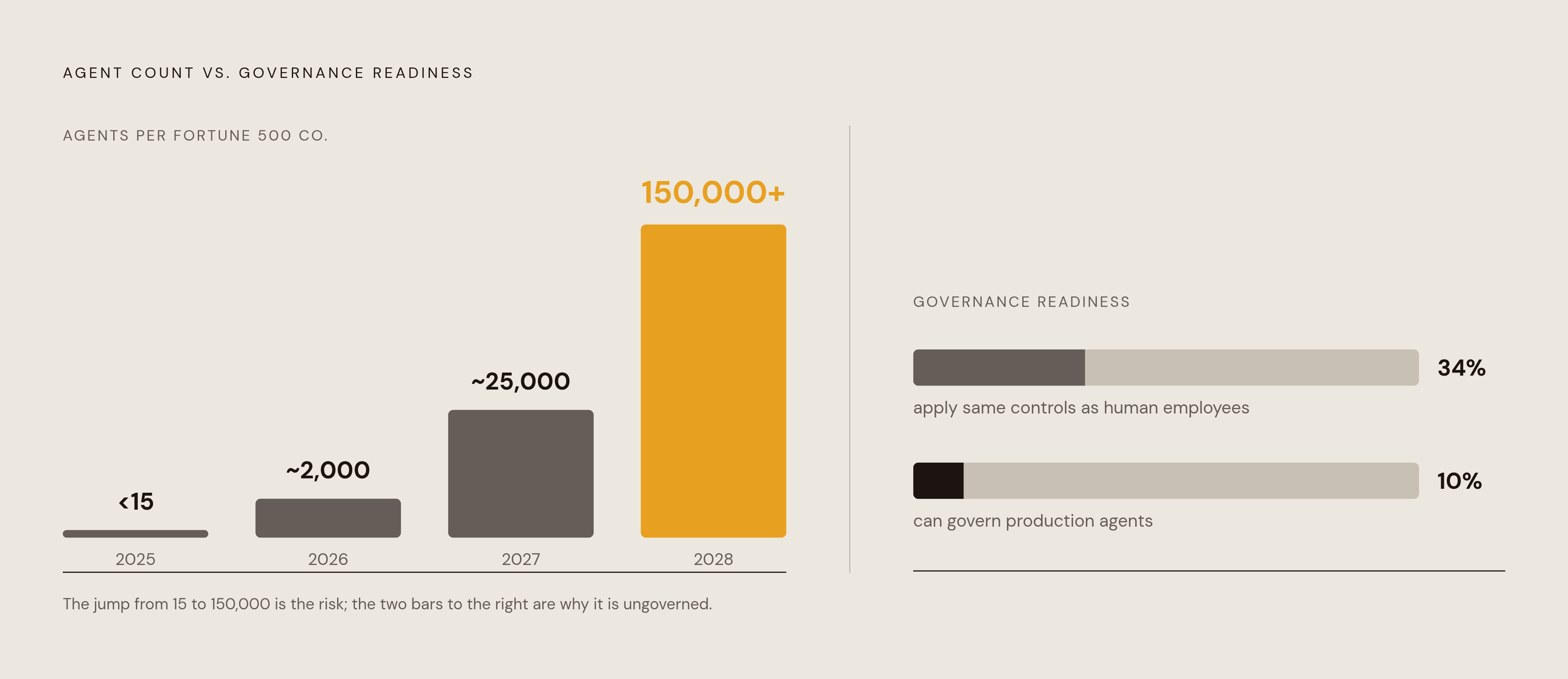
Look at where the count is headed. In 2025, the average Fortune 500 company ran fewer than 15 AI agents https://www.requesty.ai/blog/mcp-gateway-comparison-2026-enterprise-scalability-security. Gartner puts that same figure above 150,000 per enterprise by 2028 https://www.requesty.ai/blog/mcp-gateway-comparison-2026-enterprise-scalability-security. Fifteen to 150,000 isn't a curve, it's a step function, and spreadsheets don't survive step functions.
Governance infrastructure hasn't kept pace, and the gap appears in two separate but related numbers. Okta's AI Agents at Work report found that only 34% of organizations apply the same security controls to AI agents that they apply to human employees https://www.okta.com/newsroom/articles/auth0-may-2026-product-innovations/. A survey of senior technology leaders found that 90% of organizations have no way to actually govern what their agents in production are doing, and roughly half have already had a security incident where an agent did something nobody expected, a gap that platforms like Speakeasy, an enterprise AI control plane for governing MCP servers and agents across teams, are built specifically to close https://www.requesty.ai/blog/mcp-gateway-comparison-2026-enterprise-scalability-security.
Putting those two numbers side by side makes the picture turn uncomfortable fast. A human employee gets onboarding, periodic access reviews, and an exit interview on the way out. Most AI agents get an API key and the run of the building.
Differences Between a Real MCP Gateway and a Plain Proxy
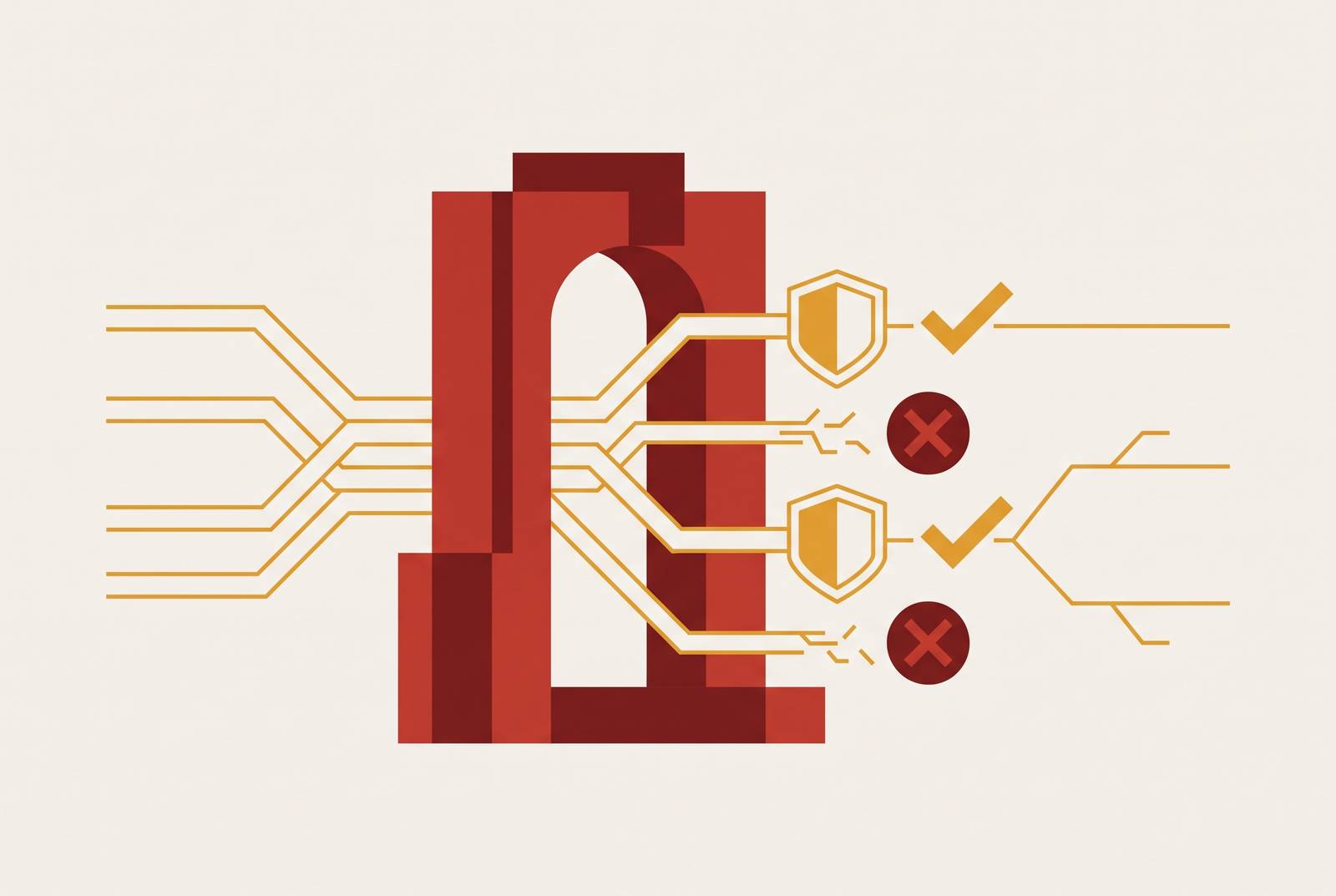
A proxy moves traffic. It takes a request from an agent and forwards it to a server, maybe tacking on a log line along the way. A governance gateway does something structurally different: it checks who's asking, decides whether they're allowed to ask, brokers the credentials on the other side, inspects what comes back, and writes all of it down in a way that survives an audit. Filtering, authenticating, enforcing policy on every call, that's governance. Routing is a much smaller thing wearing governance's clothes.
Eight criteria separate a gateway with real governance depth from one that only looks like it has one. Deployment model comes first: can the thing run where the data is legally or contractually required to sit, a developer's laptop, a VPC, on-prem hardware, an air-gapped network? OpenAPI conversion matters next: can an existing REST API become a governed MCP tool without someone hand-writing a custom server wrapper? OAuth 2.1 support has to run in both directions, client-to-gateway and gateway-to-server. Role-based access control needs to work per-tool, per-server, and per-identity, instead of handing a whole team one shared API key like a house key nobody bothers to relabel. Session handling has to account for stateful, multi-turn agent conversations rather than treating every call as a one-off. Audit logging needs to specify what actually gets captured (tool, action, outcome), whether it stores full payloads or just metadata, and how long it holds that data before it ages out. Multi-tenancy support lets cost and usage get attributed back to a team or project instead of vanishing into one shared bill.
MCP also opens a threat surface a plain proxy can't see, let alone stop. Rug-pull attacks happen when a server changes its tool definitions after an agent has already approved them, so the tool the agent trusted this morning isn't the tool it's calling this afternoon. Tool poisoning hides malicious instructions inside a tool's own description text, which the agent reads and treats as legitimate guidance. Cross-server shadowing lets one server impersonate another's tool names, tricking the agent into calling the wrong thing. Prompt injection rides in through a tool's response, turning the answer itself into the attack. None of this is visible as anomalous network traffic. A gateway that only counts packets misses every one of these by design, because it was never built to read the payload.
Most enterprises already run an AI gateway for LLM traffic, so governing tool calls in one system while governing model calls in another just recreates the same split visibility problem twice. A single path for both matters because it produces one audit trail instead of two half-finished ones that never talk to each other. Observability worth the name means OTel, SIEM export, and real-time anomaly detection.
The two-tier market and the six deployment models that define it
By June 2026, the MCP gateway market had settled into two tiers, and the line runs roughly between "built by developers, for developers" and "built to survive a compliance review". The open-source and developer tier includes Bifrost, ToolHive, agentgateway, IBM ContextForge, Docker MCP Gateway, MCPJungle, and Lasso Security, and these products optimize for speed and developer experience over covering every governance requirement at once. The enterprise platform tier includes TrueFoundry, Composio, Lunar MCPX, Willow, Kong AI Gateway, DigitalAPI, and AWS Bedrock AgentCore Gateway, and these add the governance depth, compliance certifications, and managed operations a security team can actually point to in an audit. More than 20 vendors were offering some form of MCP gateway by mid-2026, which says less about how mature the space is than about how fast it grew from a standing start https://www.digitalapi.ai/blogs/best-mcp-gateways-2026.
Six deployment models cover the 2026 market. A local container gateway runs on a developer's laptop, costs almost nothing to operate, isolates each server from the others, but enforces no central policy. Self-hosted open source runs on a team's own infrastructure, takes a moderate amount of operational work, and its governance ceiling depends entirely on which project got picked. In-VPC or on-premise deployment runs inside a cloud account or a data center, needs more operational investment, and can reach full governance if the underlying product actually supports the controls to get there. Air-gapped deployment runs on an isolated network, demands the most operational effort of any model, and can reach full governance too, though very few products on the market actually qualify. Managed SaaS runs on the vendor's own cloud, asks the least of the buyer operationally, but caps governance at whatever ceiling the vendor decided to build. MCP support bolted onto an existing API gateway inherits whatever operational posture that gateway already had: strong on HTTP policy, weak on MCP-native semantics, almost every time.
One pattern runs through all six: the deployment models that ask the least of an operations team also cap out lowest on governance, and the ones that reach full governance depth ask for real infrastructure investment in return. There's no shortcut to air-gapped-level governance with laptop-level effort, and any vendor pitch implying otherwise is selling something that doesn't exist. For a lot of buyers, deployment model works as a hard filter that eliminates most of the field before the feature comparison even starts. Data residency rules, air-gap mandates, or the compliance requirements of a regulated industry disqualify entire products regardless of how good their RBAC looks on a slide deck. That constraint belongs at the front of an evaluation, not somewhere near the end.
Open-source gateways
Bifrost, built by Maxim AI under an MIT license and written in Go, is the fastest MCP gateway with published numbers behind the claim: 11 microseconds of overhead at 5,000 requests per second https://www.requesty.ai/blog/mcp-gateway-comparison-2026-enterprise-scalability-security https://www.getmaxim.ai/articles/best-mcp-gateways-in-2026-compared-by-deployment-model-and-governance-depth/. It gets there by keeping MCP servers running as long-lived subprocesses and talking to them over stdio, skipping the HTTP handshake and TLS negotiation that eat into latency everywhere else. Bifrost also ships something called Code Mode, which cuts MCP input token usage by up to 92.8% once an agent is talking to three or more servers at once, a cost detail most gateway comparisons skip entirely even though it can matter more than latency for anyone running agents at real volume https://www.requesty.ai/blog/mcp-gateway-comparison-2026-enterprise-scalability-security https://www.getmaxim.ai/articles/best-mcp-gateways-in-2026-compared-by-deployment-model-and-governance-depth/. Bifrost claims coverage across every deployment model, from a single Docker container up through air-gapped Kubernetes. Its transport layer only works with MCP servers built to support stdio, though, so any remote HTTP-based server needs a bridge adapter bolted on, and the project is newer and less battle-tested than some of what it's racing against. Pick it when agents and servers run on the same machine or cluster, where every microsecond of latency actually shows up in the bill. Don't pick it expecting a drop-in replacement for a fleet of remote HTTP servers.
ToolHive, from Stacklok, runs under Apache 2.0 and is also written in Go, and it wins on a different axis entirely: isolation. Every MCP server gets its own container with minimal permissions, and no server shares local credentials with another, which is the strongest supply-chain posture anywhere in the open-source tier. Auth runs through OIDC and OAuth, with RBAC applied per container. ToolHive ships as a Desktop UI for local development and testing, a CLI for terminal workflows and CI/CD pipelines, and a Kubernetes Operator for shared, multi-user environments. Teams that care more about supply-chain integrity than raw speed will find ToolHive's isolation model hard to beat in this tier.
agentgateway, maintained under the Linux Foundation, runs on Apache 2.0 and is written in Rust. It authenticates with JWT, API keys, or OAuth, and supports OAuth 2.1 with PKCE for MCP/browser flows. It fits best where performance-critical routing meets a need for custom, code-defined policy logic.
Docker MCP Gateway is container-native, running each MCP server in its own isolated container with resource limits and cryptographic image signing for supply chain security. It's a local development tool at heart, though: no RBAC, no audit logging, no centralized access control. Getting it to enterprise scale means bolting on authentication, identity management, and audit infrastructure from scratch, a lot of DIY work for a team that thought it was buying a finished product. It's a comfortable mental model for teams already living in Docker and Kubernetes, but it answers a local development question, not a production governance one.
A pattern runs through the whole open-source tier. Each product picks one axis, speed, isolation, routing flexibility, container-native workflow, and delivers on that axis and stops there. None of them ship the layered RBAC, immutable audit trail, and compliance paperwork that appear once you cross into the enterprise tier. That is what "developer tool" means. It's what "developer tool" means. Teams that need the compliance paperwork should stop waiting for an open-source gateway to grow it organically and go look at the enterprise tier instead.
Enterprise gateway profiles: governance depth, deployment range, and compliance posture
MCPJungle ships a built-in curated MCP catalog, composite server support, multi-role RBAC, identity-provider integration, and GitOps-compatible administration, purpose-built for MCP governance. The catalog piece deserves more attention than it usually gets. A self-service catalog is what actually turns "the team has a gateway" into "shadow MCP is gone," because employees browse and pull from an approved list instead of going out and standing up their own unsanctioned servers. Auth runs on multi-role RBAC combined with GitOps workflows, observability comes through structured logs, and the transport layer runs in Kubernetes or Docker containers. It's licensed under MIT and can be deployed as self-hosted Kubernetes or Docker, or as a managed service. It suits enterprise teams that want real MCP governance without signing up for vendor lock-in or a multi-month integration slog, with the added benefit of open-source auditability across the detector stack, policy engine, and request path.
Lunar MCPX is licensed under MIT, written in TS, and transports over SSE, with Streamable HTTP deprecated. Gartner recognizes it as a Representative Vendor in the MCP Gateways category, and it holds SOC 2 certification at the Enterprise tier. Fortune 200 enterprises have deployed MCPX specifically to govern AI adoption across entire engineering organizations, a different problem than governing one team's agent experiment. Its access control model is the most granular in the open-source tier, running policy at three separate levels: global (every server), per-service (one server), and per-tool (individual functions within a server). A concrete rule might read: every agent can list files, only admin agents can delete them, and no agent, admin or otherwise, touches the production database server. Easy to state, and surprisingly hard to enforce without exactly this kind of layered model.
The Enterprise tier adds hosted deployment, identity-provider integration, automated risk scoring across the tool catalog, and a pre-production sandbox for testing new MCP servers before they reach agents running in production. Interceptor middleware handles request and response inspection for PII redaction, cost-attribution tagging, and compliance logging, applied inline rather than bolted on after the fact. Auth integrates with existing identity providers, RBAC operates across global, service, and tool-level access-control lists, and the audit trail is immutable, meaning nobody, including an admin with good intentions, edits the record after the fact.
Latency numbers separate the pack more than most vendor pitches let on. TrueFoundry runs about 10 milliseconds even under load https://www.truefoundry.com/blog/best-mcp-gateways. Docker MCP Gateway runs between 50 and 200 milliseconds https://www.truefoundry.com/blog/best-mcp-gateways. IBM Context Forge and Lasso Security both run in the 100 to 300 millisecond range, with Lasso's deep security scanning specifically adding 100 to 250 milliseconds of that overhead https://www.requesty.ai/blog/mcp-gateway-comparison-2026-enterprise-scalability-security https://www.truefoundry.com/blog/best-mcp-gateways. Composio competes less on speed and more on sheer breadth, with 500 or more managed integrations out of the box https://www.truefoundry.com/blog/best-mcp-gateways.
Connectivity was never the hard part in this market. MCP solved that a year ago, and 97 million monthly downloads is the proof https://www.requesty.ai/blog/mcp-gateway-comparison-2026-enterprise-scalability-security https://www.lunar.dev/post/the-best-open-source-mcp-gateways-in-2026. Governance, who's allowed to call what, under whose name, with what record left behind afterward, is the part still getting sorted out, one vendor and one deployment model at a time.