Enterprise Acceptable Use Policy for AI Tools
Most companies ignore AI's unique risks when writing policies from old IT templates.
Most enterprise AI policies get written the same lazy way: take the old IT acceptable use policy, swap "software" for "AI," ship it, move on. IBM's 2025 Cost of a Data Breach Report found 63% of surveyed organizations had no AI governance policy at all: no rules for shadow AI, no framework for the tools employees were already running on the side. Deloitte's 2026 State of AI in the Enterprise report clocked a 50% jump in worker access to AI tools during 2025 alone, so tool access outran policy fast, and the gap wasn't free. IBM measured $670,000 in added breach costs at companies with heavy shadow AI use, and 97% of companies that suffered an AI model breach had no governance controls worth naming.
So write the policy, right? A generic policy handles a generic threat, and AI brings four threats that are anything but generic.
The risk surface an AI AUP must actually address
Data leakage sits at the top, and it's a risk with real numbers behind it, not a hypothetical analysts dreamed up to fill a slide. A 2025 survey found 34% of employees using AI tools their company hadn't approved had already typed customer data into a consumer chatbot. Regular people doing their jobs, pasting things into a text box that had no business being there.
Shadow AI is the second problem, and it's really shadow IT's sequel, except the unauthorized tool this time can read your CRM, summarize your contracts, and draft an email that sounds exactly like your CEO. It's already inside the building, and it walked in through someone's browser extension.
Prompt injection is the one no traditional AUP saw coming, because the threat didn't exist when those policies got written. Bury a hidden instruction in a document, an email, or a webpage, and you can hijack how an AI system behaves without ever touching a login screen or a firewall. Old IT policy has nothing to say here, because it was written for a different war.
Then there's agentic behavior. Modern AI systems don't just answer questions, they take actions: hitting internal APIs, touching SaaS platforms, moving data, often with nobody watching the exact moment it happens. A policy that only governs what a person types into a chat window says nothing about what an autonomous agent does at 2 a.m. with a set of borrowed credentials.
Gartner surveyed 360 IT application leaders in Q2 2025, and 74% called AI agents a new kind of attack surface, while only 13% strongly agreed their organization had the governance to handle it. Read that gap plainly: most of the industry knows the barn door's open and has no idea where the horse went.
What an AI AUP must contain — the non-negotiable elements
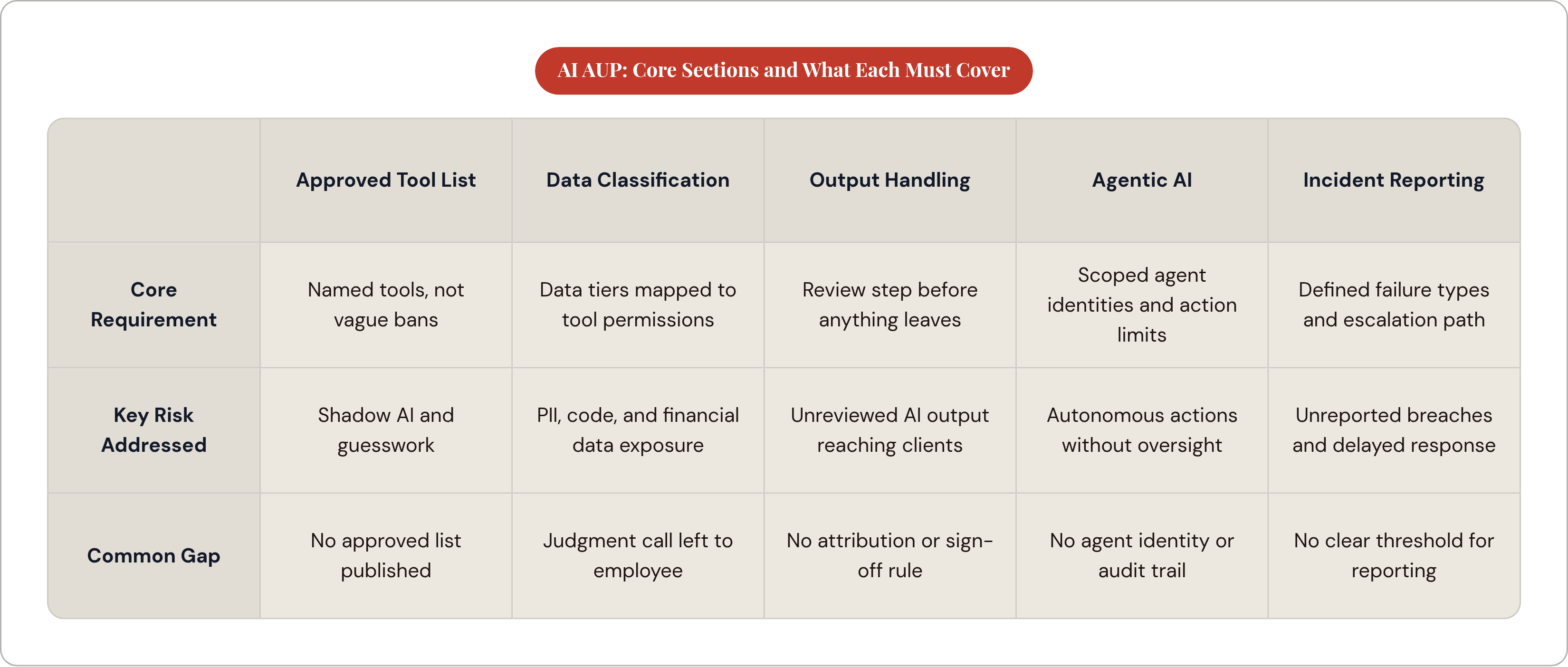
Start with the tool list, and make it an actual list, not a vague ban. Write "no unapproved AI tools" without naming the approved ones, and you're asking every employee to guess, which is exactly how half the finance team ends up running personal ChatGPT accounts on the sly. Name the sanctioned tools, then split general-use tools from the ones cleared for specific roles or specific data. Say plainly that consumer AI tools are off-limits for anything touching non-public company or customer data.
Data classification has to map straight onto AI tool permissions. Most enterprises already sort data into four tiers: Public, Internal, Confidential, Restricted. The AUP's job is naming which tiers can go into which tools, full stop, with no room for a judgment call at 4 p.m. on a Friday. Customer PII gets a named rule, source code gets a named rule, and financial data and protected health information get named rules of their own. "Use good judgment" isn't a policy; it's an invitation to a breach report.
Output handling needs its own section too. Anything AI-generated that leaves the building, marketing copy, a client memo, needs a defined review step and a clear line on attribution. Legal, compliance, and medical outputs need a human sign-off before anyone hits send, with no exceptions and no "just this once."
The section most companies still leave blank is agentic AI. Which systems can an agent touch on its own? Which actions, sending an external email, moving money, need a human's approval first? And agents need their own identities, scoped to a role and traceable to a system; never a shared login, never someone's personal token borrowed as a shortcut. An agent running on borrowed credentials is a security incident with a delayed timestamp.
Round it out with incident reporting: what counts as a reportable AI failure, who gets told, how fast. One municipal government with over 200 employees built its entire AI AUP on a single page, which shows that rigor isn't measured in word count.
Regulatory requirements that shape what the policy must say
The EU AI Act is rolling out in phases. Bans on prohibited practices started February 2025, obligations for general-purpose AI models kicked in that August, and the rest, transparency duties, high-risk system rules, lands August 2026. Miss it and fines run up to EUR 35 million or 7% of global turnover, stacking on top of GDPR exposure whenever personal data is anywhere in the mix.
Sector rules pile on more. HIPAA means AI touching protected health information has to run locally or through a vendor with a signed business associate agreement; consumer AI tools are disqualified outright. Defense contractors under CMMC need documented data classification and access controls, and the AUP has to actually run those controls, not just mention them in passing. Government bodies under FOIA have to treat AI chat logs like email: potentially discoverable, retained accordingly. Financial firms dealing with DORA get yet another layer stacked on top of everything else.
The OECD's AI Policy Observatory now tracks more than 900 AI-related policies across over 80 jurisdictions, and nobody's coming to unify this into one global standard. A multinational's AUP probably needs jurisdiction-specific annexes rather than a single document trying to satisfy Brussels, Washington, and Singapore at the same time.
Compliance sets the floor, while enforcement is what makes the policy real.
How enforcement actually works — technical controls, not just written rules
A policy that leans on employees remembering the rules carries about as much weight as a suggestion with a legal disclaimer stapled to it. Real enforcement lives at the infrastructure level, not in a PDF on the intranet.
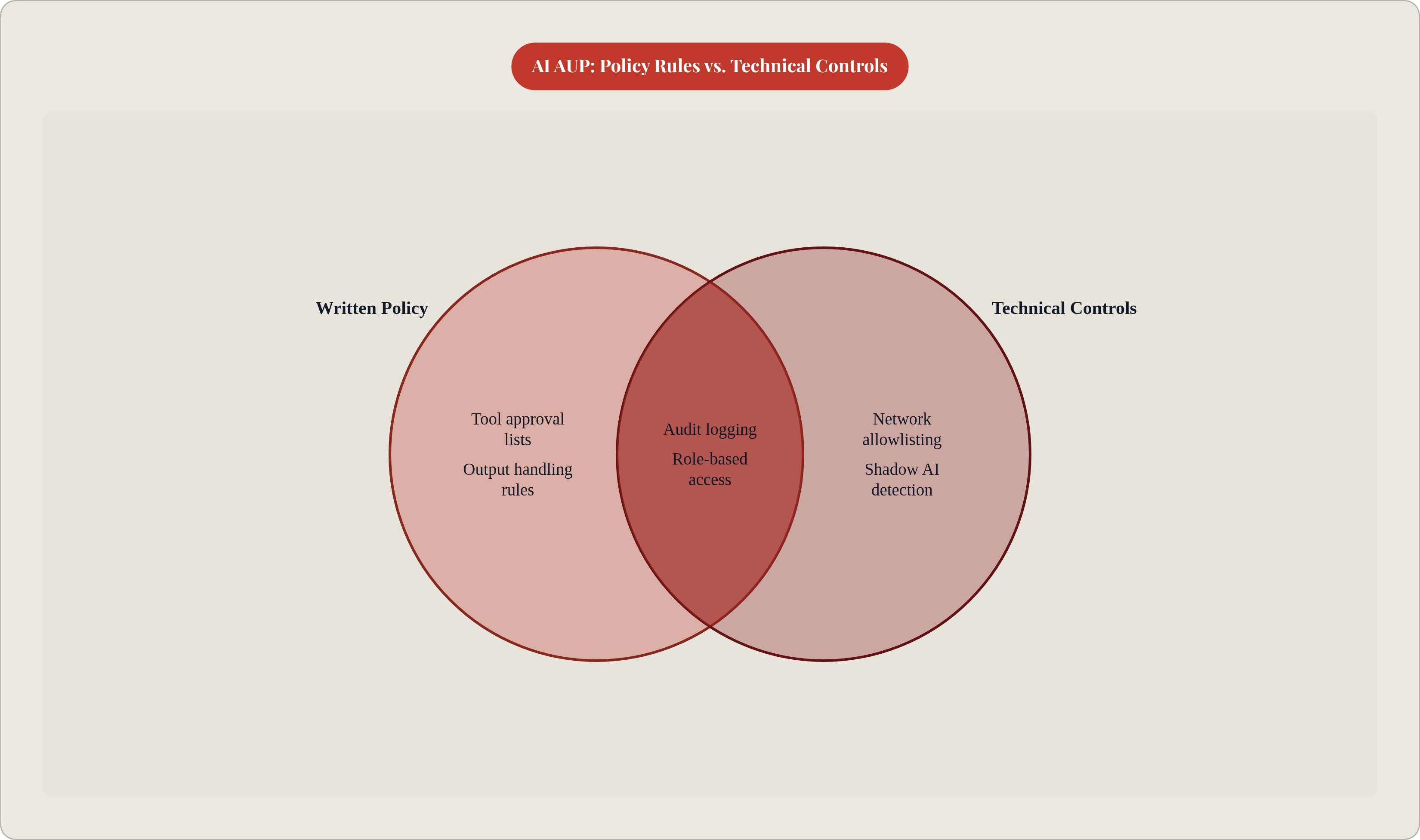
That means allowlisting approved AI tools through IT and blocking everything else at the network layer, instead of writing "don't use unapproved tools" and hoping for the best. It means data loss prevention rules that catch sensitive data before it reaches an external model, plus real-time inspection of prompts for PII, secrets, or injection attempts, built into the access layer itself rather than bolted on after the fact. It means role-based access tied to whatever identity provider the company already runs, so tool permissions follow existing role assignments instead of demanding a whole separate credentialing system nobody wants to maintain.
Audit logging is the foundation everything else sits on. Every prompt, every tool call, every agent action needs a logged user identity, a timestamp, and a record of what data got touched, and those logs need to be searchable, not archived somewhere nobody opens until a lawyer asks for them. Agentic actions raise the stakes here especially: an agent that acts without leaving a trail makes it impossible to reconstruct what happened after something breaks.
Shadow AI detection matters too: passive monitoring that shows security teams what tools employees are actually using, before a breach forces the discovery the hard way. And consequences need to be spelled out and applied the same way every time by HR, because enforcement only works if people believe it's real and not theater.
Gartner's Q2 2025 numbers back this up directly. Organizations running a dedicated AI governance platform were 3.4 times more likely to hit high effectiveness in AI governance than those without one, which shows that infrastructure moves the needle far more than a written policy sitting in a shared drive nobody's opened since onboarding.
Where governance ownership sits and who must be involved
No single department can own this alone. IT knows the tools, legal knows the liability, HR knows discipline, security knows the threats, compliance knows the regulatory floor, and the business units know which use cases actually matter day to day. Hand the whole thing to IT and watch it quietly turn into shelfware nobody reads.
What works is a named owner, a CISO, a CTO's office, a dedicated AI governance lead, backed by a cross-functional group pulling from legal, HR, security, compliance, and at least one voice from the business side. That group needs a clear answer to three questions: who approves exceptions, who handles incidents when they happen, and who updates the policy when the tool landscape shifts again next quarter, because it will.
Benjamin Herndon, formerly of Georgia Institute of Technology, wrote about this exact failure mode in the NACD's 2025 Governance Outlook. Without real cross-functional buy-in and real incentives, he warned, companies end up professing responsible AI principles while doing nothing to implement them. Call it what it is: a policy document that exists to get pointed at during an audit, not one built to change behavior.
Training closes the loop, and it can't be a once-a-year click-through people speed past to get their certificate. Employees need to know the four data tiers cold, and know which tools each tier allows, because abstract policy language doesn't change what someone pastes into a chat box under deadline pressure. A developer's risks and a finance analyst's risks aren't the same risks, and the training shouldn't pretend otherwise.
Review the policy at least once a year, though plenty of companies run six-month cycles given how fast the tool landscape moves under them. Any new AI tool deployment, regulatory change, or AI-related incident should trigger an immediate re-review outside the normal schedule, not wait for the calendar to catch up.
How a governed AI infrastructure layer makes the AUP operational at scale
All of this works fine on paper for a 50-person team running two approved tools. It falls apart at thousands of employees and dozens of agentic workflows running at once, because manual enforcement doesn't scale in a straight line, and it breaks quietly, long before anyone notices.
A governed AI control plane closes that gap. It centralizes access control across every AI tool, every agent, and every MCP server behind one layer, instead of forcing security teams to configure each tool by hand, one at a time. It enforces role-based access dynamically against the identity provider the company already runs, so a policy change propagates everywhere at once rather than needing a dozen manual updates across a dozen systems. It catches shadow AI as it happens instead of after an incident report drags it into the light. It blocks prompt injection and sensitive data submission at the infrastructure level, before any of it reaches an external model. And it gives governance teams visibility into cost and usage, so they can see what the AI fleet is actually doing instead of guessing from a spreadsheet.
The hardest piece is MCP servers and agentic skills, because that's where agents actually take action, and generating text alone doesn't cover it anymore. An MCP gateway sits between agents and the systems they can touch, applying policy at the point of action rather than only at login. Agents need role-scoped identities tied back to the enterprise identity provider, never a shared service account, never a human's personal token passed through as a shortcut. Skip this layer, and the agentic-behavior section of the AUP is just words on a page with nothing behind them.
That's what the whole exercise is actually for: employees using approved tools from day one without friction, every agent action logged and scoped to policy, and security teams watching it happen in real time instead of reading about it in a breach report three months later.