AI Risk Assessment Framework for Enterprise AI Programs
Enterprises must map AI risks across shadow tools, data exposure, and agentic attacks.
More than 75 countries had adopted or drafted AI legislation by mid-2025, and governance now comes with legal deadlines attached. Enterprises now juggle the EU AI Act, the NIST AI RMF, and ISO/IEC 42001 at the same time, each with its own paperwork and its own definition of "compliant." Only 4% of organizations report a good return on their AI spending, and a chunk of that gap comes from shadow AI use and compliance exposure quietly eating the upside before anyone gets to measure it. Without a repeatable way to find and rank AI risks, companies can't tell which ones to fix first, and this piece builds that process for agentic and generative AI inside the enterprise, leaving aside consumer chatbots or hypothetical future systems.
What a structured AI risk assessment framework actually covers
A working framework has six moving parts that all touch each other: policy, risk assessment, compliance alignment, technical controls, ethical guidelines, and ongoing monitoring. Pull one out and the rest wobble, because each piece depends on the others to hold its shape.
The NIST AI RMF organizes this into four functions: Govern, Map, Measure, Manage. It's a decent scaffold because it forces the question of ownership before anyone touches a checklist, and risk assessment under this model runs before deployment, during operation, and after any incident, on a loop that never fully closes.
None of this works without someone actually in charge of it. The minimum viable group includes an executive sponsor, a governance lead, data stewards, someone from legal or compliance, and named risk owners for each domain. Tools can absorb the grunt work of monitoring, but accountability doesn't automate; a dashboard doesn't get fired when something leaks.
Waiting for the final maturity stage before starting is how companies end up with zero controls for a year, and that's the wrong call every time. Core controls are realistic in two to three months, while a fuller framework, the kind that satisfies an auditor, takes four to six. ISO 31000:2018 makes the point directly: AI risk management has to fit the organization's actual AI footprint. A template copied from a vendor's slide deck and pasted into a policy binder carries little weight as an assessment, no matter how many logos are on the cover page.
Shadow AI as the first and most widespread risk category to assess
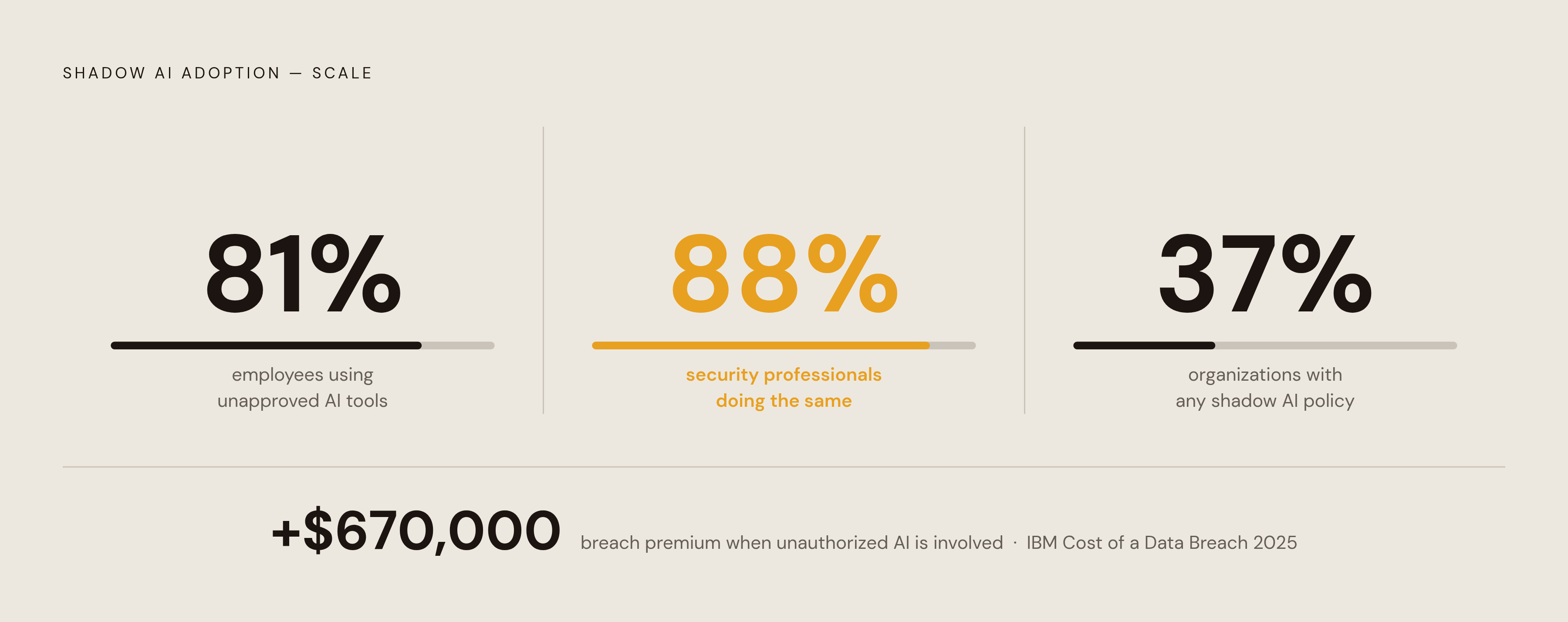
Start here, because the numbers are almost embarrassing: UpGuard's 2025 research found 81% of employees use AI tools their company never approved, and among security professionals, the group whose job is literally to stop this, the figure is 88%, a number worth sitting with for a moment.
A shadow AI assessment has to answer three plain questions: which tools are in use, who's using them, and through which accounts, which is the visibility gap platforms like Speakeasy, an enterprise AI control plane, are built to close. That last one matters more than it sounds, since Harmonic Security's 2025 analysis of 22.4 million enterprise prompts found that 16.9% of sensitive data exposures happened on personal, free-tier accounts, completely outside anything IT could see. Most CASB, DLP, and SIEM tools weren't built to watch browser-level AI traffic, so they don't catch any of it.
This carries a cost well beyond a security failure. IBM's 2025 Cost of a Data Breach report put the premium on breaches involving unauthorized AI tools at $670,000 above a standard incident, which is the price tag on not knowing what your own employees are typing into a chatbot.
Only 37% of organizations, per IBM's 2025 findings, have any policy to manage or even detect shadow AI, and most assessments start from zero, with no baseline inventory to work from. Treat this the way earlier security teams treated shadow SaaS: discovery first, policy second, enforcement third. Gartner's forecast makes the trend line clear: by 2027, 75% of employees will acquire, tweak, or build technology outside IT's view, up from 41% in 2022, and shadow AI is the ground everyone's already standing on.
The assessment should produce one concrete artifact: a live inventory of every AI tool in use, tagged sanctioned or not, corporate account or personal, matched against the sensitivity of the data it touches.
How to assess data exposure risk across AI tool interactions
Harmonic Security's 2025 dataset logged 579,113 sensitive data exposures spread across 665 distinct generative AI tools, an ecosystem operating in plain sight while most security teams watch only a sliver of it.
LayerX's 2025 research found 77% of workers have pasted sensitive data into a generative AI tool, and 82% of those pastes came from personal accounts, sitting entirely outside whatever data protection agreement the company negotiated with the vendor.
None of this can be rated without data classification done first, and skipping that step is the single most common shortcut that wrecks an assessment. An assessment that treats all AI traffic as one uniform blob of risk is guessing. PII, credentials, source code, financial records, and regulated health data each carry different legal weight if they leak, so the assessment needs to map which AI workflows touch which category, not just how much traffic is flowing.
The personal-account problem is structural, not incidental. The DBIR found that 67% of users accessing AI platforms from corporate devices do it through non-corporate accounts, so the enterprise's data agreements and DLP rules simply don't apply to that traffic. It's invisible by design, not by accident.
A working checklist asks whether output filtering or PII blocking exists at the point prompts leave the building, whether AI vendor contracts have actually been read for data-sharing and training clauses, and whether there's an incident response path for the day someone confirms sensitive data went out to an external model. A firewall rule doesn't fix this; the gap calls for visibility at the level of the prompt, not the packet.
Assessing prompt injection and agentic-specific attack vectors
OWASP ranks prompt injection as the number one risk to LLM-based systems (LLM01:2025), and the threat carries particular weight for agentic systems specifically.
This risk doesn't behave like the application security problems that came before it. The attack lives in meaning, not in network packets, so a firewall never sees it coming, and agentic systems make the exposure worse because they act on instructions without a human checking each step, often chaining actions across several tools and sessions.
The real-world evidence is not subtle. One researcher spent $500 testing Devin AI's security through crafted prompts rather than any traditional exploit, surfacing real vulnerabilities at minimal cost. Similar cross-session data leakage patterns have been documented in agentic browser contexts, where instructions embedded in external content can redirect an agent's actions in ways the user never intended.
Detection isn't close to solved either. Lakera Guard, one of the more established injection detection products, scored 92.5% on its own benchmark, meaning 7.5% of malicious inputs got through even under conditions the vendor controlled, and vendor-controlled conditions tend to be the easiest conditions a product will ever face.
The assessment needs to ask whether agents run with the minimum access a task requires or carry standing broad permissions by default, whether there's real architectural separation between the agent's reasoning and untrusted external content, and whether input validation and output filtering happen before an agent's action reaches a downstream system. NIST's AI RMF and ISO 42001 both address the kind of input-validation and control requirements that prompt injection exposes. Treating this as optional is how a company ends up in the next public disclosure.
Evaluating access control and agent identity as a discrete risk domain
Agents authenticate through paths that often sit entirely outside the identity provider's view, and they inherit access to systems that traditional IAM tools were never built to see. That's the core problem, and it stays quiet until it isn't.
Most agents today run on static API keys, OAuth 2.0 client credentials, or cloud-provider OIDC tokens, and the credential type determines how much of the existing IAM stack can actually govern it. Static API keys are the weak link: long-lived, broadly scoped, and disconnected from any identity lifecycle process that would revoke them on schedule. OIDC-based workload tokens and OAuth client credentials fit more naturally into service principal constructs that Entra ID or Okta already support, which is exactly why the industry should stop minting new API keys like it's 2015.
The stronger posture uses short-lived certificates issued from a trusted PKI instead of secrets that live for months, hardware security modules for key storage when an agent handles anything sensitive, and workload identity federation that ties the agent's identity directly to the organization's own infrastructure rather than a vendor's side system.
Static role assignments don't fit agents whose access needs shift task by task. The assessment should ask whether authorization is scoped to a specific operation on a specific resource for the duration of that operation, or whether the agent just holds a standing role that covers far more than the current job needs. AWS IAM condition keys, Azure ABAC expressions, and OPA-based policy engines all support this kind of task-scoped grant, at different levels of granularity.
Building a parallel identity system just for agents is the wrong instinct, and companies that try it end up maintaining two broken systems instead of one working one. The only practical path at enterprise scale folds agent identity into the identity providers already in place, Okta, Entra ID, SAML 2.0, OIDC, rather than standing up a second stack nobody asked for. The output of this piece of the assessment is an inventory: every agent or agentic workflow, mapped to a specific authenticated identity, its credential type, the systems it can reach, and whether the existing identity provider actually governs that access.
The role of MCP servers and gateways in the risk surface as agentic deployments scale
MCP's growth makes the urgency concrete rather than theoretical: 97 million monthly SDK downloads as of December 2025, with every major AI lab building on it. This is the deployment reality already running in production, whether the security team has caught up or not.
The protocol itself doesn't solve governance. MCP servers handle tool invocations at scale, but the spec shipped without a full authentication framework at launch; OAuth 2.1 arrived in the March 2025 revision, and how well any given server actually implements it varies a lot from one to the next.
Three threat patterns show up repeatedly: prompt injection through tool responses, where a server hands back content that hijacks the agent's next move; tool poisoning and cross-server shadowing, where permissions combined across multiple servers let data leak that no single server would have exposed on its own; and rug-pull risk, where a server's behavior changes after it's already deployed, with neither the agent nor the enterprise finding out until something breaks.
There's a financial hole here too, since MCP doesn't track token consumption or cap usage on its own. At enterprise scale, unbounded agent-to-tool calls turn into a budget problem before anyone notices they're a technical one.
When agents connect straight to MCP servers with no gateway between them, there's no single view of what any agent is actually doing: no unified timeline, no trace correlation, no cost attribution, no baseline to measure anomalies against. It's the N×M problem, every agent talking to every server, nobody watching the whole picture. Gartner's guidance on this is straightforward: treat MCP like any other API surface and put a gateway in front of it, one control plane handling authentication, authorization, audit logging, and traffic management. The assessment needs to ask whether MCP servers get deployed through a governed distribution layer or spun up ad hoc by individual teams, whether there's a curated server catalog with review built in before an agent can call something new, and whether permissions are scoped per user and per tool or whether access is effectively all-or-nothing.
Building the observability layer that makes risk assessment continuous rather than periodic
Periodic audits don't hold up against agentic AI. Agent behavior shifts with every model update, every new tool, every workflow tweak, so a risk posture that looked fine last month may not describe reality today, the same way checking the weather in January says nothing about what to pack for summer.
A real observability layer covers audit logs for every agent action and tool call, tied to a specific identity rather than a generic service account. It covers cost and token attribution broken down by agent, workflow, and team, so a financial anomaly surfaces before it turns into a surprise on the budget report. It covers usage telemetry that can establish a baseline and flag when an agent starts calling unusual tool combinations or reaching into data outside its normal scope, and it covers real-time detection of PII and secrets in prompt content before that content ever reaches an external model's servers.
Deloitte's 2026 State of AI in the Enterprise found employee access to AI grew 50% in 2025, while only one in five companies had a mature governance model for autonomous agents. That gap is widening, not closing, because deployment is outrunning oversight almost everywhere. Without one governed layer sitting between agents and their tools, debugging a multi-step agentic workflow means stitching together logs from a pile of independent servers that were never designed to talk to each other, so there's no single trace, and anomalies slip through because there was never a baseline to compare against.
Audit logs also double as compliance evidence. Both the EU AI Act and the NIST AI RMF lean on them, and they're the first thing an investigator asks for after an incident. Continuous monitoring is the mechanism that keeps the risk assessment true between the formal review cycles, not a phase that happens after governance matures.
Prioritizing and sequencing risk mitigation across the framework's domains
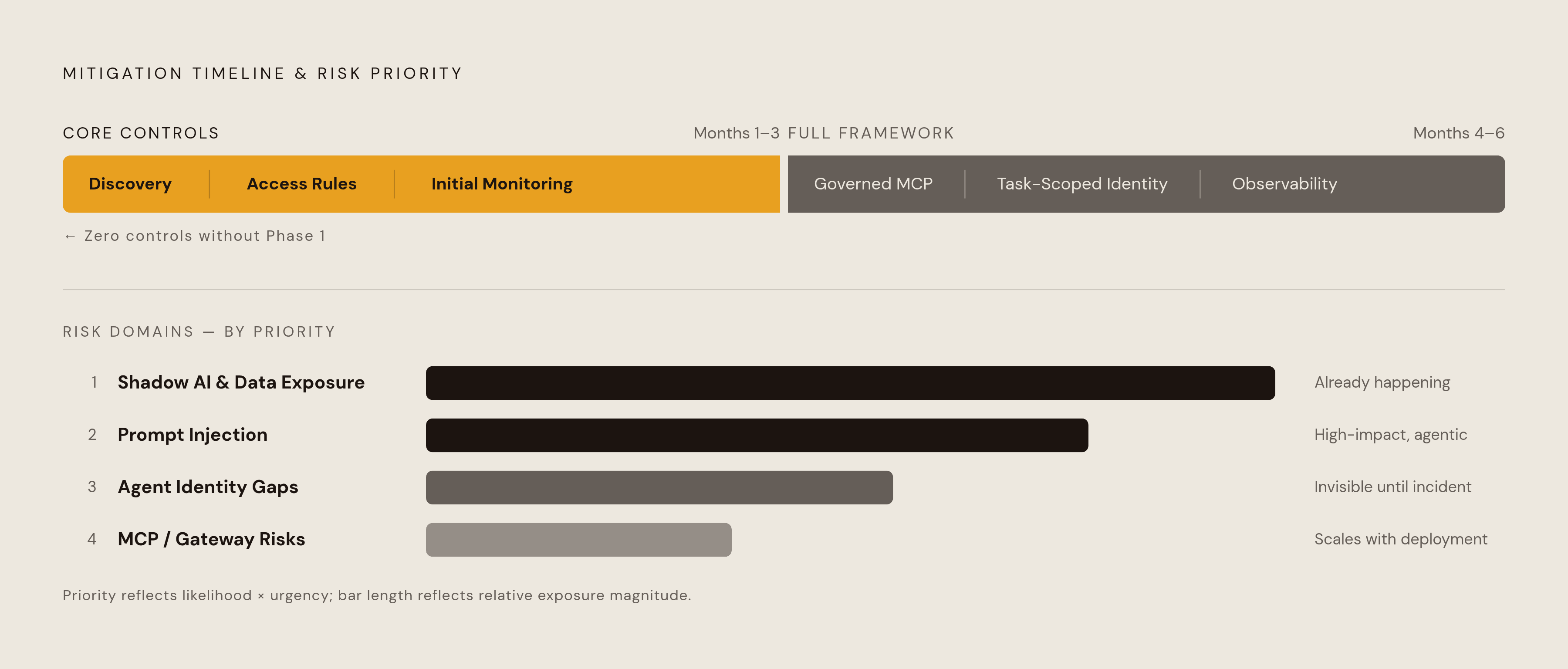
Prioritization comes down to likelihood times impact, weighted by how fast a given risk compounds if it's left alone. Not every domain deserves the same first-quarter budget, and pretending otherwise is how companies end up with a beautifully documented policy for a risk that isn't the one actually burning them.
Shadow AI and data exposure sit at the top because they're high-likelihood and already happening; an 81% adoption rate isn't a future risk, it's current behavior. Prompt injection carries less certainty of occurring but a much bigger impact once agents hold broad tool access, and that priority climbs fast as the agentic footprint grows. Agent identity gaps are the sneaky ones: they stay invisible until an incident forces the issue, so they should get prioritized based on what systems agents can reach right now, not on whether something has gone wrong yet.
The sequencing rule doesn't change across domains: discovery before policy, policy before enforcement. Skip discovery and the policy gets written for an AI footprint that doesn't match reality, which means it fails the first time someone actually checks.
The timeline matches the maturity phases from earlier. Core controls, meaning discovery, basic access rules, and initial monitoring, land in two to three months, while a fuller framework, with governed MCP access, task-scoped identity, and continuous observability wired together, takes four to six. Enterprises that wait for the six-month version before doing anything are choosing to spend that entire window with no baseline at all, which is the one thing this framework exists to prevent.